By Pet Tech Compass Editorial Team
Last reviewed: August 11, 2026
Extra features matter less than the basics: the feeder has to deliver your cat’s actual food in a measured amount, remain usable during realistic failures, and be cleaned and tested without guesswork.
Use this guide to narrow the feeder type first. Then check the exact model manual before buying. Product families often contain different generations with different food limits, battery behavior, app requirements, and removable parts.

Choose the Feeder Type Before Comparing Models

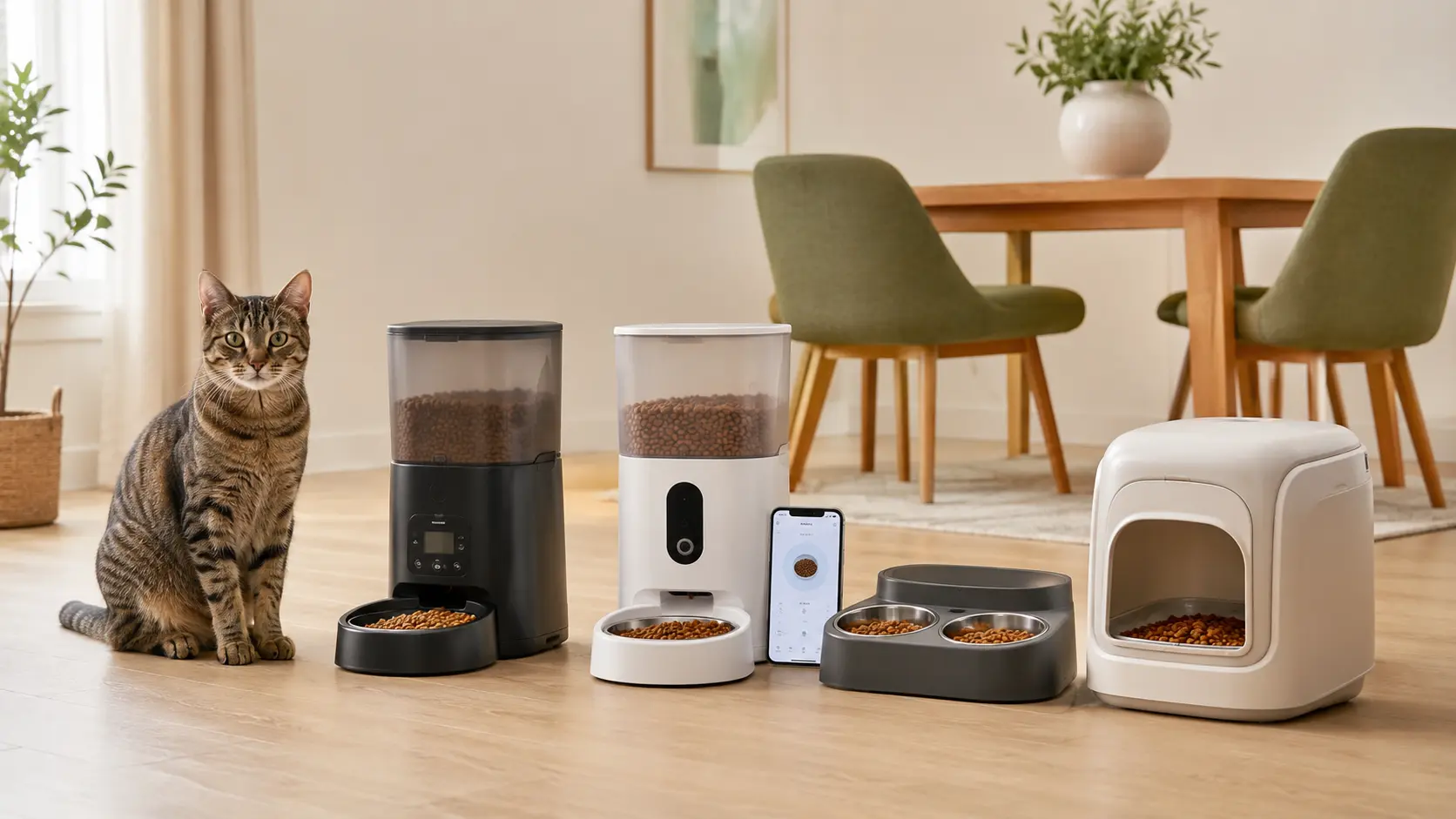
| Feeder type | Best fit | Main limitation |
|---|---|---|
| Basic programmable | Simple dry-food schedules without an app | Usually offers limited remote monitoring |
| Smart Wi-Fi | Remote schedule changes, alerts, logs, or cameras | Connected features depend on power, Wi-Fi, apps, and cloud services |
| Dual-bowl | Two compatible cats that eat calmly at the same time | Does not guarantee equal intake |
| Microchip or RFID access | Food stealing, prescription diets, or individual access | Identity compatibility and training vary by model |
| Wet-food tray or refrigerated | Timed wet meals | Food-temperature control and cleaning require extra attention |
The Feline Veterinary Medical Association notes that feeding programs should be customized to the household and may include frequent small meals, separate feeding locations, puzzle feeding, and—in some cases—automatic feeders. The machine should support the feeding plan rather than define it.
The 10 Checks That Matter Most

1. Match the feeder to the food
Confirm whether the feeder accepts dry kibble, wet food, semi-moist food, freeze-dried pieces, or only a specific food type. A dry-food hopper should not be used for wet food unless the manufacturer explicitly permits it. Refrigerated feeders also require clear instructions about cooling, power interruptions, and leftover food.
2. Check kibble size and shape
There is no universal compatible kibble size. Compare the exact food with the model’s documented range. Large, flat, irregular, oily, or crumb-heavy pieces may bridge over the outlet or dispense inconsistently.
3. Treat “one portion” as an estimate
Feeder portions are not standardized. Some models define a portion by volume, while others describe an approximate weight. Kibble density and shape can change the grams delivered. Our portion-accuracy guide explains how to weigh 10 consecutive cycles and calculate the average and range.
4. Confirm where the schedule is stored
A smart feeder may use the internet for setup, remote controls, notifications, cameras, or cloud records. That does not tell you whether scheduled meals continue offline. Look for explicit confirmation that the schedule is stored locally. See what automatic feeders can do without Wi-Fi.
5. Verify what backup batteries actually power
“Battery backup” may refer to scheduled dispensing, limited operation, or only saved settings. Confirm that the batteries operate the motor. Also check the battery type, expected duration, and which connected features stop. Use our power-outage checklist before relying on a feeder while away.
6. Inspect the cleaning design
Look for a removable bowl, hopper, lid, outlet cover, and dispensing mechanism where appropriate. The manual should identify washable parts, dishwasher-safe parts, and components that must remain dry. A feeder that is difficult to disassemble correctly is more likely to retain crumbs, grease, or moisture. Review our automatic feeder cleaning schedule.
7. Check the lid, base, outlet, and controls
A useful feeder should resist casual tipping, lid lifting, button pressing, and pawing into the outlet. Look for a positive lid latch, control lock, broad base, protected cord route, and enclosed dispensing path. If your cat is persistent, use the safeguards in our guide to stopping feeder break-ins.
8. Decide whether individual access is necessary
A divided bowl creates two eating spaces but normally cannot identify which cat ate. If diets, portions, eating speeds, or health needs differ, consider separate stations or access control. Microchip readers and proprietary RFID tags are not interchangeable terms: check whether the exact feeder reads an implanted microchip, a supplied collar tag, or both. Read our guide on using one automatic feeder for two cats.
9. Look for useful manual controls
A physical manual-feed function can help you test the motor without waiting for the schedule or opening an app. On-device controls are also useful when a phone, account, or cloud service is unavailable. Confirm whether the controls can be locked without disabling scheduled meals.
10. Check support, manuals, and replacement parts
Find the manual before buying. Confirm that the manufacturer provides model-specific troubleshooting, cleaning instructions, replacement bowls or rotors where applicable, warranty terms, and a support channel. Product names can remain similar while internal parts or app requirements change between generations.
Six Red Flags Before You Buy

- Vague portion claims: the listing never defines portion volume or estimated output.
- No offline explanation: the product says “smart” but does not explain what happens without internet access.
- Unclear battery role: the listing mentions batteries without confirming scheduled dispensing.
- Unclear cleaning instructions: washable and electronic parts are not identified.
- Weak security: the lid, controls, base, or outlet appear easy for a cat to defeat.
- No accessible manual or support: the exact model number, instructions, parts, or help channel are difficult to find.
Reviews can reveal patterns, but a review does not replace specifications. A positive review may come from a different hardware generation, food type, household, or length of use.
Test the Feeder Before You Trust It

- Run manual feeding. Confirm that the motor moves and food reaches the bowl.
- Weigh 10 identical cycles. Record the average, minimum, and maximum.
- Test the real schedule. Use the same times and portions planned for normal use.
- Disconnect Wi-Fi. Keep wall power connected and observe what continues.
- Disconnect wall power. With compatible backup batteries installed, verify that a scheduled meal physically dispenses.
- Test locks and stability. Confirm the lid, controls, outlet, cord, and base remain secure.
Match the Feeder to Your Household
Start with a reliable programmable feeder, measurable portions, physical controls, removable food-contact parts, and motor-capable backup power.
A dual-bowl model may reduce crowding, but observe complete meals and verify distribution to both bowls.
Use separate locations or access-controlled feeders after confirming identity compatibility and training requirements.
Prioritize tested schedules, backup power, secure construction, and a person who can respond. Read whether an automatic feeder is safe to leave unattended.
Whatever model you choose, load only a manageable amount of food and inspect it regularly. A large hopper is a capacity statement, not a freshness recommendation. See how long dry food should remain in an automatic feeder and keep the feeding zone clean to reduce crumbs and pests. If ants appear, follow the steps in our guide to keeping ants out of an automatic feeder.
Frequently Asked Questions
Is a smart feeder better than a basic feeder?
Not automatically. A smart feeder adds remote functions, but a basic programmable feeder may be simpler when you do not need an app, camera, cloud record, or remote control. Reliability depends on the complete design and your testing.
Should I choose a camera feeder?
A camera can help you see the bowl and surrounding area, but it cannot clear a jam or prove the exact amount eaten. Check viewing angle, subscription requirements, privacy controls, recording behavior, and what happens during Wi-Fi or battery operation.
How large should the hopper be?
Choose enough capacity for your feeding schedule and inspection routine rather than the largest available hopper. Smaller, regularly rotated loads make freshness, crumbs, moisture, and pest activity easier to monitor.
Is stainless steel always better than plastic?
A removable stainless-steel bowl can be durable and easy to clean, but the entire food path matters. Inspect the hopper, rotor, chute, seams, and manufacturer-approved cleaning method as well.
Can an automatic feeder replace a pet sitter?
No. A feeder releases food but cannot assess illness, refresh water, clean litter boxes, correct a jam, or respond to an emergency. Arrange in-person care for overnight or multi-day absences.
Official Sources Reviewed
- Feline Veterinary Medical Association: Feline Feeding Programs
- PetSafe: Smart Feed setup, portions, cleaning, and backup power
- PETLIBRO: One RFID feeder specifications and tag compatibility
- Sure Petcare: Microchip Pet Feeder operation and compatibility
- U.S. FDA: Proper Storage of Pet Food and Treats
Choosing for an older cat? Our guide to automatic feeders for senior cats looks at the life-stage questions to consider.
Shopping for a young kitten is a different question from choosing for an adult. Read whether kittens can use automatic feeders before relying on a dispenser.