
By Pet Tech Compass Editorial Team
Last reviewed: August 11, 2026
The word “automatic” can make these products sound more similar than they are. A programmable automatic feeder uses a timer and dispensing mechanism to release a selected amount at selected times. A gravity feeder uses no timer: food simply moves from the hopper into the bowl as the level falls.
That difference changes portion control, power requirements, failure risks, cleaning, and which cats are suitable for each system. The better choice is the one that matches the feeding plan—not the one with the largest hopper or longest feature list.

Automatic Feeder vs Gravity Feeder at a Glance
| Feature | Programmable automatic feeder | Gravity feeder |
|---|---|---|
| Food delivery | Motor or rotating mechanism releases food | Food falls as the bowl level drops |
| Meal timing | Scheduled by clock or app | No scheduled release |
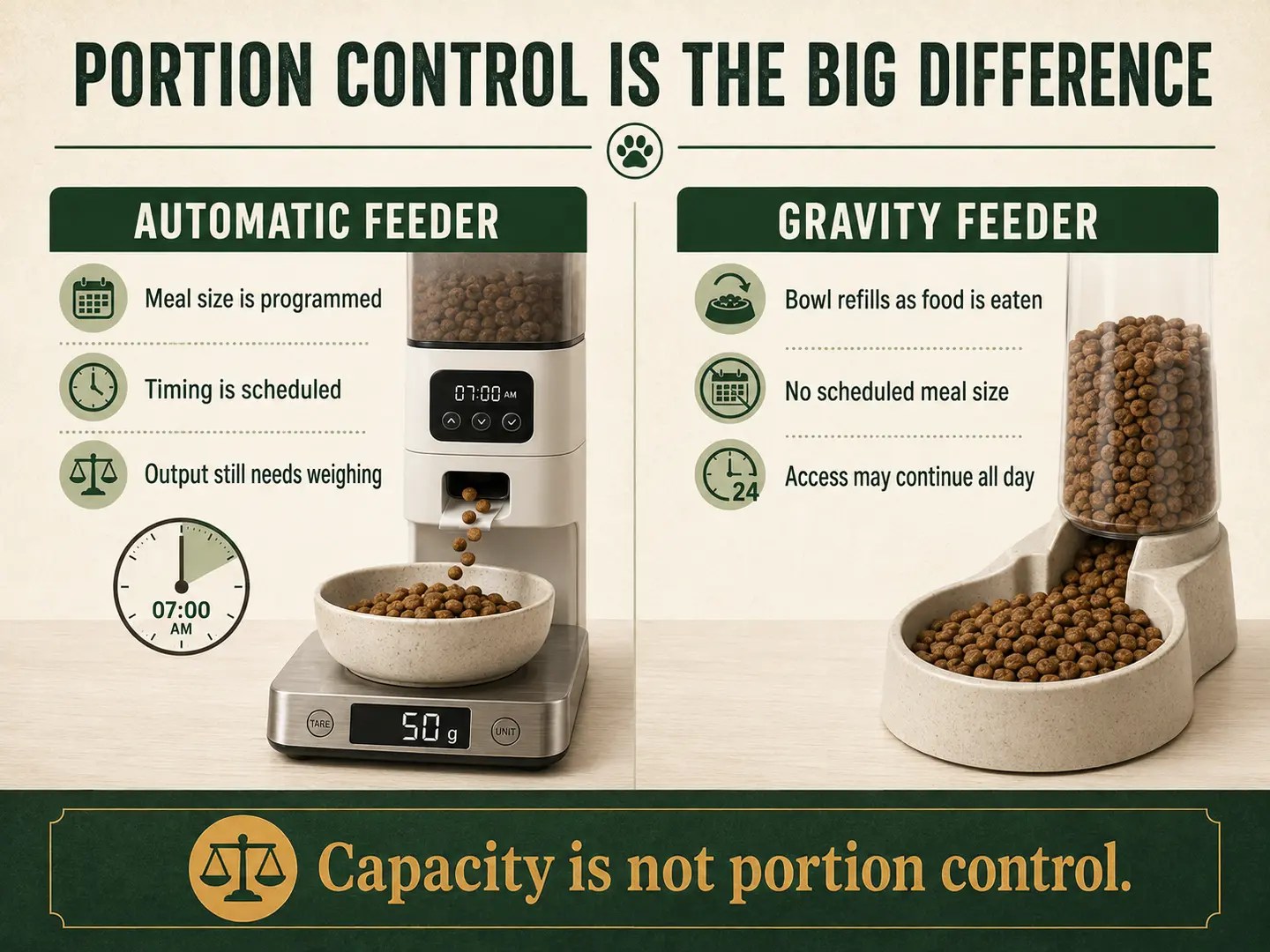
| Portion control | Programmable, but output must be measured | Does not limit how much the cat takes from the open bowl |
| Power | Requires batteries, wall power, or both | No electrical power |
| Maintenance | Bowl, hopper, outlet, rotor, sensors, and base | Bowl, hopper, outlet, lid, and base |
| Best fit | Measured meals and consistent schedules | Cats already suited to supervised free feeding |
Product names are not always consistent. Some sellers call a gravity feeder an “automatic feeder” because it refills the bowl without a person. Read the mechanism description rather than relying on the product category.
How Each Feeder Works
A programmable feeder stores meal instructions on the device, in an app, or through both. At the scheduled time, a motor moves a rotor, auger, or conveyor and releases food. The amount may be described as portions, grams, milliliters, or fractions of a cup, depending on the model.
A gravity feeder has no scheduled dispensing cycle. The hopper sits above an open bowl. As the cat eats and the level near the outlet falls, more kibble drops into the available space. The bowl may remain partly or fully supplied until the hopper empties or the flow becomes blocked.

Portion Control Is the Main Difference
If your goal is to serve a defined meal at 7:00 a.m., a gravity feeder cannot do that. It keeps food accessible rather than separating the daily allowance into timed meals.
A programmable feeder is better suited to portion planning, but its setting is not automatically accurate in grams. For example, one current manufacturer describes individual feeder portions by volume and gives an approximate gram equivalent, while also limiting the compatible kibble size. Different kibble can occupy and move through the same mechanism differently.
Before relying on any programmed amount, weigh at least 10 identical dispenses with the food you actually use. Calculate the average and note the smallest and largest results.
Measure the Real Output
Use a gram scale and 10 separate test cycles before setting the daily schedule.
Is a Gravity Feeder Safe for Free Feeding?
Free feeding means leaving food available so the cat can eat throughout the day. Cornell’s feline feeding guidance says this may be acceptable for some cats, but for others it can lead to overeating and inappropriate weight gain. It also emphasizes that feeding frequency depends on age, health, and individual preference.
A gravity feeder may be reasonable when a healthy cat already self-regulates well, maintains an appropriate body condition, eats a compatible dry diet, and lives where another pet cannot steal the food. You still need to measure how much food enters the hopper and how much remains so that changes in intake are not completely hidden.
A gravity feeder is a poor match when:
- the cat eats rapidly whenever food is available;
- weight gain or portion control is a concern;
- two pets need different foods or amounts;
- the cat requires a prescription diet;
- food must be coordinated with medication; or
- you need to know whether a specific meal was eaten.
Power and Failure Risks
A gravity feeder has a clear advantage during an electrical outage: it does not require power. However, power-free does not mean failure-free. Kibble can form a bridge above the outlet, irregular pieces can block the path, the hopper can empty, the bowl can be tipped, and exposed food can become contaminated.
A programmable feeder adds more possible failure points, including power loss, depleted batteries, incorrect schedules, locked controls, motor faults, and food jams. Some models use backup batteries, but the documentation must confirm that those batteries operate scheduled dispensing—not only the clock or memory.

Test a programmable feeder with wall power disconnected before trusting its backup system. For either feeder, observe multiple complete meals and confirm that the expected food physically reaches the bowl.
Learn how to test an automatic feeder during a power outage.
Cleaning and Food Freshness
Both feeder types expose a bowl to saliva and collect crumbs, dust, and food oils. Both require a clean, dry hopper and regular inspection of the outlet. A large reservoir should not be treated as permission to leave food untouched for weeks.
A programmable feeder usually takes more care to disassemble. The owner may need to clean a rotor, chute, sensor area, and removable bowl while keeping water away from the electronic base. Incorrect reassembly can change portion output or stop dispensing.
A gravity feeder has fewer moving parts, but the large open supply can hide old food beneath repeated top-ups. Empty it between batches, inspect the outlet, and clean according to the manufacturer’s instructions. Do not pour new kibble indefinitely over old crumbs and residue.

The FDA recommends storing dry pet food in its original bag in a cool, dry location. If another container is used, placing the entire original bag inside helps retain the product name, lot number, manufacturer, and best-by information. Wash and dry storage containers between bags.
How Long Should Food Stay in the Hopper?
Use a short-term measured load and inspect it regularly instead of confusing capacity with freshness.
Which One Fits Your Cat?

Choose a programmable automatic feeder when:
- you need defined meals at defined times;
- your cat tends to overeat when food remains available;
- several smaller meals are easier than manual feeding;
- you are prepared to measure the real output;
- you can clean and test the mechanism; and
- you have a backup plan for power or mechanical failure.
Consider a gravity feeder when:
- your cat already maintains an appropriate intake with free access;
- the feeding plan does not require timed portions;
- power-free simplicity is important;
- only compatible dry food will be used;
- other pets cannot steal the food; and
- you will inspect the bowl, outlet, and food supply frequently.
If neither description fits, a standard bowl with measured manual meals may be the better system. Buying a device is not required to create a consistent feeding routine.
Five Questions Before You Choose

- Must each meal be measured? If yes, a tested programmable feeder is the stronger option.
- Can food remain available all day? If no, do not use an unrestricted gravity feeder.
- What happens during a power loss? Verify battery-backed motor operation on the exact automatic model.
- Can every food-contact part be cleaned? Check removal, washing, drying, and reassembly instructions.
- Who can respond if feeding fails? Neither design replaces someone who can enter the home and correct a problem.
Still Comparing Automatic Feeders?
Check food compatibility, portion settings, backup power, cleaning, locks, and replacement support before buying.
Final Verdict
A programmable automatic feeder is usually the better choice when the purpose is portion control, scheduled meals, or several small meals. Its advantages depend on accurate setup, compatible food, reliable power, and regular maintenance.
A gravity feeder is simpler and does not need electricity, but it is fundamentally a continuous-access system. It is appropriate only when leaving dry food openly available matches the cat’s feeding plan and the owner continues to inspect and measure the supply.
Neither is universally better. Choose based on how food must be delivered, how intake will be monitored, and how a failure will be detected and corrected.
Frequently Asked Questions
Is a gravity feeder the same as an automatic feeder?
Retailers may describe it as automatic because it refills the bowl by itself, but it does not schedule or measure individual meals. A programmable feeder uses a timer and dispensing mechanism.
Will a gravity feeder work during a power outage?
Yes, because it does not use electricity. It can still fail if food bridges, the outlet blocks, the hopper empties, or the bowl becomes inaccessible or contaminated.
Can a gravity feeder help with portion control?
It can help you track how much food you place in the hopper, but it does not prevent the cat from eating the available food quickly. It is not equivalent to timed measured meals.
Which feeder is better for two cats?
Neither open system identifies how much each cat ate. If portions, diets, or eating speeds differ, separate rooms or access-controlled feeders may be needed. See the guide to feeding two cats with an automatic feeder.
Is an automatic feeder worth the extra complexity?
It can be when scheduled portions solve a real problem and the owner is willing to test and maintain it. Review the full guide to whether automatic cat feeders are worth it.
Official Sources Reviewed
- Cornell Feline Health Center: How Often Should You Feed Your Cat?
- Cornell Feline Health Center: Feeding Your Cat
- U.S. FDA: Proper Storage of Pet Food and Treats
- Petmate: Pet Cafe Gravity Feeder Product Information
- PETLIBRO: Granary Smart Feeder Specifications