By Pet Tech Compass Editorial Team
Last reviewed: August 11, 2026
The real value of an automatic feeder is not that it removes all feeding work. It moves one repetitive task—releasing food at a set time—from you to a machine. Whether that exchange is worthwhile depends on your cat, your schedule, and how willing you are to test and maintain the device.
Before buying, compare the benefit you actually need with the new responsibilities the feeder introduces. A simple timer model may solve an early-morning meal problem. A connected model may add remote controls and feeding records, but it also adds app, Wi-Fi, and cloud dependencies.

When an Automatic Feeder Is Usually Worth It
You need consistent meal timing
A programmable feeder can release meals at the same times each day, including early morning or while you are at work. This can make a routine easier to maintain than relying on changing work, sleep, or travel schedules.
You want several smaller meals
Feline feeding guidance supports matching the feeding program to the individual cat and household. For some cats, dividing the daily allowance into several scheduled meals may be more practical with a feeder than serving everything once or twice a day. The total daily calories still need to be appropriate.
You want a repeatable portion routine
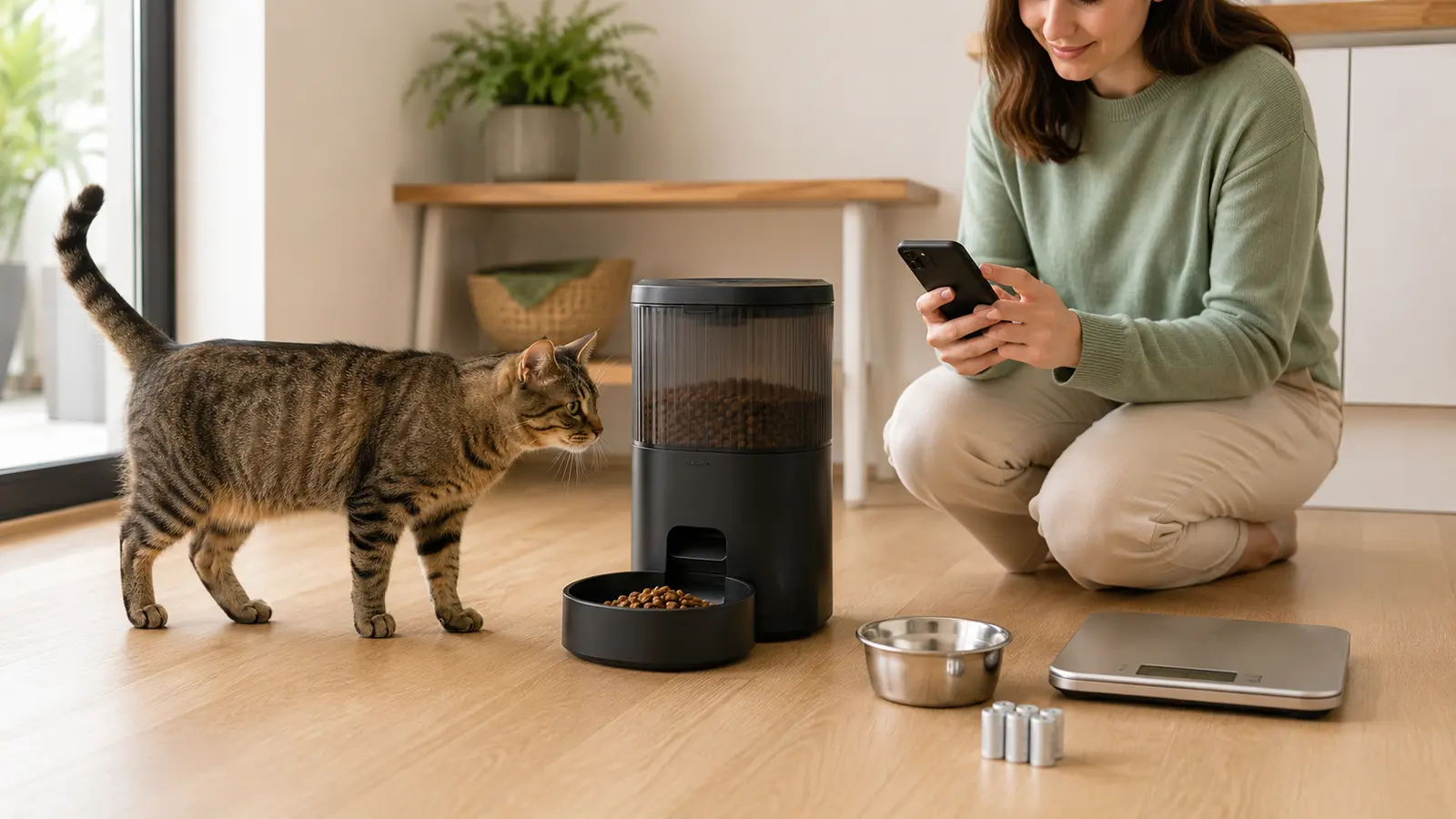
A feeder can be more repeatable than scooping by eye, but its numbered “portions” are not a universal gram measurement. Kibble shape and density change the delivered weight. Weigh at least 10 cycles with the food you actually use, then build the schedule from the measured average.
Does One Portion Equal the Amount You Expect?
Measure repeated dispenses in grams before relying on the feeder for calorie control.

You need limited remote visibility
Some smart feeders provide meal logs, low-food alerts, cameras, or remote dispensing. These features can reduce uncertainty, but they are model-specific and may stop when power, Wi-Fi, the app, or the manufacturer’s service is unavailable. A notification is also not proof that the expected amount reached the bowl or that your cat ate it.

What an Automatic Feeder Does Not Solve
An automatic feeder does not make feeding risk-free. It cannot reliably:
- confirm that your cat swallowed and kept down the meal;
- distinguish between cats unless the model controls individual access;
- clear a physical jam or refill an empty hopper;
- replace spilled or contaminated water;
- clean the litter box or observe changes in urine and stool;
- assess pain, lethargy, vomiting, or a sudden appetite change; or
- provide veterinary care during an emergency.
This is why a feeder is most useful as one layer in a care system. It can handle scheduled dispensing while power, water, litter-box access, health monitoring, and a person who can respond remain separate requirements.

The Real Costs and Trade-Offs
The purchase price is only one part of ownership. A useful comparison includes time, maintenance, accessories, and the cost of a failure.
| Trade-off | What to check before buying |
|---|---|
| Cleaning | Which food-contact parts are removable, washable, and easy to dry? |
| Batteries | Do backup batteries run the motor or only preserve settings? |
| Food limits | Does your kibble size and food type match the exact model? |
| Connected features | What stops without Wi-Fi, an app account, or cloud service? |
| Consumables | Are desiccant packs, filters, tags, or subscriptions required? |
| Repairability | Are bowls, rotors, adapters, lids, and other replacement parts available? |

Routine cleaning is not optional. Bowls collect saliva, while kibble oils and crumbs accumulate in the hopper, outlet, and rotor. Before buying, check whether the parts you will handle most often can be removed without tools and reassembled correctly.
Choose by Evidence, Not Feature Count
Use a 10-point checklist covering portions, food compatibility, power, cleaning, security, and support.
Who Benefits Most—and Who Needs More Caution?

| Situation | Potential value | Main caution |
|---|---|---|
| Healthy adult cat eating dry food | High for routine timing and measured meals | Still test portions, jams, and power |
| Two or more cats | Useful only with a suitable feeding setup | One cat may eat another cat’s portion |
| Weight-management plan | Can support measured scheduled meals | Calorie target and progress need veterinary guidance |
| Medication with meals | Limited unless intake is verified | Dispensing does not prove the cat ate |
| Wet or refrigerated food | Possible with a purpose-built model | Temperature control and cleaning are critical |
| Travel | Helpful as one meal-delivery layer | Does not replace regular in-person checks |
Multi-cat households need special care because a standard feeder normally controls timing, not identity. If food stealing, different diets, or different calorie needs are involved, compare separate rooms, separate feeders, and access-controlled models.
See when two cats can share one automatic feeder—and when they should not.
Run a Seven-Day Trial Before You Depend on It
The best way to decide whether a feeder is worth keeping is to test the real device with the real food while you are still home.

- Day 1—Manual feed: Confirm that controls, locks, and the basic dispensing mechanism work.
- Day 2—Weigh 10 cycles: Record the average, minimum, and maximum output.
- Day 3—Watch every meal: Verify that food reaches the bowl and your cat can access it calmly.
- Day 4—Test Wi-Fi loss: Check whether saved schedules continue and which connected features stop.
- Day 5—Test backup power: Disconnect wall power and confirm that the motor completes a scheduled meal.
- Day 6—Clean and reassemble: Confirm that routine maintenance is realistic and dispensing remains normal afterward.
- Day 7—Review: Decide whether the feeder solved your original problem without creating unacceptable new risks.
If the feeder misses meals, varies widely, jams, loses schedules, or is difficult to clean correctly, contact the manufacturer or return it within the seller’s allowed period rather than hoping the behavior will improve.
Final Verdict
An automatic cat feeder is worth it when it reliably solves a specific problem: inconsistent timing, early-morning feeding, measured dry-food portions, or several small scheduled meals. The most expensive model is not automatically the best value. A simpler model that works with your food, stores its schedule correctly, is easy to clean, and has tested backup power may be the better purchase.
It is not worth treating the feeder as a substitute for observing your cat. If the meal is medically important, the food is difficult to keep safe, cats compete, or no person can respond to a failure, automation alone is not enough.
Frequently Asked Questions
Do automatic feeders save money?
They may reduce accidental over-serving if portions are measured, but savings are not guaranteed. Include batteries, accessories, replacement parts, subscriptions, and the food types the feeder accepts when comparing cost.
Are smart feeders better than basic timer feeders?
Only when you will use the connected features. A basic programmable feeder may be better if you want on-device controls and fewer app or cloud dependencies. Confirm whether a smart feeder stores schedules locally and what happens without Wi-Fi.
Can I rely on an automatic feeder while traveling?
Use it as one part of the care plan, not the entire plan. Test dispensing and backup power, provide reliable water, and arrange a person who can enter the home. Review the unattended feeder safety guide before an overnight or multi-day absence.
How long should an automatic feeder last?
There is no universal lifespan. Motor load, food dust, cleaning, product design, battery condition, parts availability, and daily use all matter. A clear warranty and obtainable replacement parts improve long-term value.
What is the biggest automatic feeder risk?
The most important risk is assuming that a scheduled event guarantees a successful meal. Food can jam, power can fail, the bowl can be blocked, or another pet can eat it. Test the device and keep a human response plan.
Official Sources Reviewed
- Feline Veterinary Medical Association: Feline Feeding Programs
- U.S. FDA: Proper Storage of Pet Food and Treats
- PetSafe: Smart Feed Setup and Backup-Power Information
- PETLIBRO: Granary Smart Feeder Specifications