By Pet Tech Compass Editorial Team
Last reviewed: August 3, 2026
- Test the complete feeding schedule before relying on it.
- Use backup power only after confirming that it operates the dispensing motor.
- Arrange human check-ins for overnight or multi-day absences.
An automatic feeder solves one specific problem: releasing a measured amount of food at a scheduled time. It does not confirm that your cat is healthy, drinking, urinating, using the litter box, or actually eating the meal.
The safest plan treats the feeder as one layer of support. A second layer—such as tested batteries, a separate water source, or a camera—can reduce uncertainty. In-person care remains the only way to physically correct a jam, clean a spill, refill water, assess illness, or take a cat to a veterinarian.
When Is Leaving an Automatic Feeder More Reasonable?
Using a feeder during a normal workday or another short absence may be reasonable when:
- your cat is a healthy adult with stable eating habits;
- the feeder has completed multiple full schedules without a missed meal;
- the kibble is within the manufacturer’s approved size and food type;
- the programmed amount has been weighed and verified;
- the feeder cannot be tipped, opened, unplugged, or blocked easily;
- fresh water is available from more than one reliable source;
- litter boxes are clean and accessible; and
- someone can respond if a problem is discovered.
Previous success matters, but it is not a permanent guarantee. Recheck the setup after changing food, cleaning the dispensing parts, installing firmware, moving the feeder, or replacing its power supply.
When Should You Not Rely on the Feeder Alone?
Closer supervision or a veterinarian-approved care plan is more appropriate when a cat:
- is a young kitten, frail senior, or newly adopted;
- has diabetes or needs medication coordinated with food;
- has kidney, urinary, gastrointestinal, or other ongoing disease;
- has recently vomited, stopped eating, or changed weight unexpectedly;
- requires a prescription or refrigerated diet;
- has a history of breaking into, tipping, or jamming the feeder;
- shares the home with another pet that steals food; or
- becomes highly stressed when left alone.
Can Your Cat Open or Tip the Feeder?
Check the lid, hopper, buttons, power cord, bowl attachment, and feeder placement before leaving it unattended.
The Main Ways Automatic Feeders Can Fail
Food jams or incomplete rotation
Oversized, irregular, oily, or crumb-heavy kibble can bridge over an outlet or interfere with a rotor. A motor sound does not guarantee that food reached the bowl.
Power and battery problems
A wall adapter can be unplugged or power can fail. Some backup batteries operate the motor, while others may preserve only limited functions. Test the exact model instead of assuming that the battery symbol guarantees feeding.
Schedule or clock errors
An incorrect time zone, disabled meal, unsaved app change, control lock, or reset clock can produce a missed or mistimed meal. Review the device display as well as the app.
Empty or inaccessible food
A hopper can look full while food is no longer falling toward the dispensing mechanism. The bowl can also be moved, blocked, contaminated, or reached by another pet first.
Connected features can stop
Wi-Fi loss may disable notifications, cameras, remote feeding, and logs even when a locally stored schedule continues. A “connected” feeder should not be treated as continuous proof that feeding succeeded.
Is Food Failing to Reach the Bowl?
Use a manual-feed test to check the schedule, food outlet, rotor, motor, and power supply before relying on the feeder again.
Dry Food and Wet Food Need Different Plans
| Food setup | Main concern | Safer practice |
|---|---|---|
| Dry-food hopper | Jams, crumbs, moisture, stale food, or an empty outlet area | Use compatible kibble, keep parts dry, and test repeated dispenses |
| Timed wet-food tray | Food warming or remaining exposed too long | Follow the food label and feeder instructions; verify cooling performance |
| Refrigerated feeder | Cooling loss during a power failure or lid malfunction | Confirm safe operating limits and do not rely on cooling after power loss |
The U.S. Food and Drug Administration’s pet-food handling guidance advises promptly refrigerating or discarding unused or leftover canned and pouched pet food and following storage instructions on the package. A timed tray does not override the food manufacturer’s handling requirements.
How Long Can Dry Food Stay in the Feeder?
Learn how heat, humidity, food oils, air exposure, hopper design, and refill habits affect freshness.
A Pre-Departure Automatic Feeder Safety Checklist
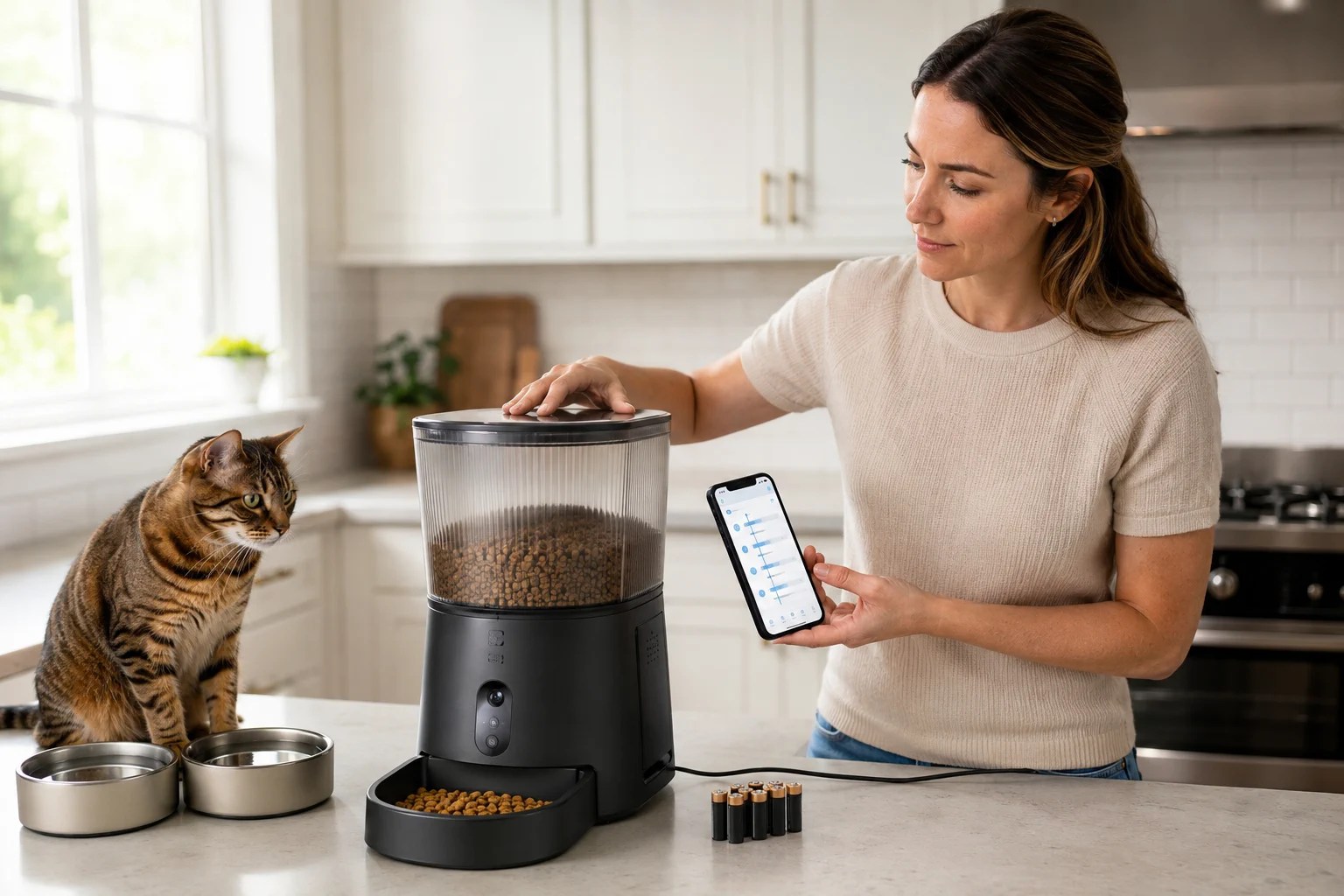
- Run the real schedule. Test the same meal times and portion sizes you plan to use.
- Weigh repeated dispenses. Confirm both average output and cycle-to-cycle consistency.
- Test with Wi-Fi disconnected. Verify what continues and which alerts disappear.
- Test backup power. Unplug wall power and confirm that a scheduled meal physically dispenses.
- Inspect and clean the outlet. Reassemble all removable parts correctly and keep them completely dry.
- Secure the feeder and cord. Prevent tipping, unplugging, chewing, or access to the hopper.
- Provide redundant water. Do not depend on a single powered fountain.
- Prepare litter boxes. Use clean, accessible boxes in appropriate locations.
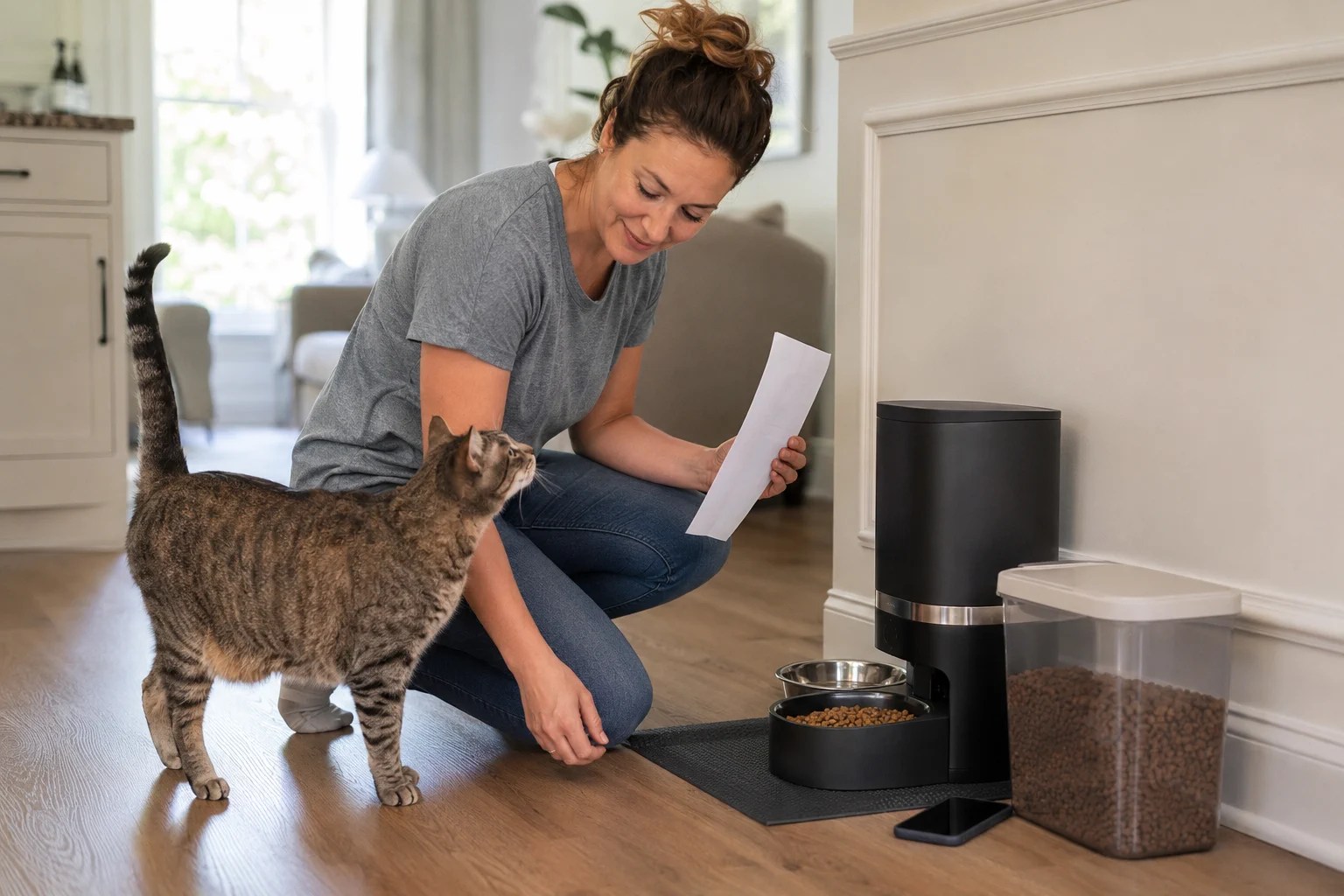
- Leave written care instructions. Include meal amounts, veterinary information, and emergency contacts.
- Arrange a person who can enter the home. Remote monitoring is useful only when someone can respond.
Clean the Feeder Before Departure
Use the correct cleaning schedule for the bowl, hopper, rotor, outlet, sensors, and wet-food trays—and test dispensing after reassembly.
Does a Pet Camera Make the Setup Safe?
A camera can show whether food appears in the bowl, whether your cat approaches, and whether the feeder has been tipped. It may also help you notice vomiting, unusual inactivity, or another pet stealing food.
However, a camera cannot clear a jam, restore power, replace spilled water, clean a litter box, assess dehydration, or provide veterinary treatment. Position the camera so that the feeder and surrounding floor are visible, but use it as monitoring rather than as the only safety measure.
How Often Should Someone Check the Cat?
There is no single unattended-time limit that is safe for every cat. Age, health, medication, diet, temperament, home temperature, water reliability, and the length of the absence all change the risk.
For overnight or multi-day travel, arrange regular in-person visits rather than extending the feeder’s schedule and assuming the home will remain unchanged. The caregiver should see the cat, confirm food and water intake, inspect litter-box output, and have authority to respond to a problem.
Frequently Asked Questions
Can I leave my cat alone overnight with an automatic feeder?
A tested feeder can support scheduled meals, but the decision depends on the cat’s health, age, diet, water access, environment, and ability to cope alone. For overnight and longer absences, arranging an in-person check is the safer plan.
Will the feeder alert me if it jams?
Some connected feeders report suspected blockages or meal events, but alert behavior varies and may depend on power, Wi-Fi, sensors, and app services. Verify alerts with deliberate tests and do not treat them as guaranteed confirmation.
Is battery backup enough?
Only if the batteries are fresh, compatible, correctly installed, and proven to operate the motor and saved schedule. Battery mode may disable Wi-Fi, cameras, or controls.
Should I leave extra food in the hopper?
Provide enough food for the planned schedule plus a reasonable margin, but do not overfill beyond the manufacturer’s instructions. Extra food does not solve a blocked outlet, failed motor, or another pet gaining access.
Can two cats share one feeder while I am away?
Sharing makes individual intake harder to verify and may allow one cat to eat both portions. Separate stations or access-controlled feeders are safer when diets, portions, eating speeds, or health needs differ.
Feeding More Than One Cat?
Learn when sharing may work and when separate or RFID-controlled feeding stations are the safer choice.
Continue Checking Your Automatic Feeder
Check whether the feeder stores schedules locally and which app functions stop.
Verify whether backup batteries power the clock, controls, and dispensing motor.
Measure repeated dispenses with your cat’s actual kibble before setting the schedule.
Official Sources Reviewed
- U.S. FDA: Tips for Safe Handling of Pet Food and Treats
- VCA Animal Hospitals: Feline Environmental Needs Guidelines
- Feline Veterinary Medical Association: Feline Feeding Programs
- VCA Animal Hospitals: Feeding Multiple Pets