By Pet Tech Compass Editorial Team
Last reviewed: August 12, 2026
- Do not make hunger the training method.
- Separate the new object, new bowl, sound, movement, and schedule into manageable steps.
- Let the cat approach and retreat freely.
- Move forward only while the cat eats normally and shows relaxed body language.
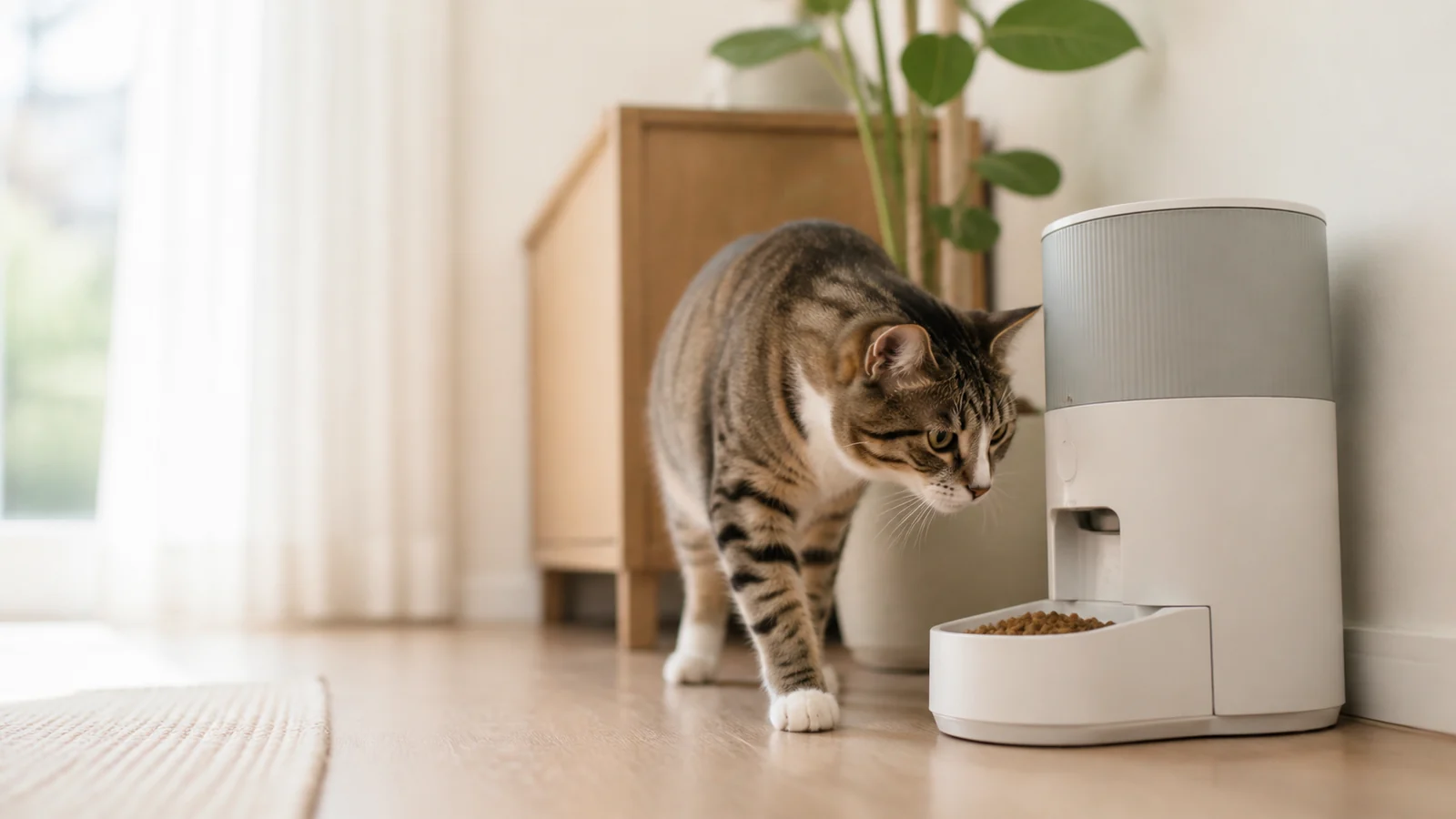
Many cats use a new feeder immediately, but others avoid unfamiliar shapes, reflective bowls, motor noise, moving lids, or a changed feeding location. That hesitation is not stubbornness. The feeder may combine several unfamiliar sensations at the place where the cat expects to feel safe.
The goal is not to force the cat to tolerate the machine. It is to make the feeder predictable and allow the cat to build a positive association with it while normal nutrition continues.
Why Some Cats Avoid a New Automatic Feeder
Cats often prefer predictable resources in locations where they can eat without competition or surprise. The Cat Friendly Homes feeding guidance emphasizes a safe feeding environment, separate stations in multi-cat homes, and feeding methods that fit the individual cat.
A new automatic feeder may change several things at once:
- The bowl’s depth, material, edge, or reflection
- The smell of new plastic, packaging, or cleaning products
- The motor, rotating tray, dropping kibble, or moving lid
- The location and approach path
- The timing and size of meals
- Which person—or machine—predicts food
Training is easier when those changes are introduced separately instead of switching the entire routine in one meal.
Before Training: Set Up the Feeder Safely
- Wash food-contact parts. Follow the exact manual and rinse and dry removable bowls or trays before use.
- Use compatible food. Verify food type and kibble-size limits in the current manual.
- Measure output. Programmed portions are not universal grams. Test the feeder with the food you will use.
- Choose a quiet location. Avoid litter boxes, noisy appliances, busy passageways, and places where another pet can block access.
- Test failures first. Check the clock, schedule, batteries, wall power, and manual-feed control before depending on the feeder.

If you have not yet selected a model, use our guide on how to choose an automatic cat feeder. Training cannot compensate for an incompatible bowl, food type, portion range, or access system.
How to Train a Cat to Use an Automatic Feeder
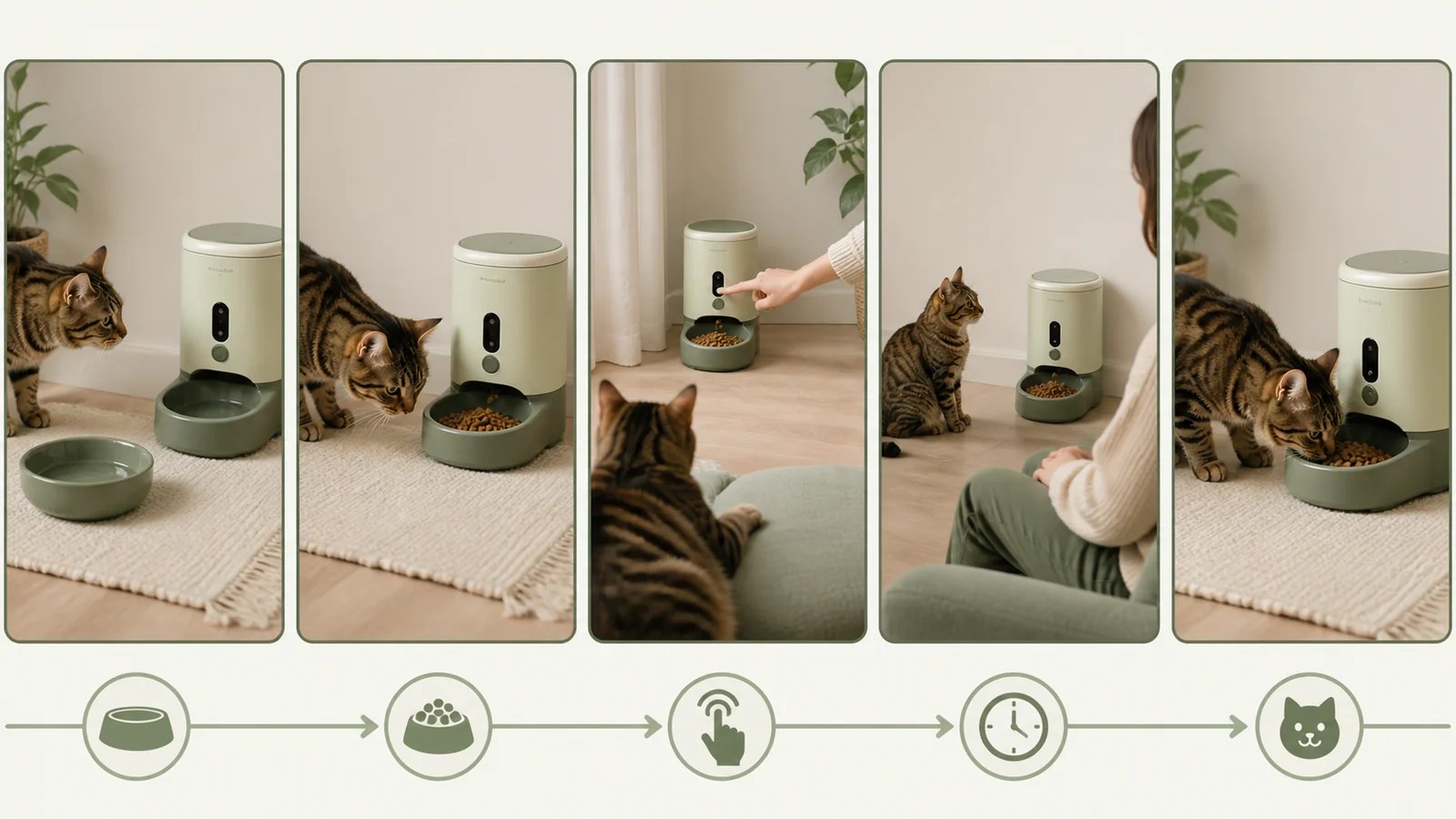
Step 1: Introduce the feeder while it is silent
Place the unplugged feeder near the familiar feeding area, but do not remove the old bowl. Give the cat room to look, sniff, walk away, and return. Do not carry the cat to the machine or place the cat’s face near it.

For a cautious cat, begin far enough away that normal eating continues. Move the feeder closer over several meals only if the cat remains comfortable. A cat that will not eat with the feeder nearby is telling you the step is too difficult.
Step 2: Make the feeder bowl predict familiar food
With the machine still off, place a small amount of the cat’s usual food in the feeder bowl. You can initially keep the familiar bowl beside it. Once the cat voluntarily eats from the new bowl, gradually serve more of the normal meal there.

Do not introduce a new food and a new machine at the same time unless a veterinarian has given different instructions. If a therapeutic diet is involved, follow the veterinary transition plan.
Step 3: Introduce the dispensing sound separately
When the cat comfortably eats from the silent feeder bowl, trigger one small manual dispense while the cat is several feet away—not with its face at the outlet. Let the sound predict a small amount of familiar food. If the cat startles and retreats, do not immediately repeat it. Increase distance and try later at a lower-pressure moment.

Short, successful exposures are more useful than repeated noise after the cat has become worried. Keep access to normal food during training.
Step 4: Pair one scheduled meal with supervision
Program one meal at a time when you can watch from a distance. Confirm that the feeder releases the expected amount, the cat approaches, and the food is eaten. Keep the remainder of the day’s routine unchanged.
After several successful meals, add other scheduled times. If you plan multiple meals, divide the existing daily allowance rather than adding food. Our guide to testing automatic-feeder portion accuracy explains how to weigh repeated dispenses.
Step 5: Remove the old bowl only after reliable eating
The transition is ready when the cat repeatedly approaches the feeder without coaxing, eats a normal amount, and remains relaxed around dispensing. Remove the old bowl gradually if it is no longer needed. Continue checking the bowl and the cat; a successful app log does not prove that food was eaten.
Read the Cat’s Body Language

| Continue at this level | Make the step easier |
|---|---|
| Voluntary approach, sniffing, normal posture, eating, grooming afterward, returning later | Crouching, flattened or sideways ears, repeated scanning, darting away, refusing familiar food, guarding the exit |
The FelineVMA caregiver feeding resource advises watching for caution, constant looking around, flattened or sideways ears, and crouched posture around food. These signals can indicate that the feeding environment does not feel safe.
Training Moving-Lid and Microchip Feeders
Access-controlled feeders introduce movement near the cat’s head as well as a new bowl. Use the manufacturer’s training mode when available. The SureFeed Microchip Pet Feeder manual, for example, documents a training function that changes lid movement gradually. That feature is model-specific; do not assume another feeder works the same way.

Keep the lid at the easiest stage until the cat eats comfortably. Advance one level, observe several meals, and step back if the cat begins avoiding the feeder. Never hold the cat in position while a lid moves.
Training in a Multi-Cat Home
Train each cat separately when possible. A confident cat can consume the reward before a cautious cat approaches, while guarding or staring may suppress eating without an obvious fight. FelineVMA recommends separate food and water resources with distance and visual separation.

If the cats need different portions or diets, one open feeder may not be suitable. Review whether two cats can share one automatic feeder before treating one bowl as a fair distribution system.
A Practical Seven-Day Introduction

- Days 1–2: feeder off, familiar bowl available, voluntary investigation
- Days 2–3: familiar food served in the silent feeder bowl
- Days 3–4: one manual dispense while the cat is at a comfortable distance
- Days 4–5: one supervised scheduled meal
- Days 5–7: add scheduled meals only after reliable eating
This is a sample pace, not a deadline. Repeat a stage for days or weeks if needed. Stop the timeline and contact a veterinarian when appetite changes or the cat is not eating normally.
Common Introduction Mistakes

- Removing the familiar bowl on the first day
- Triggering the motor beside the cat’s face
- Moving the feeding station to a busy or exposed location
- Pushing, carrying, or trapping the cat near the feeder
- Ignoring competition from another pet
- Leaving home before testing several complete cycles
FAQ
How long does it take a cat to learn an automatic feeder?
Some cats eat from it immediately; cautious cats may need days or weeks. Progress depends on the feeder’s noise and movement, the cat’s history, the environment, and whether steps remain below the cat’s stress threshold.
Should I record my voice on the feeder?
A voice recording may help some cats but startle others. Treat it as another new sound: test it quietly while you are home. The feature and volume vary by model.
What if my cat eats from the bowl but fears the motor?
Return to silent bowl feeding, trigger a small dispense while the cat is farther away, and pair the sound with food without forcing an approach. Reduce repetition if the cat retreats or stops eating.
Can I leave once my cat eats one automatic meal?
No. Observe multiple scheduled cycles and confirm portion output, access, power behavior, and normal intake. Use the precautions in our guide to leaving an automatic feeder unattended.
Official Sources Reviewed
- Cat Friendly Homes: How to Feed a Cat — safe, individualized feeding environments and separate resources.
- FelineVMA: Feline Feeding Programs — gradual feeding programs, small meals, and household customization.
- FelineVMA: Positive Reinforcement Training — rewarding desirable behavior and timed feeders in appropriate routines.
- SureFeed Microchip Pet Feeder Manual — documented model-specific training mode.