By Pet Tech Compass Editorial Team
Last reviewed: August 12, 2026
Quick answer: An automatic feeder can help with cat weight loss when it dispenses a veterinarian-approved daily food allowance in measured meals. It does not determine how many calories your cat needs, account for unlogged treats, stop another pet from stealing food, or detect unsafe weight loss. What helps is the consistency, not the machine by itself.
An automatic feeder can turn an imprecise “small scoop” routine into scheduled, repeatable portions. That can be valuable because free-choice feeding may encourage excess intake, while measured feeding makes the daily total easier to control. However, weight loss in cats must be gradual. A sudden calorie cut or a cat that stops eating can create a serious health risk.
What matters most
- Ask your veterinarian to set the target weight, food, and starting daily calories.
- Weigh the entire daily ration in grams before loading or programming the feeder.
- Test what the feeder actually dispenses; “one portion” is not a universal amount.
- Include treats, hand-fed food, supplements, and stolen food in the daily total.
- Track appetite, body weight, body condition, and muscle condition — not weight alone.

How an automatic feeder can support weight loss
The feeder’s main advantage is control over when and how much dry food becomes available. It may help replace an always-full bowl, reduce accidental double-feeding between family members, and divide one measured daily ration into several meals.
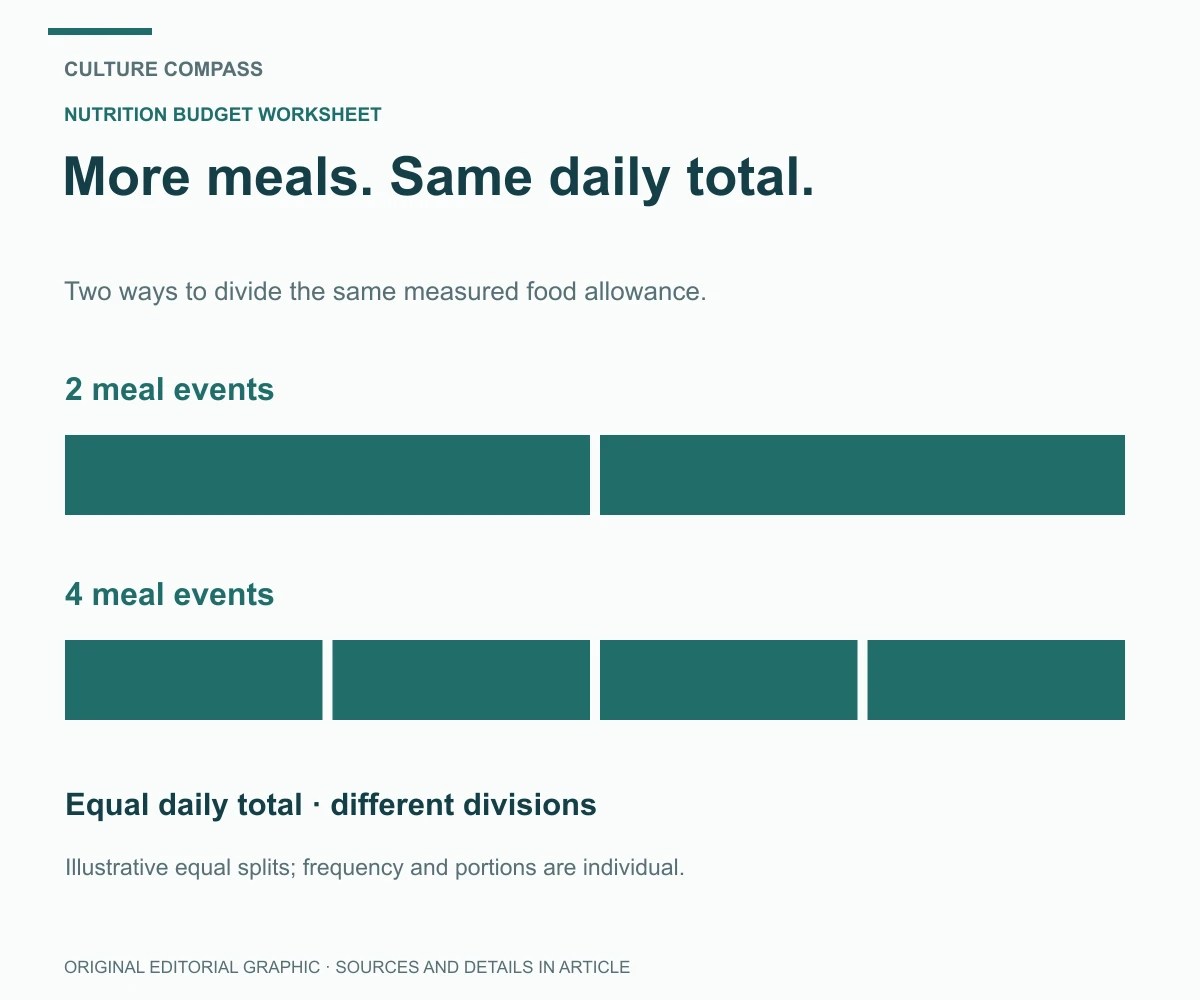
That does not mean more meals automatically cause more weight loss. Two meals or six meals can contain exactly the same number of calories. Meal timing should fit the cat and household; the daily total remains the controlling variable. Our guide to how many times an automatic feeder should feed a cat explains how to divide that total without adding food.
Start with a veterinary weight and nutrition assessment
Before reducing food, ask your veterinarian to assess current weight, target weight, body condition score, muscle condition score, health conditions, medications, and the food’s calorie density. The AAHA/AAFP feline life-stage guidance notes that energy needs vary with age, activity, neuter status, body condition, muscle condition, and health.
Do not calculate a severe restriction from a generic online formula and assume it is right for your cat. A therapeutic weight-management food may be appropriate because simply feeding much less of a maintenance diet can also reduce essential nutrient intake.

A safer automatic-feeder setup in six steps
1. Get the daily calorie target and food choice
Use the daily calories and food recommended for your individual cat. Find the food’s metabolizable energy on the label or manufacturer information — usually shown as kcal per cup, can, pouch, or kilogram. If the food or formula changes, recalculate the gram amount with your veterinarian.
2. Convert the daily allowance to grams
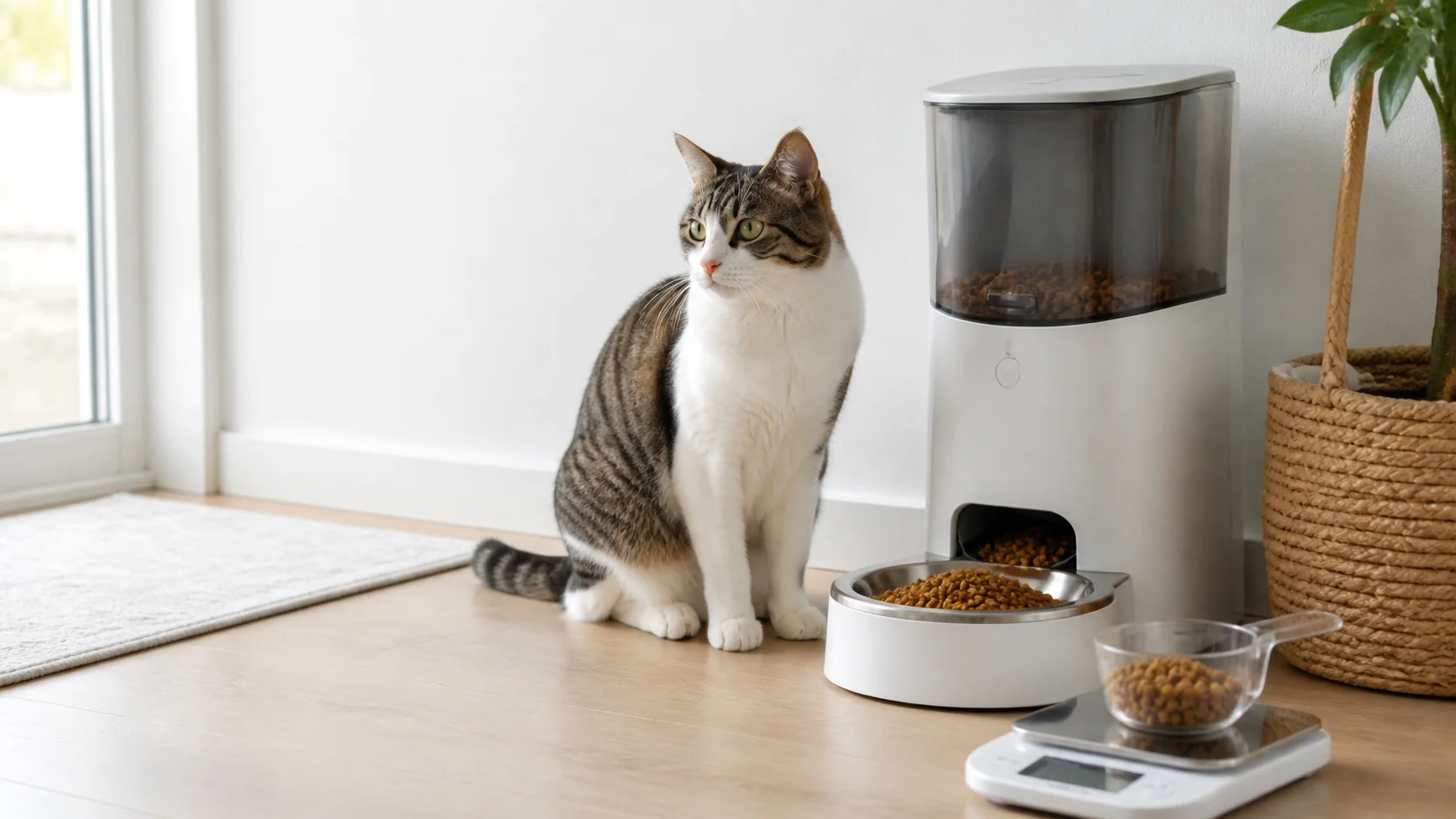
A kitchen gram scale is generally more repeatable than a measuring cup for dry food. Weigh the full amount for 24 hours, including any kibble reserved for treats or puzzle toys. This daily-container method makes it obvious when the allowance has already been used.

3. Divide one total — do not create extra food
Program the approved daily amount across the number of meals your cat tolerates well. For example, four feeder events should add up to the same daily ration that two meals would contain. Treats and food used for medication still count.

4. Test the feeder’s real output
Do not assume the screen’s portion number equals a specific gram weight. Kibble size, shape, density, hopper level, and feeder design can affect output. Dispense the same setting at least seven times, weigh each result, and calculate the average. Recheck after changing food. See our detailed guide to automatic feeder portion accuracy.

5. Prevent calories outside the plan
Check every food source: another pet’s bowl, children offering treats, food dropped during cooking, open kibble bags, and prey caught outdoors. In multi-cat homes, scheduled supervision, separate rooms, or access-controlled feeders may be needed. A standard timed feeder cannot identify which cat ate the food. Read whether two cats can share one automatic feeder before relying on a shared bowl.

6. Monitor and adjust with your veterinarian
Use the same scale and similar conditions for each weigh-in. Record the date, weight, appetite, vomiting, stool changes, activity, and feeder problems. AAHA’s current feline diabetes dietary guidance cites a healthy loss range of about 0.5% to 2% of body weight per week for an obese cat, but your veterinarian may choose a narrower target based on the individual. Do not chase a faster result.

Does feeding more small meals help?
Small meals may fit a cat’s preferences, reduce long gaps, and make a routine easier to automate. They are not a license to add calories. If your cat becomes more food-focused around frequent feeder sounds, a different distribution may work better. Keep the approved daily total unchanged unless your veterinarian adjusts it.
When an automatic feeder may not be enough
| Situation | Why the feeder is insufficient | Safer next step |
|---|---|---|
| The cat steals another pet’s food | A timed bowl does not verify identity. | Separate meals or use appropriate access control. |
| The feeder output varies or jams | Actual intake may differ from the program. | Retest portions and resolve dispensing problems. |
| Wet food is central to the plan | Many hopper feeders are designed only for dry food. | Use a wet-food-safe method with suitable temperature control. |
| Diabetes or another medical condition is present | Food timing and intake may interact with treatment. | Follow the treating veterinarian’s specific plan. |
Safety warning: Never make a cat “diet” by abruptly withholding food. Contact your veterinarian promptly if your cat refuses food, eats substantially less than planned, vomits repeatedly, seems weak or unusually withdrawn, or loses weight faster than the agreed target. Cats that do not eat can develop hepatic lipidosis, a potentially life-threatening liver condition.

Automatic-feeder weight-plan checklist

- Veterinarian-confirmed target weight and daily calories
- Food calorie density confirmed
- Daily ration weighed in grams
- Feeder setting tested across repeated dispenses
- Meals add up to the daily ration
- Treats and medication food counted
- Other pets cannot access the meal
- Backup feeding plan ready for power or dispensing failure
- Weight, body condition, muscle condition, and appetite reviewed
Related guide: Is your feeder right for this job?
Portion range, backup power, bowl design, food compatibility, and access control can determine whether a feeder supports a reliable routine.
Frequently asked questions
Can I use the feeder’s recommended portion setting?
Use it only as a starting interface setting. Weigh repeated dispenses and compare the measured daily grams with the amount in your veterinarian-approved plan.
How quickly should an overweight cat lose weight?
The safe target is individual. Veterinary sources commonly describe gradual loss, and current AAHA guidance cites about 0.5% to 2% of body weight per week for an obese cat. Your veterinarian should set and monitor the actual target.
Should I fill the hopper completely?
You can, but pre-weighing a daily ration in a separate container makes auditing intake easier. If you fill a large hopper, record additions carefully and confirm that family members do not add uncounted food.
Can a feeder help if my cat begs for food?
It may separate the caregiver from some meal cues and provide predictable times, but begging can have behavioral or medical causes. Do not respond by making unsupervised calorie cuts. Discuss persistent appetite changes with your veterinarian.
What if my cat is afraid of the feeder?
Do not make access to food depend on a device the cat fears. Use a gradual introduction while protecting normal intake. Follow our guide on training a cat to use an automatic feeder.
Bottom line
An automatic feeder can improve portion consistency, meal timing, and accountability. Those benefits can support cat weight loss only when the daily calorie target, food choice, medical monitoring, treats, and access by other pets are also controlled. Think of the feeder as a delivery tool — not a diagnosis, diet prescription, or safety monitor.
Official sources reviewed
- AAHA: Weight Reduction in the Obese Pet — individualized calorie planning and monitored weight reduction.
- AAHA: Prevention of Obesity — measured intake, calorie density, gram-scale accuracy, and obesity prevention.
- 2026 AAHA Diabetes Management Guidelines for Cats: Dietary Management — portion control, monitoring, timed feeders, and gradual loss guidance.
- Cornell Feline Health Center: Feeding Your Cat — body condition, obesity, feeding environment, and appetite warnings.
- WSAVA Cat Body Condition Score — nine-point visual and hands-on body-condition framework.
Research note: This guide synthesizes veterinary guidelines and educational resources available on August 12, 2026. It is not a substitute for an examination or an individualized nutrition plan. Feeder accuracy and features vary by model, kibble, maintenance, and setup.
Affiliate disclosure: Pet Tech Compass may earn a commission from qualifying purchases made through affiliate links, at no additional cost to you. No product was selected or ranked in exchange for inclusion in this guide.