By Pet Tech Compass Editorial Team
Last reviewed: August 12, 2026
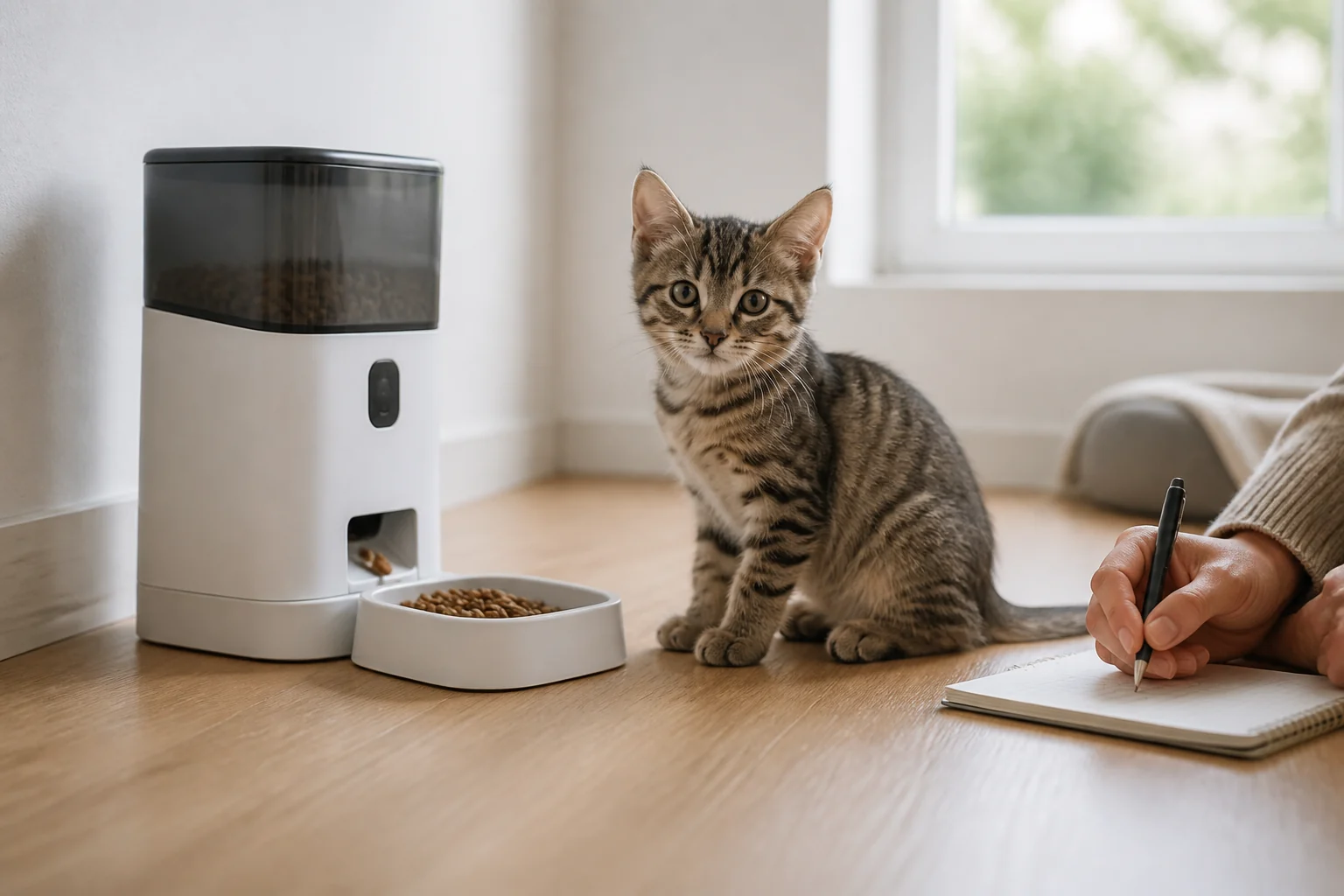
Quick answer: A healthy, fully weaned kitten that reliably eats solid kitten food can use an automatic feeder for some meals. The feeder must deliver suitably small portions, provide an easy-to-reach bowl, and sit in a kitten-proof location. It should support—not replace—caregiver meals, daily appetite checks, and veterinary growth monitoring.
Kittens are not simply miniature adult cats. Their energy needs change rapidly during the first year, and missed meals or unnoticed poor intake matter more during growth. An automatic feeder can add consistency between caregiver-served meals, but the schedule and total amount must change as the kitten grows.
What matters most
- Wait until the kitten is fully weaned and eating solid growth food reliably.
- Use a food labeled complete and balanced for growth or the veterinarian-recommended equivalent.
- Test the feeder’s smallest setting in grams before relying on it.
- Verify that the meal was dispensed and eaten; an empty hopper is not an intake record.
- Track weight, appetite, stool, activity, and body condition as the plan changes.

When is a kitten ready?
Do not use an automatic feeder for a bottle-fed kitten or as the primary tool during weaning. AAHA/AAFP guidance says kittens can begin weaning onto commercially balanced kitten food at about 3–5 weeks, but starting solid food is not the same as being fully weaned and independently reliable.
A practical readiness check is that the kitten eats an appropriate solid diet consistently, can comfortably reach the bowl, is growing normally, and has no illness or underweight concern requiring closer feeding supervision. Ask the veterinary team when the history is uncertain.
Use kitten food—not an adult maintenance ration
The AAHA/AAFP kitten nutrition guidance reports that energy needs per kilogram are much higher at 10 weeks than at 10 months. Choose a food whose nutritional adequacy statement covers growth, or follow a veterinarian’s specific recommendation.

Test whether the feeder can dispense a small enough meal
“One portion” has no standard gram value across feeders. Large minimum settings can make several small kitten meals impossible without exceeding the daily total. Dispense the smallest setting at least seven times, weigh each result, and calculate the average. Repeat after changing kibble because shape and density affect output.

Our guide to automatic feeder portion accuracy provides a complete test method.
Kitten-proof the feeder and surrounding area
- Use a stable base on a non-slip surface away from stairs.
- Protect or conceal the power cable from chewing and pulling.
- Remove narrow gaps where a paw, head, collar, or body could become trapped.
- Check that moving doors and dispensing parts are shielded from curious paws.
- Choose a shallow, reachable bowl and a quiet location.
- Keep plastic packaging, desiccant packets, and spare batteries inaccessible.

How often should the feeder serve a kitten?
Meal frequency depends on age, health, total intake, and food. Cornell notes that kittens generally need food more often than adults and that kittens under six months often do well with three meals daily; veterinary nutrition guidance commonly divides the total into three or four small meals or more. These are starting frameworks, not fixed prescriptions.
The feeder can cover one or two times when a caregiver is unavailable while human-served meals preserve observation and social contact. Every meal must fit within one veterinarian-informed daily total.

Track growth and revise the program
A program that fit last month may become inadequate as the kitten grows. Weigh the kitten consistently, record appetite and the actual amount eaten, and review body and muscle condition with the veterinary team. Recalculate after food changes, neutering, illness, unusual growth, or a significant activity change.

Call your veterinarian promptly if a kitten stops eating, repeatedly vomits, has diarrhea, becomes weak or unusually sleepy, loses weight, fails to gain as expected, or cannot reliably access the feeder. Do not wait for an app alert to identify poor intake.
Verify that every scheduled meal was eaten
A successful dispense is not proof of eating. Kibble may remain in the chute, another pet may eat it, or the kitten may be frightened by the sound. Supervise initial cycles, inspect the bowl, and compare the day’s remaining food with the planned total.

Separate kitten food from adult-cat food
In a multi-cat home, the adult may steal energy-dense kitten food while the kitten eats an inappropriate adult ration. Use separate rooms, supervised periods, physical access barriers, or a suitable access-controlled feeder. Read whether two cats can share one automatic feeder.

Introduce the feeder gradually
Let the kitten explore the unplugged feeder, serve familiar food from its bowl, introduce the operating sound separately, and supervise scheduled meals. Never use hunger, restraint, or forced proximity. Our full automatic feeder training guide provides the staged method.

Kitten automatic feeder checklist

Frequently asked questions
Can an eight-week-old kitten use an automatic feeder?
A fully weaned, healthy eight-week-old kitten may be able to use a suitable feeder for some meals, but age alone is insufficient. Confirm reliable solid-food intake, bowl access, portion size, and normal growth with the veterinary team.
Can I leave kibble available all day?
Free feeding may suit some individuals but makes intake harder to measure and can promote overeating in others. Use the feeding method recommended for the kitten and track the total offered and eaten.
Can a kitten eat wet food from an automatic feeder?
Yes, only in a feeder approved for wet food with an appropriate cooling and cleaning plan. See our wet-food automatic feeder guide.
Can the feeder replace a pet sitter?
No. A person must check the kitten’s welfare, intake, water, litter box, environment, and equipment. Young kittens need especially close observation.
Bottom line
A fully weaned, healthy kitten can use a well-tested automatic feeder as one part of the feeding routine. Select growth food, verify tiny portions, kitten-proof the setup, watch the kitten eat, and revise the program as growth changes. The feeder delivers food; it does not monitor development or replace a caregiver.
Official sources reviewed
- AAHA/AAFP: Nutrition and Weight—Kittens — weaning, growth energy needs, feeding environment, and obesity prevention.
- AAHA/AAFP Life Stage Checklists — kitten diet, quantity, intake, meal frequency, body condition, and enrichment.
- Cornell Feline Health Center: How Often Should You Feed Your Cat? — age-based meal-frequency context.
- VCA: Feeding Growing Kittens — nutritional adequacy for growth and small-meal distribution.
Research note: This guide was reviewed against current veterinary resources on August 12, 2026. Kitten needs vary with age, size, health, neuter status, food, and growth rate. It does not replace an individualized veterinary nutrition plan.
Affiliate disclosure: Pet Tech Compass may earn a commission from qualifying purchases made through affiliate links, at no additional cost to you. No product was selected or ranked in exchange for inclusion.