By Pet Tech Compass Editorial Team
Last reviewed: August 12, 2026
Quick answer: An automatic feeder can be useful for a senior cat when it provides easy-to-reach, measured meals and the caregiver still verifies appetite and intake. It is not automatically suitable for every older cat. Mobility, dental comfort, vision, hearing, cognition, hydration, medical diets, and weight or muscle loss may require a different feeder or more hands-on feeding.
The best feeder for a senior cat is not necessarily the most connected model. It is the one the cat can comfortably find, approach, and eat from—and whose meals can be checked by a person. Older cats are more likely to develop conditions that change appetite, food choice, or access, so automation should make observation easier rather than hide changes.
What matters most
- Use the diet and daily amount recommended for the individual cat.
- Place a low, wide bowl on a stable surface along a clear path.
- Measure food offered and food left—not just feeder events.
- Track weight, body condition, and muscle condition.
- Keep daily human check-ins and a backup feeding plan.

Potential benefits for a senior cat
- Smaller scheduled meals: one daily ration can be divided without requiring a person at every serving.
- More visible intake: portion feeding can make reduced appetite easier to notice than an always-full bowl.
- Routine: predictable meals may help some cats, provided the sound and movement remain familiar and comfortable.
- Diet separation: an access-controlled design may protect a medical diet in a multi-cat home.
These benefits depend on actual use. A notification that food was dispensed does not prove the cat found or ate it.
Make the bowl easy to reach
AAHA/AAFP life-stage guidance emphasizes easy access to food and water as cats age. Arthritis, weakness, impaired vision, and reluctance to cross slippery flooring can turn a technically working feeder into an inaccessible one.

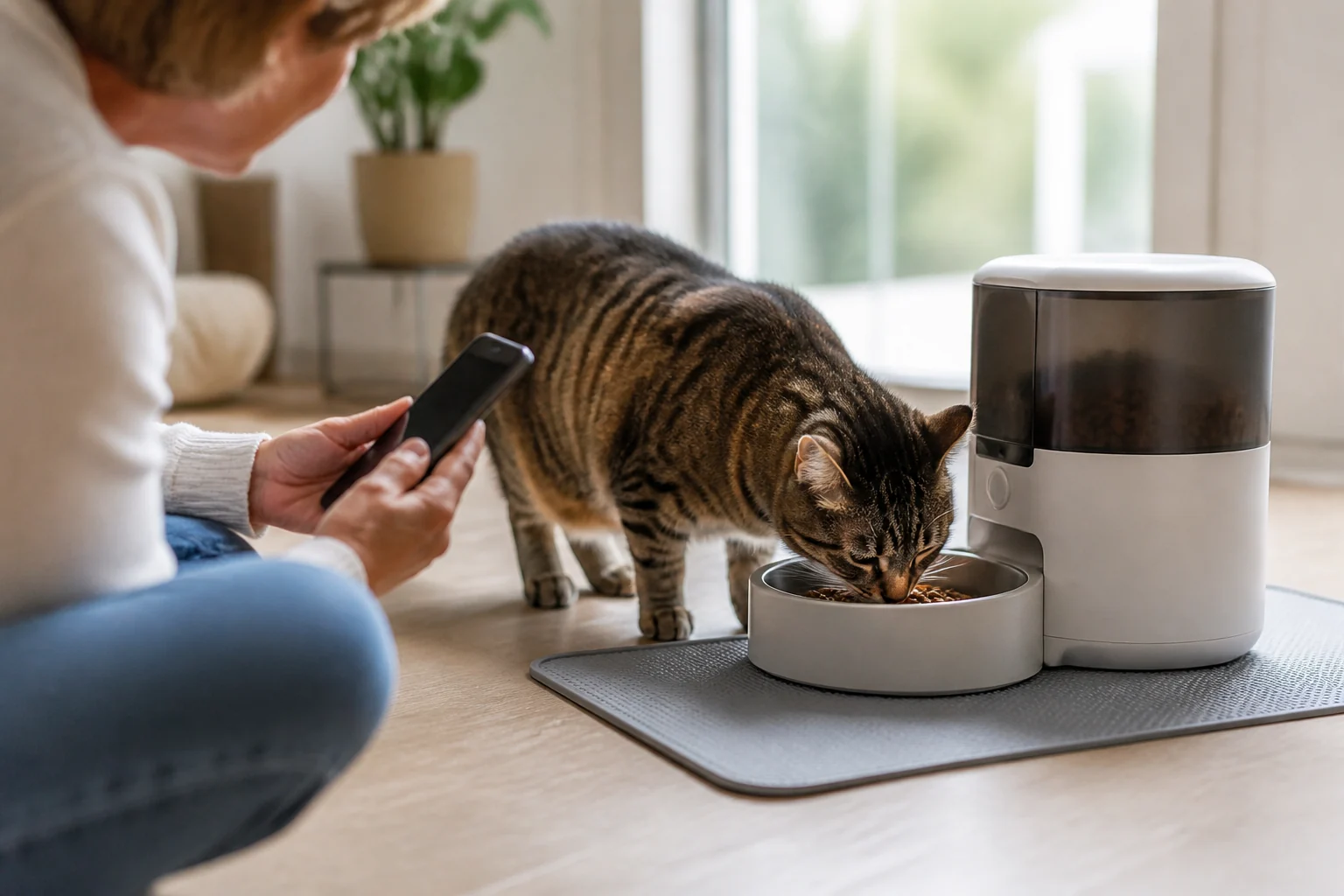
Keep the feeder on the floor the cat normally uses, away from stairs, litter boxes, loud appliances, and competition. A wide shallow bowl may reduce whisker contact and awkward neck positioning. If elevation appears helpful, ask the veterinarian or rehabilitation professional what height and posture suit the cat; taller is not always better.
Should senior cats eat more small meals?
There is no universal senior-cat meal count. Cornell notes that senior cats can often maintain their established regimen unless a veterinarian advises otherwise. VCA suggests that measured food divided into two or more meals can make intake easier to observe. The cat’s disease, appetite, medication plan, and household routine determine the best distribution.

For general scheduling principles, see how often an automatic feeder should feed a cat.
Measure what the cat actually eats
Record food offered, leftovers, treats, hand-fed food, and food used with medication. Weighing leftovers in grams is more informative than assuming a bowl was emptied. In multi-cat homes, identify which cat ate.

Appetite changes are not “just old age.” Contact the veterinarian promptly if a senior cat refuses food, eats substantially less, vomits repeatedly, loses weight, becomes weak, or shows a new behavior change. Cornell notes that sustained anorexia can seriously affect a mature cat’s health in as little as 24 hours.
Track weight and muscle—not weight alone
Some senior cats gain excess fat; others lose weight or lean muscle. AAHA/AAFP guidance notes that underweight is common in senior cats and that digestive capability and calorie needs can change. Use the same scale consistently and ask the veterinary team to assess body condition and muscle condition.

Prescription diets and medication need a specific plan
Chronic kidney disease, diabetes, hyperthyroidism, osteoarthritis, obesity, dental disease, and gastrointestinal disorders can change the appropriate food, texture, amount, and timing. The feeder must accommodate the veterinarian-selected plan; it must not choose the diet.

Do not hide medication in an unattended meal unless the prescribing veterinarian confirms the method and you can verify the entire dose was consumed. A missed meal can become a missed dose.
Wet food may require a different feeder
Wet food can support water intake and may be easier for some cats with dental discomfort, but it requires a compatible tray and safe cooling. Never place it in a dry-food hopper. Follow our wet-food automatic feeder safety guide.

Watch for sensory or cognitive changes
A cat that once responded to the dispenser sound may no longer hear it, may have trouble finding the bowl, or may become startled by movement. Keep the feeder in a consistent, well-lit location and use familiar caregiver cues. New confusion, nighttime vocalization, altered sleep, or changed feeding behavior deserves veterinary evaluation.

Protect the senior cat’s meal in a multi-cat home
A younger cat may steal the senior cat’s food, especially when it is energy-dense or highly palatable. Use separate rooms, supervision, or an appropriate access-controlled feeder. Confirm that the older cat can comfortably operate any moving lid and that the younger cat cannot intimidate it near the station.

Senior-cat feeder checklist

- Veterinarian-approved diet and amount
- Low, wide, stable bowl
- Quiet, well-lit station with a clear path
- Repeated portion-output test
- Daily check of offered food and leftovers
- Regular weight, body-condition, and muscle-condition tracking
- Power and dispensing-failure backup plan
- Reliable human welfare checks
Frequently asked questions
Is a raised bowl better for an arthritic senior cat?
It may help some cats and worsen posture for others. Start with a stable, comfortably accessible bowl and ask the veterinary team what height suits the cat’s mobility and neck position.
Can a feeder tell me whether my cat ate?
Most feeders report dispensing, not ingestion. Even a camera may not measure the amount swallowed. Inspect and weigh leftovers and observe the cat regularly.
Should every senior cat eat senior food?
No single food is appropriate for every older cat. Health status, body and muscle condition, disease, and current diet determine the recommendation.
Can I leave a senior cat alone with an automatic feeder?
The feeder can cover meal timing but cannot replace welfare checks. Older cats may need medication, hydration monitoring, litter-box checks, mobility support, and prompt response to appetite or behavior changes.
Bottom line
An automatic feeder can support a senior cat when it improves meal access and makes measured intake easier to review. Choose the food and schedule with the veterinary team, keep the bowl easy to reach, verify eating, monitor weight and muscle, and preserve daily human contact. If automation makes appetite harder to see, it is the wrong setup.
Official sources reviewed
- AAHA/AAFP: Nutrition and Weight—Mature Adult and Senior Cats — changing energy needs, underweight risk, medical diets, hydration, and food preference.
- AAHA/AAFP Life Stage Checklists — senior access, appetite, hydration, mobility, cognition, weight, and muscle monitoring.
- 2023 AAHA Senior Care Guidelines: Nutritional Disease Management — nutrition in common senior diseases.
- Cornell Feline Health Center: Loving Care for Older Cats — accessibility and the importance of investigating changes.
- VCA: Feeding Mature, Senior, and Geriatric Cats — portion feeding, appetite visibility, small meals, and weigh-ins.
Research note: This guide was reviewed against current veterinary sources on August 12, 2026. “Senior” definitions and nutritional needs vary. Medical conditions and medications can change the appropriate food, schedule, and monitoring plan.
Affiliate disclosure: Pet Tech Compass may earn a commission from qualifying purchases made through affiliate links, at no additional cost to you. No product was selected or ranked in exchange for inclusion.