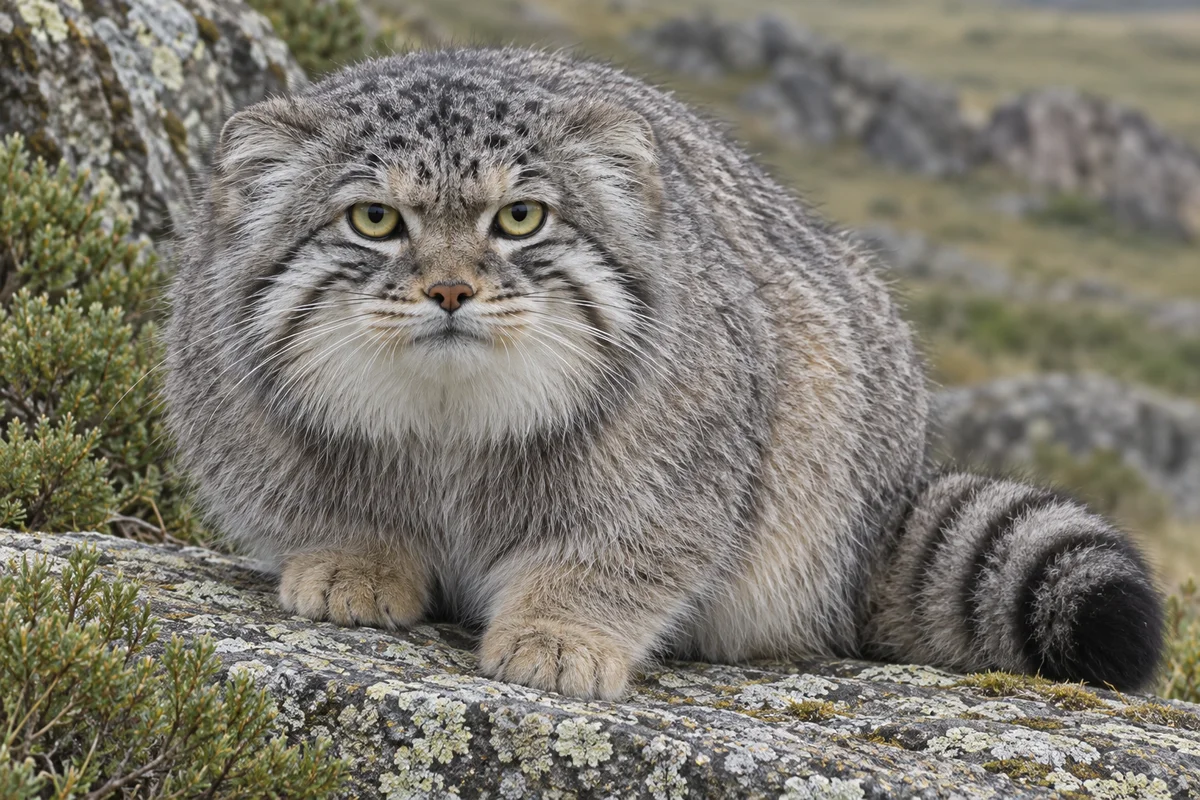
The cat is sitting on a rock, doing very little, and somehow looks deeply unimpressed.
That is the charm of a Pallas's cat, also called a manul. Its broad face and thick coat are memorable enough without a caption telling you it has had a terrible day.
The short answer: "grumpy" describes how the face looks to us, not a mood you can reliably read from one picture. A Pallas's cat has a naturally broad, flattened face and small ears set low on its head. Those features can look stern even when the animal is simply watching its surroundings. The animal's behavior and context matter more than the meme. Smithsonian species profile

First, yes: this is a real wild cat
The Pallas's cat is Otocolobus manul, not an unusually fluffy domestic breed. Pallas's Cat International Conservation Alliance describes a small wild cat adapted to rocky grasslands and steppes across Central Asia. "Manul" and "Pallas's cat" refer to the same animal. PICA species information
Its face is an excellent introduction. It is a poor stopping point. Keep watching, and the interesting part becomes how a compact hunter uses a much larger landscape.

The features behind the expression
A wide face with ears that do not stick up much
Smithsonian describes low-set, rounded ears that let the cat look over rocks while keeping much of its head hidden. Its flat face is not a human frown, and the position of those ears is a species feature, not automatically the same signal as a pet cat pinning its ears back. Smithsonian species profile
The useful distinction is between what the animal is built like and what it is doing right now. A single still image tends to erase the second part.

A large-looking body is not necessarily a large cat
Dense fur, short legs, and a stocky build give a manul its rounded silhouette. PICA also notes the coat and low ears as camouflage features. Fur changes the outline; it does not turn the animal into a giant house cat. PICA species information
This is why a tightly cropped portrait can be misleading. A wider view gives you the legs, tail, posture, and surroundings that a face-only image leaves out.

The round pupils are another surprise
Pallas's cats have round pupils rather than the vertical slit shape familiar from many domestic-cat photographs. That is a real species difference, not a filter applied to make a meme funnier. Smithsonian species profile
Our images are editorial illustrations. For a close look at the actual eyes and markings, use the real photographs in the institutional sources, not an illustration as an identification test.
What that still face leaves out
A low profile helps a hunter stay hidden
The Cat Specialist Group describes stalking, ambushing prey at burrows, and using rocks or vegetation for cover. When threatened without shelter nearby, a Pallas's cat may stay still and rely on camouflage. A motionless animal can be doing something useful; it does not have to be sulking. IUCN/SSC Cat Specialist Group

That does not mean every motionless cat is hunting, either. The honest answer from an isolated frame is sometimes simply: we cannot tell what happened before or after it.
The tail can be more than a beautiful accessory
Smithsonian's 2024 feature describes Pallas's cats resting their paws on their thick tails in cold conditions. It is a detail worth noticing when you watch footage: the pose can make more sense once you look beyond the face. Smithsonian's illustrated facts

The soundtrack is not a house-cat soundtrack
PICA describes hisses, snarls, and an unusual breeding-season call documented in captive research. That work gives context to a sound that might otherwise end up online as a joke about an angry cat. The researchers suggest the call may help attract a mate; a repost rarely includes that explanation. PICA species information
Do not assume every sound in a short clip has the same purpose. You need the original recording and its circumstances, not just a funny subtitle.
Is it angry, dangerous, or secretly cuddly?
Those are different questions. Looking stern does not prove anger. Looking fluffy does not make a wild cat safe to handle.
Smithsonian emphasizes that Pallas's cats have not been domesticated and may become aggressive when threatened. Their care belongs in specialized facilities with trained staff, not in a household pet experiment. Smithsonian's wildlife-care guidance

We do not need to replace "always angry" with "actually sweet." Both labels flatten the animal into a character. Enjoy the face without approaching, touching, feeding, or trying to get a reaction from a wild animal.
If you encounter one at a zoo, follow the institution's viewing rules. A quiet animal behind a barrier is not inviting you to tap on it.
Watch the next clip a little differently
Try three simple questions:
- Where did this footage come from? Look for the original zoo, researcher, or conservation organization rather than a chain of reposts.
- What can you actually see? Separate visible movement and posture from the emotion supplied by a caption.
- What is outside the crop? The surroundings, another animal, a keeper, or a cut between shots may change the interpretation.
Researchers need context too. PICA uses camera-trap material to investigate presence and activity, and stresses the limitations of small numbers of observations. Its research account includes daytime activity as well as twilight and nighttime tendencies. "They only come out at night" is too neat a rule. PICA research

The bigger story is not whether one manul looks annoyed. PICA's work aims to improve knowledge and conservation action for a species that remains difficult to study. A clear original source is worth more than the most dramatic caption. PICA's conservation mission

The face can be funny. The conclusion should stay modest. It is a real wild cat with a distinctive appearance, not a permanent bad mood with paws.
If a different small wild cat first caught your attention, our Tilcayo tiger-cat guide separates another appealing face from the idea of keeping it as a pet.
Research checked September 28, 2026. All images are AI-generated editorial illustrations, not real sightings, documentary photographs, or scientific identification plates. The linked institutional sources contain real species information and imagery.
Leave a Reply