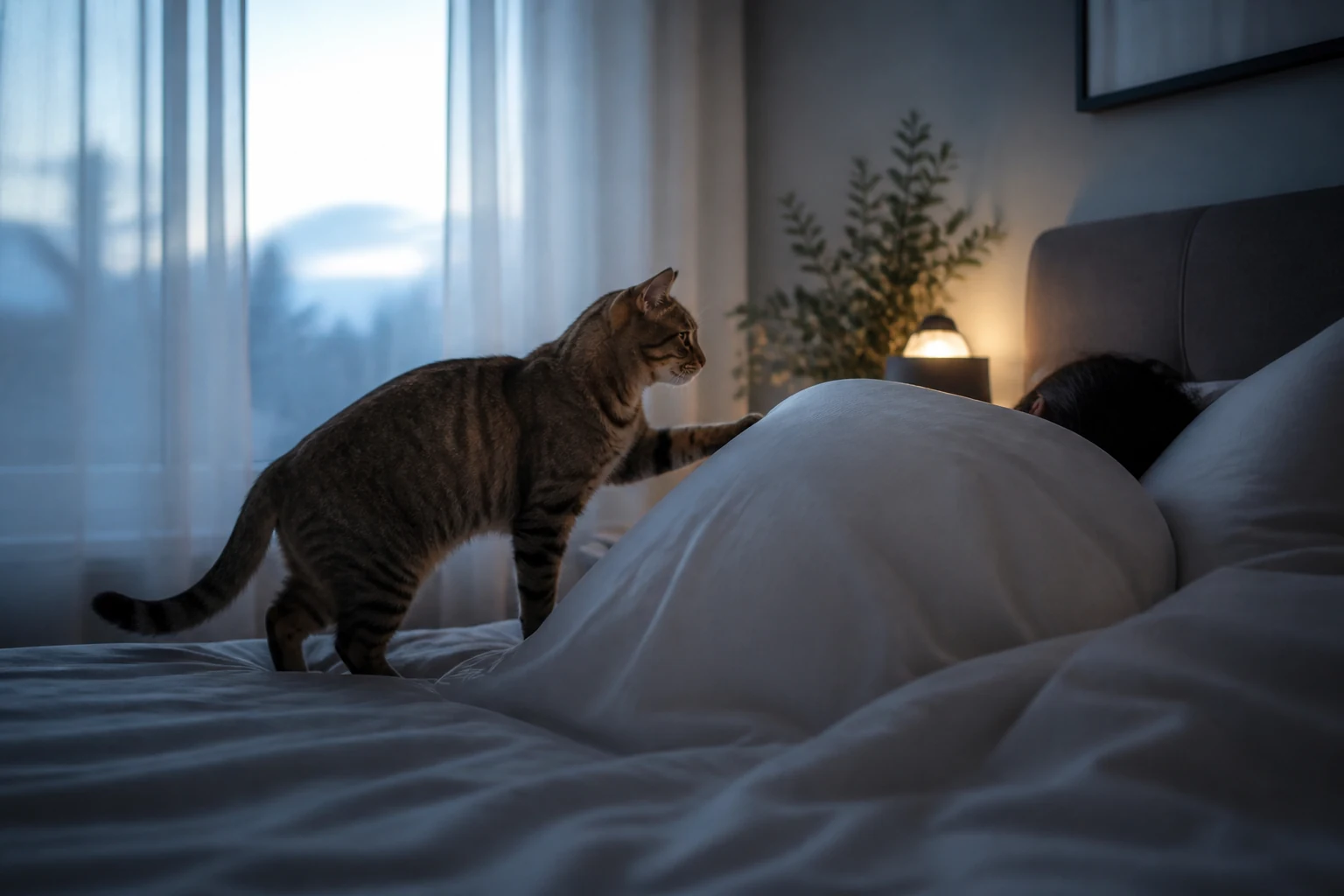
It is 5 AM. You are not awake yet, but a paw on your face is negotiating breakfast. You get up, fill the bowl, and finally get some quiet. Tomorrow, the negotiation may start again.
Why your cat wakes early is only half of it. Also look at what happens immediately after they wake you. Dawn activity, hunger, and a learned routine can overlap. Here is how to separate those clues without ignoring a sudden change in appetite, vocalization, or behavior.

Quick answer: Cats are often most alert around dawn and dusk. Early waking can become a learned routine when food, play, or attention follows it. A consistent evening routine and a carefully scheduled feeder can help, but sudden vocalization or behavior changes deserve a veterinary check first.
The early-morning routine can look personal: a meow beside the bed, a paw on your face, a hallway sprint, or a suspiciously accurate bowl inspection. Usually, your cat is not trying to ruin your sleep. They are responding to biology, routine, hunger, boredom, attention history, or occasionally a problem worth discussing with a veterinarian.

What your cat may be expecting at 5 AM
Dawn is naturally active
Cats are generally crepuscular, meaning many are more alert around dawn and dusk. A cat that has slept much of the day can be ready to explore at 5 AM.
Waking you has worked before
If meowing once led to breakfast, a treat, conversation, or even a response at all, your cat learned that the method works.
The first meal is tied to you
Food can be a real trigger after a long overnight gap. The goal is a predictable plan, not an extra unmeasured meal.
Daytime naps leave energy
Many cats rest while people are busy, then become more active after the household settles for the night.
Your cat wants access or play
A closed door, a favorite morning interaction, or a quiet house can be just as motivating as a food bowl.
Your routine is a cue
Alarms, lights, coffee machines, birds outside, and an early-rising partner can all become reliable signals.
The change is new
Sudden loud vocalization, restlessness, appetite or weight changes, or altered sleep in an older cat needs a veterinary conversation.
Make the last hour of the day more satisfying.
A short interactive play session before bed, followed by a planned meal when appropriate, can give a cat a better outlet than a pre-dawn hallway sprint. Daytime enrichment matters too.
Watch what your cat does when you get up. Bowl? Door? Toy? Or simply follows you? That small observation tells you which routine to change first.

First, confirm whether hunger is actually the trigger and make sure any change still fits your cat’s daily portion plan.
Spend a week looking for the cue, not arguing with the cat
| Day | One change | What to observe |
|---|---|---|
| 1 | Record the time, behavior, and where your cat goes when you wake. | Hunger, attention, door, or play clue. |
| 2 | Add a 10–15 minute interactive play session before bed. | Does the first wake-up shift later? |
| 3 | Give a measured final meal after play if it fits the daily plan. | Does food timing matter? |
| 4 | Remove accidental 5 AM rewards when your cat is safe and well. | A habit may get briefly louder before it fades. |
| 5 | Add daytime enrichment or a food puzzle. | Is boredom part of the pattern? |
| 6 | If hunger is clear, test a small scheduled feeder meal. | Keep the portion within the daily allowance. |
| 7 | Keep only the changes that improved sleep. | Build a consistent routine. |

Move breakfast away from your bedside—not into an unlimited refill.
An automatic feeder can change the association from wake the human → food appears to wait for the feeder → food appears.
- Your cat is healthy and heads to the food area consistently.
- You know the correct daily portion plan.
- You can schedule a measured meal before the wake-up begins.

The goal is a consistent plan—not an argument at 5 AM.
The most effective answer is usually not “ignore your cat forever” or “feed your cat whenever they demand it.” It is a repeatable routine: daytime stimulation, evening play, measured meals, predictable mornings, and veterinary advice when the behavior is sudden or unusual.
Sources
- VCA: Cat Behavior Problems—Nocturnal Activity
- VCA: Why Do Cats Meow?
- VCA: Automatic Feeders for Cats
- Cornell: Cognitive Dysfunction
Pet Tech Compass may earn a commission from qualifying purchases. This article is educational information, not veterinary diagnosis.
Is the early wake-up part of a noisy night?
An early alarm and repeated nighttime meowing are not quite the same question. If the noise continues through the night, read the nighttime guide alongside this one.