
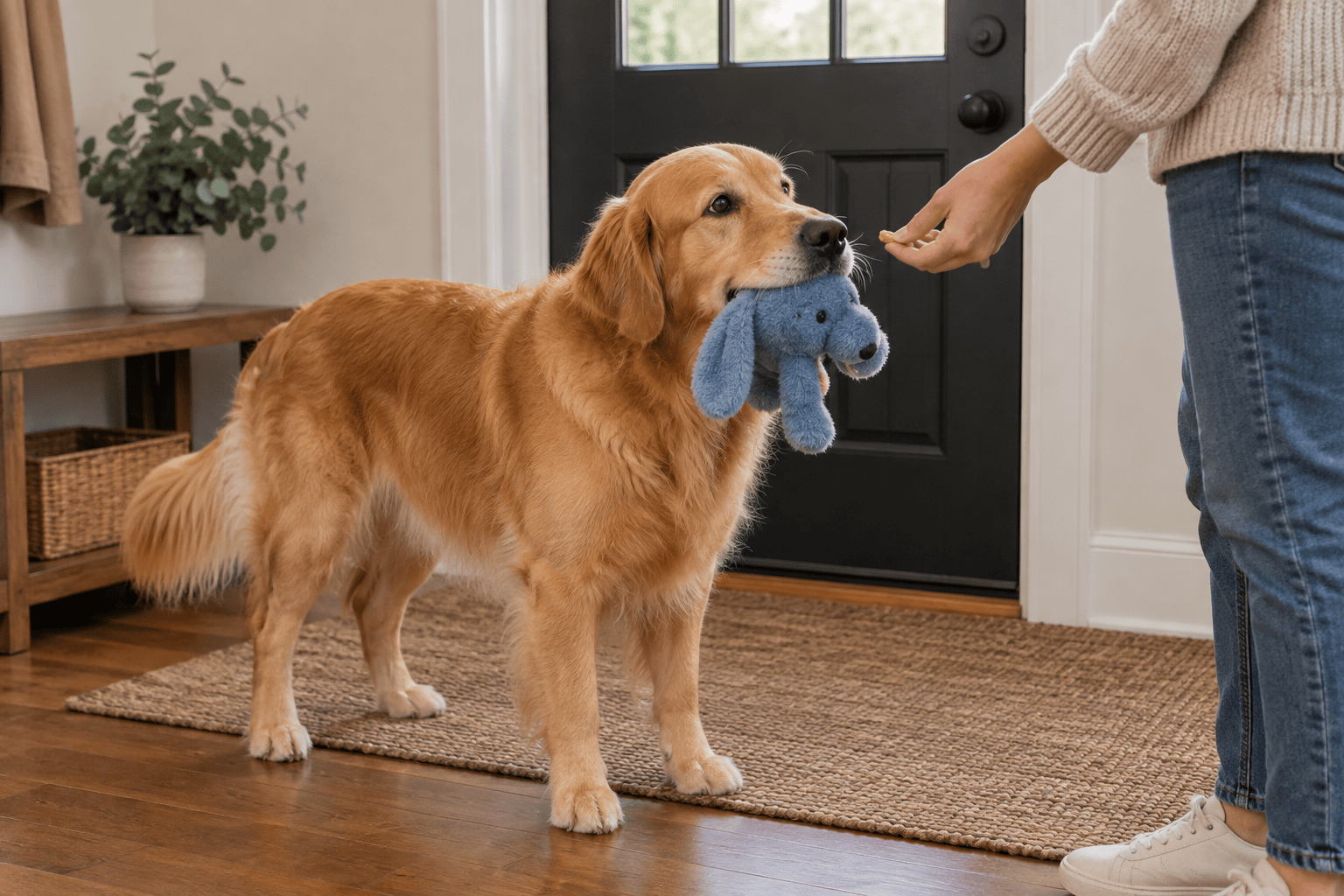
A golden retriever named Nash recently became the internet’s least convincing guard dog. Door-camera footage from a San Diego home appeared to show him greeting a person inside the house with toys instead of barking or backing away. The clip is funny because it overturns the job people expected him to do.
But there is a more useful question than “Was he being brave or clueless?” What can a dog carrying a toy during a strange encounter actually mean?
The short answer: a toy can be part of a greeting routine, an outlet for excitement, a learned way to get attention, or something a dog grabs when unsure what to do. A video cannot tell us which explanation was operating in one dog’s mind. It also cannot tell us whether another dog will behave the same way tomorrow.
Why the story went viral
Google Trends showed golden retriever dog rising in the United States Pets & Animals category after reports about the video appeared. The related term was simply toy, which captures the surprise: viewers expected an alarm and saw an apparent offering instead.
That contrast makes excellent social media. It does not make a behavioral diagnosis. We do not know what Nash smelled, heard, had previously learned, or did outside the visible clip. We can describe the scene reported by AP; we cannot translate it into a single motive.

The same caution matters at home. A wagging tail, a toy, or silence is one piece of a larger picture. Look at movement, muscle tension, distance, ears, mouth, weight shift, and whether the dog can disengage.
A 20-second body-language check
| What you see | More consistent with | What to do |
|---|---|---|
| Loose body, curved approach, soft face | Social interest or play | Keep the greeting calm and controlled |
| Fast pacing, jumping, frantic toy grabbing | High arousal or excitement | Add distance and use a trained station |
| Low posture, tucked tail, retreating | Uncertainty or fear | Stop the approach and give space |
| Still body, hard stare, weight forward | Possible conflict or threat | Do not reach in; use a barrier |
| Growling over the toy or blocking access | Possible resource guarding | Do not grab the item; get qualified help |

No single signal settles the question. The pattern and context matter more than the prop in the dog’s mouth.
Six behavior clues behind the toy
1. Carrying something may already be the dog’s hello
Some dogs regularly pick up a toy when family members arrive. If that routine has earned attention, conversation, or play, it can become the dog’s default response to any person entering. The object is not necessarily a gift. It may simply be the first step in a rehearsed greeting sequence.
Ask what happens on ordinary days. Does your dog rush to the same basket when you come home? Do guests laugh, pet the dog, or throw the toy? Repetition can make the behavior fast and automatic.

2. The toy may channel a burst of excitement
Arrivals are emotionally intense. VCA notes that greeting behavior can reflect social enthusiasm, play, anxiety, or conflict. Holding a toy gives the mouth a job while the body processes that energy.
This is not automatically calm behavior. A dog can be friendly and still be far too aroused to make good choices. Fast circling, crashing into people, frantic grabbing, or an inability to pause are reasons to lower the intensity.

3. Retrieving can be highly reinforcing
Golden retrievers were developed for retrieving, but a breed label is not a mind reader. Individual experience still determines whether a dog loves carrying soft objects, balls, shoes, or nothing at all.
The useful point is narrower: if carrying objects has repeatedly led to play or praise, the behavior has a strong reward history. That history can appear in a surprising context. It does not mean every golden retriever will greet every stranger with a toy.
4. The dog may be seeking attention, not judging intent
Dogs learn which actions make people respond. A toy presented at knee height often produces eye contact, speech, touch, or a game. A highly social dog may try the same strategy with a person the dog has never met. That does not show the dog approved of the person or understood why they were there.
5. Toy carrying can occur during uncertainty
Not every toy-carrying greeting is carefree. A dog who moves toward a person and then away, keeps the body low, pauses repeatedly, or avoids contact may be conflicted. Carrying or mouthing an object can coexist with uncertainty.
Do not force contact because the dog brought something. AKC and AVMA guidance on unfamiliar dogs emphasizes allowing the dog to choose whether to approach. A stranger should not reach over the dog’s head, corner the dog, or pull at the object.
6. The dog may simply lack a trained door job
When the door opens, many dogs improvise. One barks, another jumps, another bolts outside, and another searches for a toy. The cleanest solution is to teach a repeatable behavior before a real visitor creates pressure.
A mat, bed, gated area, or closed room gives the dog a clear place to be. It also gives the owner time to identify the visitor and control access.

What the viral clip does not prove
It does not prove that golden retrievers cannot guard a home. It does not prove that a quiet dog is safe to approach, that a barking dog is dangerous, or that the dog recognized an intruder as a friend.
Most importantly, it does not make the dog responsible for stopping a person. Dogs are companions, not locks, cameras, or emergency plans. Relying on an unpredictable animal response can endanger the dog, the visitor, and the household.
A safer four-layer door plan
Layer 1: Secure the entry
Use functioning locks, adequate lighting, and a door or camera system that lets a person check before opening. Keep doors and gates latched so a startled or excited dog cannot escape.

Layer 2: Create physical separation
Before opening the door, place the dog behind a closed interior door, gate, exercise pen, or other secure barrier. A barrier is management, not punishment.
Layer 3: Teach “go to your spot”
Practice when nobody is arriving. Toss a treat onto a mat, mark the moment the dog steps onto it, and reward a short stay. Gradually add distance, door sounds, and familiar helpers. If the dog cannot respond, reduce the distraction.

Layer 4: Make greetings optional
Not every visitor needs to meet the dog. If a greeting is appropriate, wait until the visitor is settled and the dog shows loose, voluntary interest. Keep the first interaction short.
Do not run a “guard dog test”
Do not ask a friend to sneak in, wear a disguise, threaten you, or provoke the dog. That experiment can frighten the dog, rehearse dangerous behavior, injure someone, and teach the wrong lesson.
If home security is the concern, improve the home security system. If greeting behavior is the concern, practice controlled setups with a qualified reward-based professional.
When to get professional help
Contact your veterinarian or a qualified behavior professional when a dog freezes, hard-stares, lunges, snaps, bites, guards toys, redirects onto a household member, or becomes harder to control around arrivals. Sudden behavior change also deserves a veterinary check because pain or illness can change tolerance.
Until help is in place, prevent rehearsals. Use distance and barriers. Do not punish growling; it is information that the dog is uncomfortable. Do not take a guarded toy by force.

Frequently asked questions
Is bringing a toy always friendly?
No. It often appears in social or playful greetings, but the rest of the body and the context decide whether the dog is loose, overexcited, uncertain, or guarding the item.
Are golden retrievers bad guard dogs?
A breed stereotype cannot predict an individual response. More importantly, a family pet should not be the household’s primary security system.
Should a visitor take the toy?
Only if the owner says it is safe and the dog is relaxed. If the dog stiffens, hovers, growls, or resists, the visitor should step away.
Can I reward my dog for holding a toy at the door?
Yes, if carrying the toy is part of a calm routine and the dog can still go to a station, release the item when asked, and disengage. Reward calm feet and distance from the doorway.
What should my dog do when someone enters?
Choose one simple job: go to a mat, enter a gated area, or settle in another room. Train it in easy sessions long before relying on it during a real arrival.
The useful lesson behind the funny video
The memorable part of the story is the toy. The practical lesson is that dogs respond from learning, emotion, and context, not from the job title people assign them. Enjoy the clip, but do not turn it into a personality test for an entire breed.
Give your dog a predictable door routine. Give unfamiliar people space. Leave home security to equipment and people who can make deliberate decisions.
This article provides general behavior and safety information. It cannot diagnose an individual dog from a video or replace advice from a veterinarian or credentialed behavior professional.
Leave a Reply