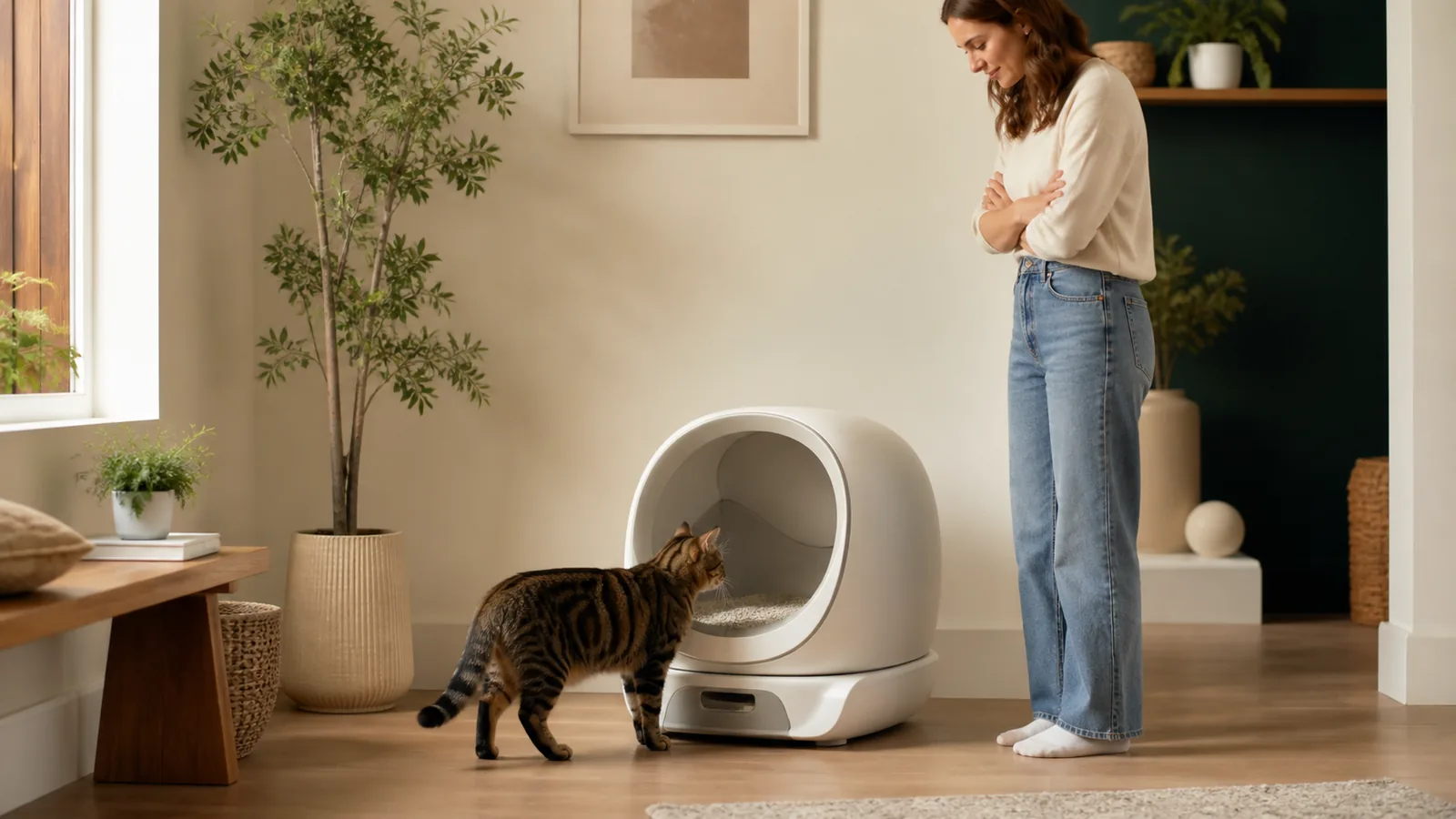
The right machine can remove daily scooping. The wrong one becomes an expensive box your cat avoids. Judge the purchase by cat fit, documented safety, real maintenance, and total cost—not by the word “automatic.”

A self-cleaning litter box is worth it when daily scooping is the main problem, your cat comfortably fits and accepts the design, and you can manage drawer emptying, deep cleaning, consumables, and troubleshooting. It is not a maintenance-free appliance.
Our verdict
Convenience is real—but narrower than the marketing
Most models detect that a cat has left, wait, then rake or rotate to move clumped waste into a drawer. That can remove a repetitive daily chore. It does not wash the litter bed, refill litter, clean sensors, remove stuck residue, or confirm that a cat is healthy.
60-second decision
Five questions before you compare models
Your cat has to fit—and choose it
Measure entry width and height, litter-bed space, step height, and turning room. Senior or mobility-limited cats may need a lower stable entry. A large cat can fit through an opening yet still lack room to dig and turn.

Safety is a complete system
Look for a current model-specific manual, more than one form of cat detection, cycle interruption, a delay after exit, a defined automatic-mode weight threshold, and documented behavior during a jam or sensor fault.
Whisker says kittens below 3 lb (1.3 kg) should not use Litter-Robot 4 in automatic mode. Neakasa specifies a different threshold and Kitten Mode for its M1 Lite Plus. Never transfer one model’s number to another.

It reduces scooping—not maintenance
WORK USUALLY REDUCED
- Scooping after individual visits
- Handling fresh clumps daily
- Waste sitting exposed in the bed
- Manual visit counting on capable models
WORK THAT REMAINS
- Checking completed cycles
- Emptying and washing the drawer
- Adding compatible litter
- Cleaning sensors and stuck residue
- Periodic disassembly and deep cleaning
- Maintaining a backup box

Calculate the full first-year cost
The machine price is only the first layer. Include every required or realistically recurring item.
| Official U.S. example | Price shown Aug. 18, 2026 | Context |
|---|---|---|
| PetSafe Crystal Pro Legacy | $199.99–$229.99 | Crystal-tray system |
| Neakasa M1 Lite Plus | $332.99 sale / $499.99 regular | Promotion may change |
| Whisker Litter-Robot 4 | $699 | Current official starting price |
| Whisker current range | $599–$899 | Several different models |
Dated market examples, not equivalent products, rankings, or hands-on recommendations. Confirm current price, return shipping, warranty, and included accessories.

Litter and placement rules can decide it
Some systems require crystal trays; others need fast-clumping granular litter and reject pellets or non-clumping products. Verify fill line, particle guidance, and clump time. Measure the machine with its drawer open and include required wall clearance.
Whisker documentation says a firm, level surface improves weight accuracy and carpet can reduce it. PetSafe’s original ScoopFree setup calls for a flat, dry indoor location and notes that humidity can shorten tray life.
Health data is a clue—not a diagnosis
Visit and weight trends may help reveal change, but shared boxes, similar cat weights, missed detection, dirty sensors, or network loss can affect records. Continue observing urine, stool, appetite, behavior, and the machine itself.
The return policy matters because the cat votes
Read the in-home trial, return window, restocking rules, return-shipping responsibility, warranty, and parts policy. Keep the packaging until transition succeeds. Place the new and familiar boxes near each other, leave the machine powered off initially, and never force the cat inside.
Save before shopping
Before-you-buy checklist
Continue the litter-box setup
Common follow-up questions
FAQ
Do self-cleaning litter boxes eliminate odor?
They can reduce how long waste remains exposed, but odor still depends on litter, drawer seal, emptying frequency, cleaning, humidity, diet, and accidents outside the box.
Can one automatic box serve multiple cats?
Some are marketed for multiple cats, but feline guidance still recommends multiple resources—commonly one box per cat plus one extra in different locations.
Do they work without Wi-Fi?
Some continue saved cleaning routines while app features stop; behavior differs. Check the exact manual.
Are they safe for kittens?
Only within the exact model’s instructions. Minimum detectable weight and kitten modes differ. Below the threshold, disable automatic cycling and use the manufacturer-approved supervised method.
How often do they need cleaning?
Drawer and deep-clean intervals vary with the machine, cats, diet, litter, and environment. Inspect frequently and follow the manual. Self-cleaning never means maintenance-free.
Official sources reviewed
Whisker Litter-Robot 4 manual · PetSafe acclimation guide · PetSafe ScoopFree setup · Neakasa M1 Lite Plus official page · FelineVMA litter-box guidance
Affiliate disclosure: Pet Tech Compass may earn a commission if affiliate links are added later. Editorial conclusions are based on cat fit, documented operation, maintenance, and ownership cost.