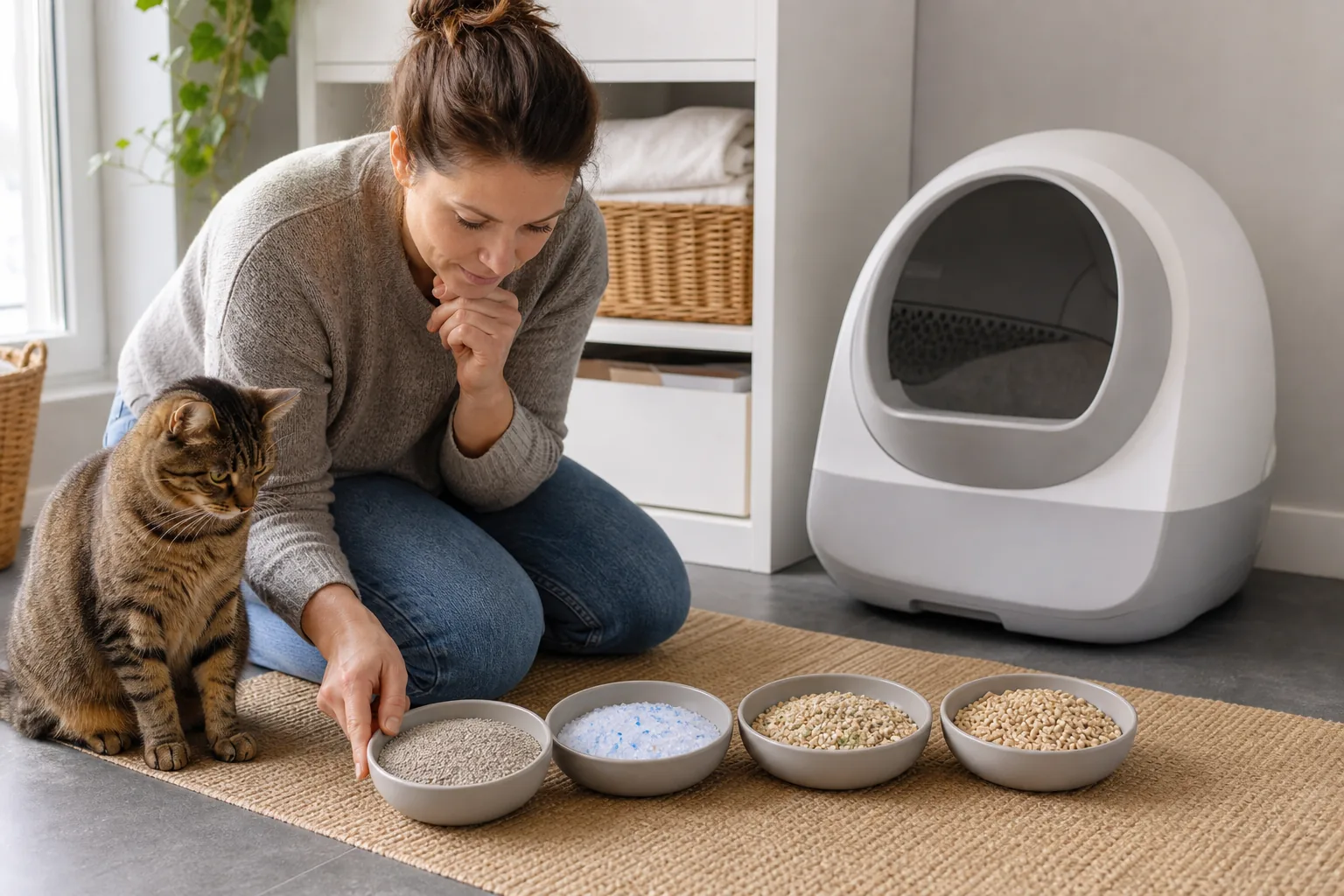
Sometimes—but “regular litter” is not a compatibility standard. A rotating sifter, rake tray, and sensor-heavy smart box can require completely different litter.

Check six things before buying a large bag
- Firm clumps?
- Particles within the screen limit?
- Approved material?
- Suitable weight and flow?
- No sensor-visibility conflict?
- Enough time to dry before cycling?
Compatibility is a system
A litter can work beautifully in an ordinary pan and fail inside an automatic separator.

What the machine actually needs
Clumping behavior
The clump must survive movement. Weak clumps can break apart, return damp fragments to the clean bed, or smear the liner.
- Use only litter formats allowed by the manual.
- Test one clump after the normal cycle delay.
- Inspect the clean bed, screen, and drawer.
Particle dimensions
Long pellets may be discarded as waste even when clean. PETKIT’s PURA MAX manual, for example, specifies litter shorter than 1.2 cm and under 3 mm in diameter.
- Measure the format—not only the material name.
- Distinguish long tofu pellets from crushed tofu.
Weight and flow
Unusually light litter may sift unpredictably or affect weight-dependent features. Never compensate by overfilling.
- Follow the fill line.
- Use the stated standard or supported weight.
- Recalibrate only as instructed.
Sensor visibility
Color and translucency can matter. Whisker warns that translucent or white crystal litter may affect level and drawer readings in certain models.
- Watch readings after a litter change.
- Keep optical areas clean.
- Return to an approved litter if readings become implausible.
Dust, residue, and moisture
Low dust does not guarantee firm clumps. Watch for paste-like residue, damp fragments, condensation, sensor dust, and clean grains in the waste bag.
Required litter format
Some PetSafe legacy tray systems use crystals, while its clumping models have different requirements. Confirm the full model name, generation, tray, screen, fill level, and delay.

Use this table before opening the bag
This is a screening guide, not permission to override the manual for your exact machine.
| Litter format | General fit | Main risk | Verify first |
|---|---|---|---|
| Standard-weight clumping clay | Often supported | Dust, tracking, liner sticking | Manual approval, fill line, cycle delay |
| Crystal litter | Model-specific | Sensor visibility or non-clumping behavior | Exact crystal format and model |
| Fine or crushed tofu | Conditional | Soft clumps or oversized pieces | Maximum diameter and length |
| Long tofu pellets | Often unsuitable | Jams or clean-litter waste | Screen dimensions and explicit approval |
| Wood or pine pellets | Often unsuitable | Sawdust and poor clump separation | Machine designed specifically for pellets |
| Paper litter | Often unsuitable | Non-clumping or oversized pieces | Explicit manual approval |
| Corn or plant-based clumping litter | Model-specific | Light flow, moisture, weak clumps | Weight, clump strength, cleaning frequency |
Run three supervised cycles
Dry flow
Fill only to the line. Confirm clean litter settles correctly and is not dumped.
Clump release
After the approved delay, confirm the clump leaves intact without smearing.
Sensor reset
Confirm normal status, plausible readings, and actual delivery into the drawer.
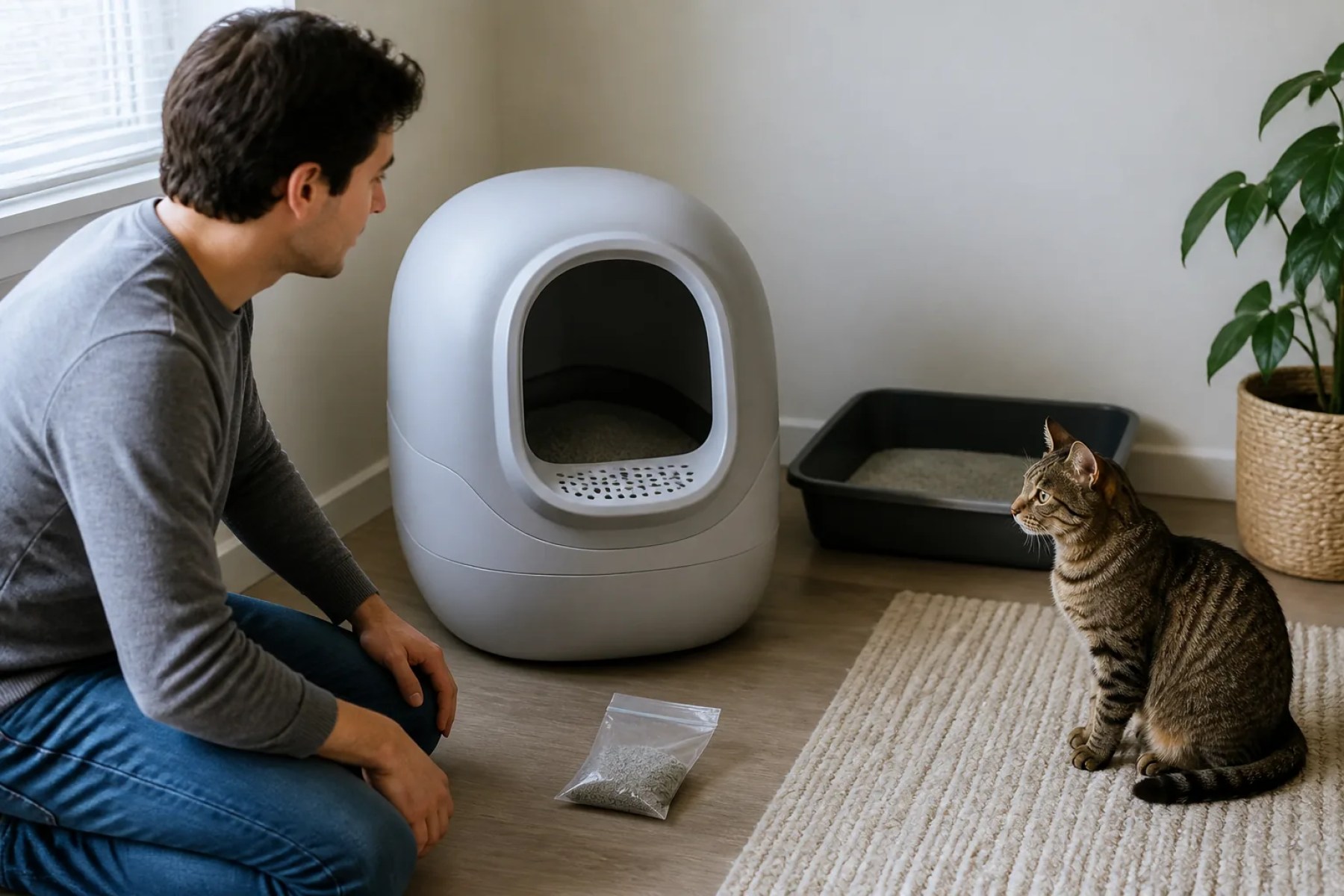
Signs the litter is not working
- Clean litter fills the drawer
- Cycles jam or stop
- Wet clumps stick or smear
- Level alerts become implausible
- Dust builds near sensors
- Your cat starts avoiding the box

Change litter without forcing the cat
- Keep a familiar ordinary box nearby.
- Choose an unscented approved option when possible.
- Mix only when both the machine and litter guidance allow it.
- Increase the new litter gradually over several days.
- Keep initial automatic cycles off or supervised when directed.
- Restore the familiar setup if the cat avoids the box.
“Regular” works only when the exact litter matches the exact machine
The broadly compatible starting point for many rotating sifters is standard-weight, fast-clumping litter with particles that pass the screen. But crystal trays, alternative-litter machines, and sensor-heavy models can require something different.
Buy a small bag, verify the current manual, run three supervised cycles, and judge what reaches the waste drawer.
Related guides
Common compatibility questions
Does every self-cleaning litter box need clumping litter?
No. Many rotating sifters require clumping litter, while some rake-and-tray systems are designed for crystals. Follow the exact model’s current manual.
Can tofu litter go in an automatic litter box?
Only in models that allow its particle dimensions and clumping behavior. Long tofu pellets are often too large for fine screens; crushed versions may work in selected models.
Why is my automatic box dumping clean litter?
Possible causes include overfilling, particles that cannot pass the screen, unsuitable litter weight, or the wrong operating cycle. Stop and use the model’s troubleshooting guide.
Can I mix clay and plant-based litter?
Only if the machine manufacturer allows both and the mixture stays within its size, weight, and clumping requirements.
Should I change the cleaning delay after switching litter?
Possibly, but use only delay options and recommendations provided for your model. Observe the first cycles while you are home.
Sources and review notes
- Whisker: Litter-Robot 4 FAQ
- Whisker: Does Litter-Robot require special litter?
- PETKIT: PURA MAX User Manual
- PetSafe: ScoopFree model and litter-format support
- Neakasa: Cat Litter Box FAQ
Research note: Compatibility can change by generation, screen, firmware, region, and product revision. Reviewed against official manufacturer material available August 18, 2026. Follow the manual for the exact machine.
Affiliate disclosure: Pet Tech Compass may earn a commission from qualifying purchases. Editorial conclusions are based on documented compatibility and practical ownership requirements, not commission rates.