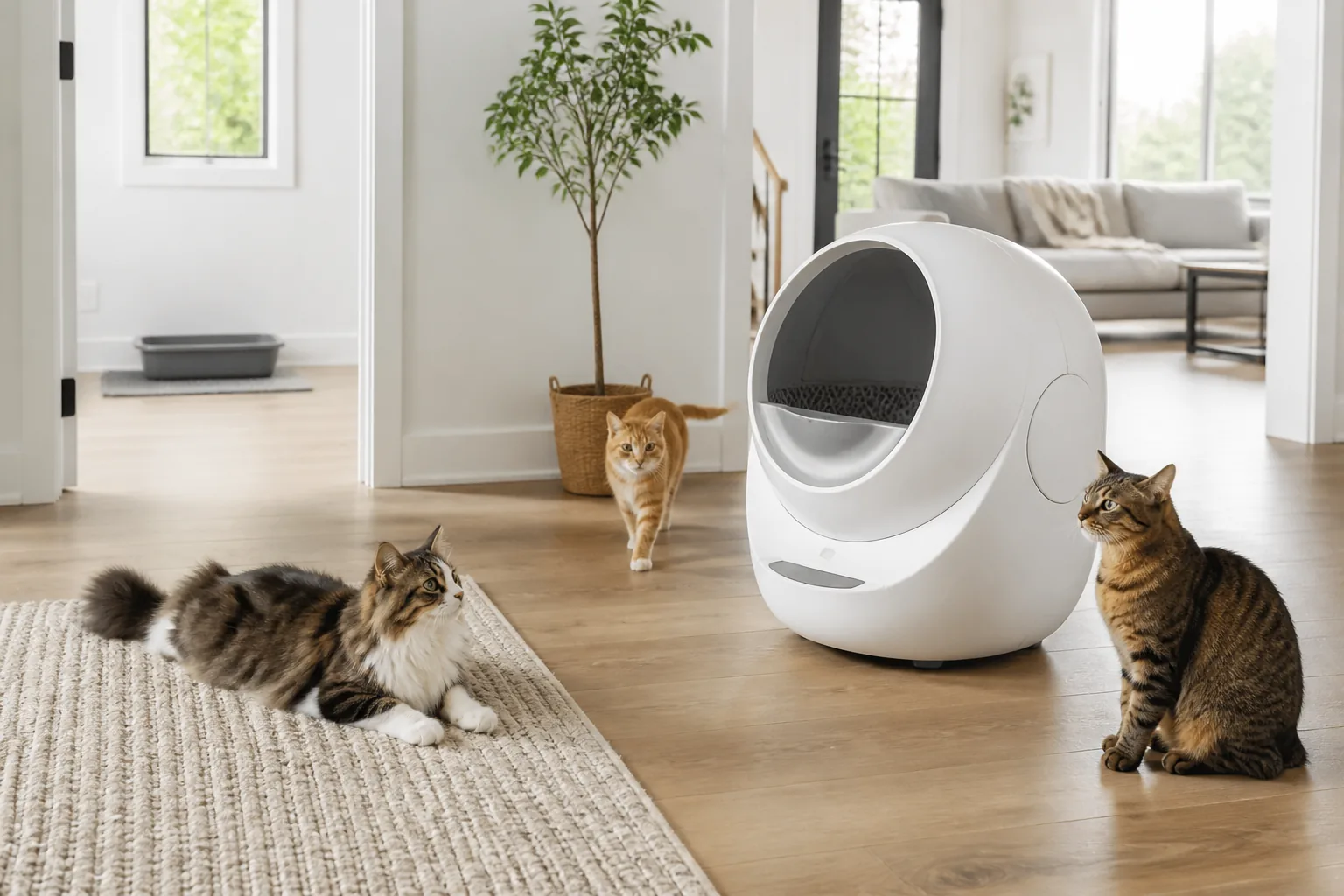
A machine’s advertised cat capacity describes hardware. It does not prove that every cat can approach, use, and leave the same toilet comfortably.

A machine can pass one test and fail the other two
Mechanical
Can the motor, litter bed, and drawer process the household’s waste volume?
Physical
Can the largest, oldest, and least mobile cat enter, turn, posture, and exit?
Social
Can every cat approach and leave without another cat controlling the route?

Test the cats, traffic, and maintenance—not only the motor
Count social groups
Cats that groom, rest, and play together may share more readily. Watch for quiet staring, following, doorway waiting, and use only at quiet times.
Map approach and escape
A closet, corner, or dead-end hall creates a route another cat can control. Distribute boxes in genuinely different locations.
Measure recovery
Observe peak periods. Record cycle completion, repeated entries that reset the timer, pauses, faults, and overlapping visits.
Track waste and litter speed
Log drawer fill, liners, top-ups, odor, sensor alerts, and clean litter waste for seven days. Set service by observation.
Check the smallest and largest cat
Every cat must meet the exact automatic-mode threshold and fit the usable entrance and interior comfortably.
Test individual monitoring honestly
Similar weights, floor surface, camera view, subscriptions, and offline behavior can affect identity data. Monitoring is not diagnosis.
Prove the backup plan
Keep an ordinary box elsewhere, compatible litter, manual cleaning instructions, travel checks, fault procedures, and veterinary contact information.

Run a 7-day sharing trial
Stationary introduction
Maintain all familiar boxes. Record investigation and avoidance; keep power off when the manual recommends it.
Supervised cycles
Confirm thresholds and observe whether movement or sound changes another cat’s willingness to approach.
Traffic audit
Track visits, overlap, drawer fill, litter use, guarding, faults, and outside-box elimination.

When sharing may work—and when to add boxes
| Question | One unit may be workable | Add or retain boxes |
|---|---|---|
| Social relationship | Affiliated cats; no guarding | Separate groups, staring, blocking, chasing |
| Access | Open approach and escape | Closet, dead end, narrow doorway |
| Traffic | Rare overlap; reliable reset | Queues or interrupted cycles |
| Physical fit | Every cat moves comfortably | Large, arthritic, timid, or mobility-limited cat struggles |
| Safety | All cats meet requirements | Any cat falls below automatic threshold |
| Maintenance | Serviced before urgent alerts | Fast fill, odor, low litter, repeated faults |
| Backup | Ordinary box available elsewhere | The machine would be the only toilet |
Warning signs that sharing is failing
- Waiting while another cat sits nearby
- Ambushing at the entrance or exit
- Elimination beside the machine
- Sudden use of tubs, laundry, or soft surfaces
- Frequent visits with little output
- One cat disappears from usage history
- Drawer fills far faster than expected
- Refusal after a noisy or interrupted cycle

Do not rank products by cat count alone
- Fit the largest cat
- Detect the smallest cat
- Size the drawer for real output
- Return the bed to service reliably
- Disassemble and clean quickly
- Work safely offline with clear alerts
- Identify individuals only when useful
- Keep parts and consumables available
Advertised cat count is an upper hardware claim—not a household prescription
Multiple cats may share one automatic box mechanically and willingly. But one unit should not erase distributed, accessible toilet resources.
Keep backup boxes, watch social behavior, measure real recovery and drawer rates, and let the least confident cat determine whether the setup works.
Related guides
Multi-cat sharing questions
Is one self-cleaning litter box enough for two cats?
It may process the waste, but that does not guarantee comfortable access. Keep another box elsewhere and observe traffic, guarding, fit, and drawer capacity.
Can four cats use one automatic litter box?
Some products advertise capacity for up to four cats. Treat it as a hardware claim; four cats create faster fill, overlapping visits, and greater risk that one location becomes unavailable.
Will an automatic litter box identify each cat?
Some estimate identity by weight; selected camera models offer visual recognition. Accuracy varies with weights, placement, lighting, subscriptions, and features.
How often should the drawer be emptied with multiple cats?
Use observed fill rate and the exact manual. Check daily during the first week and schedule service before the drawer becomes full.
Should I remove the old boxes after the cats use the robot?
No immediate removal is recommended. Keep familiar boxes during transition and retain distributed backup resources.
Sources and research notes
- FelineVMA: Feline House-Soiling
- Whisker: Litter-Robot 4 multi-cat information
- Whisker: Litter-Robot 4 Manual
- Neakasa M1 specifications
- PETKIT Purobot Ultra recognition information
Research note: Capacity, recognition, subscriptions, thresholds, and app history vary by model and region. Reviewed August 18, 2026. Follow the exact current manual.
Affiliate disclosure: Pet Tech Compass may earn from qualifying purchases. Advertised capacity does not replace independent evaluation of fit, access, behavior, maintenance, and backup resources.