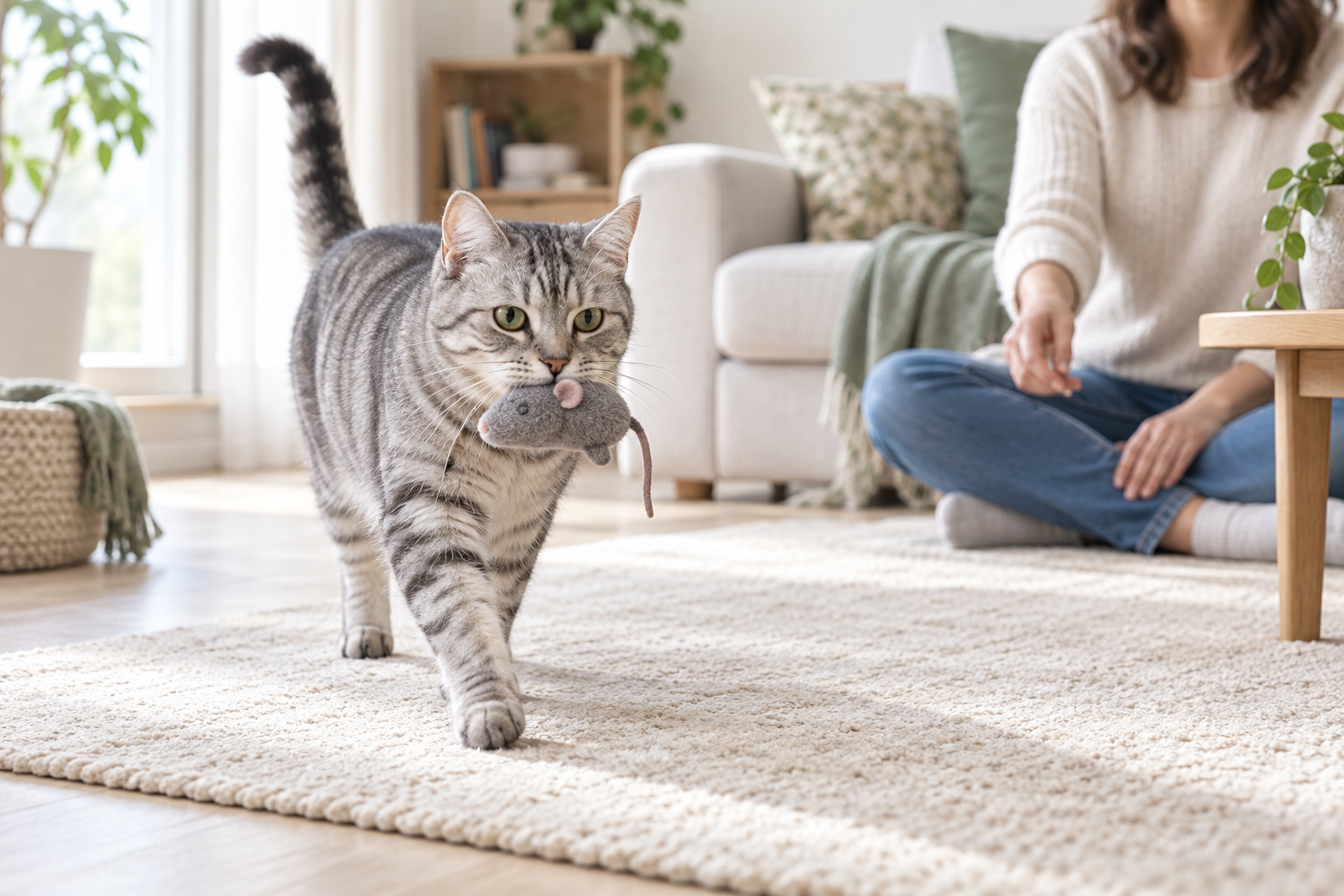
Your cat walks into the room with a stuffed mouse in its mouth, drops it near your feet, and looks up as if you missed an important part of the conversation.
It is tempting to translate the moment as a gift, a hunting lesson, or proof that your cat thinks you are helpless. Those explanations make good social posts, but one toy delivery cannot tell you exactly what a cat is thinking. Timing, body language, vocalizing, and what happens after the drop are more useful clues.
Quick answer
Cats may bring toys because carrying is part of hunting-style play, because they want the game to continue, because the behavior reliably gets attention, or because your room is a preferred place to store or explore an interesting object. Some cats also build a repeated carrying-and-meowing routine around one favorite toy.
If the cat looks relaxed, plays normally, eats and uses the litter box as usual, and can settle afterward, the behavior is usually an enrichment question rather than an emergency. Call a veterinarian when carrying or vocalizing is suddenly new, hard to interrupt, paired with confusion, pain, appetite or litter-box changes, or involves unsafe objects.

First, watch what happens after the drop
| What your cat does next | What it may suggest | Best response |
|---|---|---|
| Crouches, watches, or bats the toy when you move it | The hunt-style game may not be finished | Offer a short interactive play session |
| Meows, follows you, or repeats the delivery | Your response may be part of the routine | Give planned attention without making every loud delivery the only route to play |
| Leaves the toy and settles nearby | The destination may simply feel safe or familiar | Let the cat rest; return the toy later if needed |
| Carries one soft toy at a predictable time | A learned comfort or activity routine may be involved | Keep the routine safe and provide variety |
| Brings string, elastic, foam, or a damaged toy | The object creates an ingestion or entanglement risk | Remove it calmly and replace it with a safer option |
| Suddenly carries, cries, paces, or seems disoriented | This is a behavior change, not just a cute ritual | Record the pattern and contact a veterinarian |

1. Carrying completes part of the play sequence
Cats are built to notice movement, stalk, chase, pounce, capture, and manipulate. VCA notes that many cats enjoy toys they can hunt and carry, including small stuffed toys and balls. Bringing the captured object into your room may simply be another step in that sequence.
Look for a loose body, forward interest, quick bursts of movement, and an immediate reaction when the toy moves again. Instead of throwing it endlessly, use a short wand-toy session that allows stalking, chasing, and a final catch. Put string-style toys away when the session ends.

2. Your cat may be inviting you to continue
The strongest clue is not where the toy lands. It is what the cat does when you respond.
If your cat backs up, crouches, chirps, watches your hand, or runs after the toy when you move it, the delivery may function as an invitation. A few minutes of predictable play can be more satisfying than absent-mindedly tossing the toy while doing something else.
Use toys to keep claws and teeth away from hands. Do not turn fingers, ankles, or bedding-covered feet into prey.

3. The delivery has learned to earn attention
Cats notice reliable outcomes. If carrying a toy leads to your voice, eye contact, play, food, or getting out of bed, the sequence can become an effective attention routine.
That does not make the cat manipulative. It means the behavior works. If midnight deliveries are becoming disruptive, schedule interactive play earlier in the evening and respond most enthusiastically during planned play. Avoid punishment or chasing; both can add excitement or fear without teaching a safer alternative.

4. Your room may be the safest place to keep it
Cats Protection cautions against assuming every carried object is a present. Cats may move prey-like or interesting objects into a secure core area where they can inspect them without competition.
An indoor cat can make a similar choice with a toy. The bedroom, hallway, or spot beside your chair may be quiet, familiar, and easy to monitor. In a multi-pet home, note whether another animal steals toys or interrupts play. Separate play areas may reduce competition.

5. One toy has become part of a routine
Some cats repeatedly choose one soft toy, carry it at roughly the same time, and vocalize during the trip. The routine may combine play, arousal, attention, and familiarity. It does not prove the cat believes the toy is a kitten or prey.
If the behavior is calm and stable, you do not need to stop it. Inspect the toy for loose seams, stuffing, bells, feathers, or pieces that could be swallowed. Rotate a few safe toys rather than leaving a large pile out all the time; novelty can help maintain interest.

6. The object itself is unusually interesting
A toy may be easy to grip, carry a familiar scent, make an appealing sound, or move like prey. Some cats also collect socks, hair ties, foam pieces, or other household objects. That turns a harmless-looking ritual into a safety issue.
Remove small ingestible objects, thread, yarn, ribbon, elastic bands, and damaged toys. Choose replacements that are too large to swallow, do not break apart easily, and are appropriate for your cat’s play style. Supervise new or motorized toys until you know how the cat uses them.

What to do tonight
- Note the time, toy, location, vocalizing, and body language.
- Offer five to ten minutes of interactive play if the cat appears to invite it.
- Let the cat catch the toy at the end instead of creating an unwinnable chase.
- Put away string, ribbon, and wand toys after play.
- Inspect carried objects for loose or swallowable pieces.
- Track a new or escalating pattern rather than trying to decode one isolated delivery.

When the pattern deserves a veterinary call
Toy carrying by itself is not a diagnosis. Contact a veterinarian when it is a sudden change or appears with persistent yowling, confusion, restlessness, pain, weakness, appetite change, vomiting, altered sleep, or litter-box changes. A senior cat with new nighttime carrying and vocalization deserves a lower threshold for assessment.
If you suspect your cat swallowed string, ribbon, elastic, foam, stuffing, or part of a toy, contact a veterinarian promptly. Do not pull visible string from the mouth or anus.
The bottom line
A carried toy may be part of a hunt-style game, an invitation, a successful attention routine, or simply an interesting object moved to a preferred place. Watch the entire sequence before assigning a human story to it. Reward safe play, remove risky objects, and treat sudden or concerning changes as a reason to ask a veterinarian.
This article provides general education and cannot diagnose a behavioral or medical condition.
Leave a Reply