
Your cat has the whole bed, a quiet chair, and at least one expensive cat bed. Still, sometime after the lights go out, they climb onto you and settle as if you were the only available mattress.
The short answer is that you are warm, familiar, and usually safe. But the exact spot your cat chooses can add useful context. A cat tucked against your legs may be avoiding movement. One on your pillow may be choosing warmth and scent. A cat that suddenly starts sleeping on you every night, however, deserves a little more attention than a lifelong cuddler.
Quick answer

Jump to a section
The 30-second sleep check
| What you notice | Likely context | First response |
|---|---|---|
| Loose body, steady breathing, normal routine | Comfortable social sleep | Let the cat stay if everyone is comfortable |
| Pillow or head | Warmth, scent, and less nighttime movement | Offer a warm bed beside the pillow if needed |
| Chest or lap | Heat, closeness, and easy access to attention | Check that the cat can leave freely |
| Legs or feet | Contact with a quick exit and less disturbance | Move slowly before turning over |
| Suddenly much clingier or sleeping more | Stress, discomfort, or another change may be involved | Compare appetite, movement, grooming, and litter-box use |
| New nighttime waking in an older cat | A medical or age-related change is possible | Record the pattern and call your veterinarian |
1. You are warm
Cats are skilled at finding the warmest square foot in a room. Sun patches, radiators, laptops, fresh laundry, and human bodies all qualify. Cats Protection lists warmth as a leading reason cats choose to sleep on people.
This explanation becomes especially likely when your cat arrives after the room cools, burrows against a blanket, or leaves once the sun reaches another spot. Warmth does not make the moment less affectionate. It simply means your cat has found a place that meets two needs at once.

2. They trust you enough to sleep close
Sleep leaves an animal less ready to react. Choosing contact with you suggests that your presence is familiar rather than threatening. Bonded cats also sleep touching one another, so sharing body contact can fit normal social behavior.
That does not mean every cat will sleep on a person. A cat that sleeps at the foot of the bed, on a nearby chair, or in the doorway may feel just as secure while preferring more space.

3. Your scent is familiar
Your clothes, bedding, hair, and skin carry a scent your cat encounters every day. A familiar smell can make a resting place predictable. This helps explain why some cats choose a recently vacated pillow or settle on a sweatshirt even when the person is not in the room.
If you want your cat to use a separate bed, scent can work in your favor. Put a familiar blanket in the new bed rather than introducing a spotless cushion in an unfamiliar corner.

4. Your bed is already an excellent cat bed
The choice may be less about your body than the location around it. Human beds are soft, warm, elevated, and surrounded by familiar household smells. Many also provide a view of the room and a quick route underneath the bed.
Before buying another bed, copy those features. Try a stable raised surface, a quiet location, a washable soft layer, and more than one option. Cats often rotate sleeping places instead of committing to a single bed.
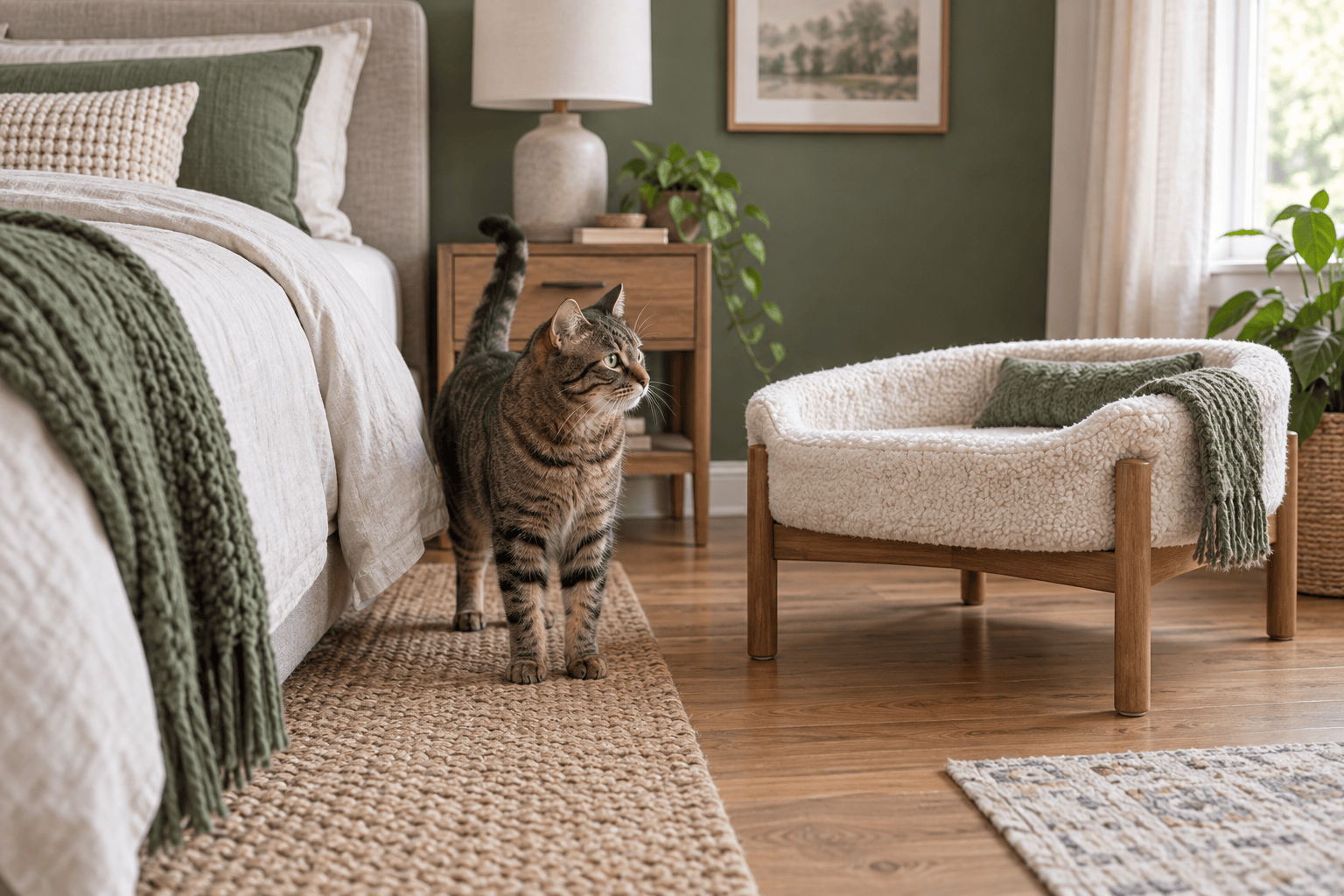
5. That body part moves less
The cat on your head may have made a practical choice: your head usually moves less than your arms and legs under the covers. The pillow is also exposed, cushioned, warm, and strongly scented. A cat near your feet may be choosing easier escape access, while one between your knees may be using the shape as a sheltered pocket.
Treat these as context clues, not a dictionary. Sleeping on your chest does not prove one emotion, and sleeping at your feet does not mean a weaker bond.
6. It has become part of the nightly routine
Cats learn sequences. If getting into bed leads to warmth, quiet petting, and several uninterrupted hours beside you, returning makes sense. Your own routine can become the signal: lights off, phone down, blanket lifted, cat arrives.
The habit may also be reinforced when you pet the cat each time they climb onto you. That is fine if you enjoy it. If you do not, make another sleeping place rewarding before the cat settles on you.
What the sleeping spot may suggest
On your head or pillow
This spot is warm, exposed, cushioned, relatively still, and full of familiar scent. It can be inconvenient for people with allergies or light sleep.
On your chest
Your chest provides warmth and close contact. Some cats may also find the rhythm of breathing and a heartbeat settling. Make sure the cat is not restricting your breathing and can move away freely.
On your lap
A lap combines warmth with easy access to petting. If the cat wakes when you shift, give a small warning movement rather than lifting abruptly.
On your legs or feet
This gives a cat contact without placing them at the center of your movement. It may also provide a quick route off the bed.
Beside you, not on you
This still counts as social sleep. Some cats prefer proximity without pressure, heat, or unexpected movement.

Is it safe to let a cat sleep with you?
For many healthy adults, sharing the bed is a comfort decision. It may be a poor fit if close contact worsens allergies, if either of you loses sleep, or if the cat becomes startled when a person moves.
Cats Protection recommends keeping cats out of babies’ and young children’s bedrooms. People who are immunocompromised, pregnant, managing a health condition, or unsure about parasites and zoonotic risk should ask their physician and veterinarian for advice specific to their household.
Never trap a cat under blankets or hold them in place. Give them a clear exit and a separate sleeping option.

How to help your cat sleep somewhere else
You do not need to punish, spray, or startle the cat.
- Put a warm, stable bed close to the place they already choose.
- Add a blanket that smells familiar.
- Reward the cat for entering or resting there.
- Offer several sleep locations, including one that is elevated and one that is private.
- Keep your response calm and consistent when redirecting.
- Add evening play and a predictable bedtime routine if nighttime activity is the bigger problem.
Closing the bedroom door may work, but a sudden change can produce scratching or calling at first. Set up the alternative before changing access, and do not open the door in response to repeated scratching if the cat’s needs have been met.

When a change matters
A cat choosing you for one cold night is not automatically concerning. The useful question is whether the pattern changed along with anything else.
Call your veterinarian when new clinginess or altered sleep comes with reduced appetite, weight change, vomiting, diarrhea, changes in thirst or urination, difficulty jumping, stiffness, hiding, poor grooming, unusual vocalization, breathing changes, confusion, or litter-box changes.
Older cats can develop altered sleep-wake cycles for several reasons. Cornell Feline Health Center notes that cognitive dysfunction can include disorientation, changes in interaction, altered sleep, house-soiling, and changes in activity. Those signs also overlap with other medical conditions, so they need veterinary assessment rather than an at-home diagnosis.

The practical answer
Your cat probably sleeps on you because you are a warm, familiar, comfortable part of a safe routine. Enjoy the contact if it works for both of you. Offer an equally attractive alternative if it does not.
Most importantly, judge the behavior against your cat’s own baseline. A lifelong pillow sleeper is different from a normally independent cat that becomes inseparable overnight. The change, not the cuddle itself, is what may matter.
FAQs
Does my cat sleep on me because they love me?
Trust and social closeness may be part of it, but warmth, scent, comfort, and routine can contribute at the same time. One sleeping position cannot prove a single emotion.
Why does my cat sleep on my head?
Your head and pillow are warm, exposed, strongly scented, and often move less than the rest of your body under a blanket.
Why does my cat suddenly sleep on me?
A colder room, a household change, stress, or a new preference may explain it. If the change persists or arrives with physical or behavioral symptoms, contact your veterinarian.
Should I move my cat if they sleep on my chest?
Move them gently if your breathing, sleep, pain, or comfort is affected. Provide a warm alternative beside you and reward the cat for using it.
Why does my cat sleep beside me but not on me?
Many cats prefer closeness without direct pressure or extra heat. Sleeping nearby can still reflect familiarity and comfort.
Sources reviewed
- Cats Protection: Why does my cat sleep on me?
- PetMD: Why Does My Cat Sleep on My Head?
- PetMD: Why Do Cats Lie on Your Chest?
- PetMD: Why Do Cats Sleep So Much?
- Cornell Feline Health Center: Cognitive Dysfunction
Medical note: This article provides general education and cannot diagnose a cat. Contact your veterinarian about a sudden or concerning change.
Leave a Reply