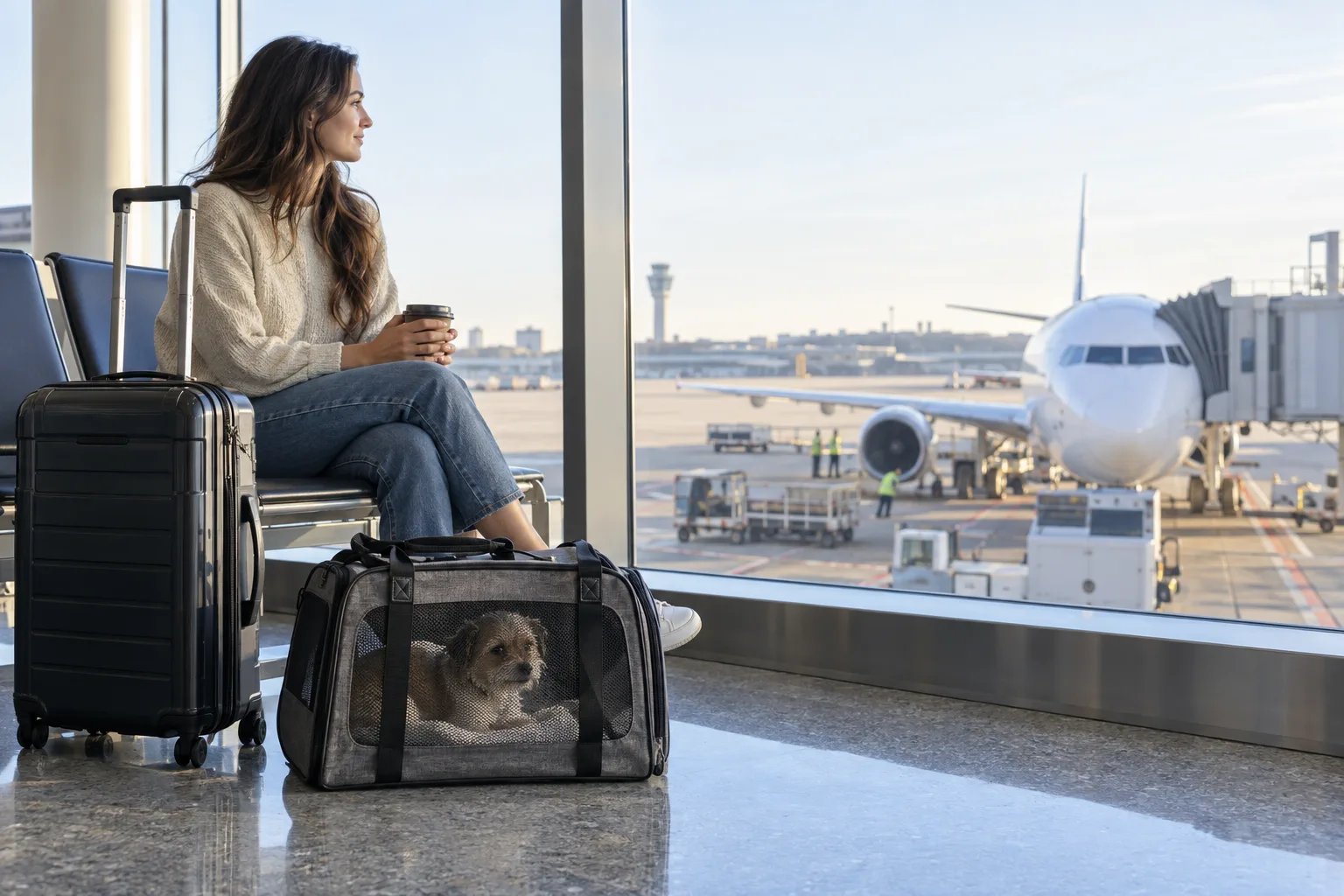
The short answer is often yes, but not always in the way travelers expect.
On many airlines, a dog traveling in the cabin must stay inside a carrier under the seat, and that carrier may count as your carry-on item or personal item. Other airlines charge a separate pet fee but still limit what else you can bring into the cabin. There is no single rule that applies to every airline, aircraft, route, or fare.
That means the safest time to solve the luggage question is before you buy the ticket, not while you are standing at the gate with a suitcase, a carrier, and no room to rearrange either one.
Quick answer
Assume your dog’s carrier will use one of your cabin-bag allowances until your airline confirms otherwise in writing. Then check the pet reservation, carrier dimensions, seat restrictions, documents, and destination rules for the exact itinerary.
1. A pet fee does not automatically buy an extra bag
Paying to bring a dog does not necessarily give you an additional carry-on allowance. The U.S. Department of Transportation notes that airlines handle pet charges differently: a carrier may count the pet toward a baggage allowance, apply a baggage charge, or collect a separate pet fee.
Those are billing categories, not a promise that you can bring a roller bag, a backpack, and a pet carrier. Read the airline’s cabin-pet page and the baggage rules attached to your fare. If the wording is vague, ask one direct question: “With an in-cabin pet, may I also bring a carry-on bag and a personal item?”
Save the answer with your confirmation. Airport staff will apply the airline’s current policy, and a screenshot is much more useful than remembering what a search result seemed to say.

2. Your dog needs a reservation even when you already have a seat
A confirmed passenger ticket does not confirm space for a pet. Airlines may limit the number of in-cabin animals on each flight, and the available pet spaces can disappear before the passenger cabin sells out.
Do not buy a nonrefundable itinerary and assume you can add the dog later. Check whether the airline wants you to call before booking, add the pet during checkout, or contact it immediately after purchasing. Record the pet confirmation number or note on the reservation.
This matters even more on a trip with a connection. A pet must be accepted on every flight segment, including a short regional leg operated by a different carrier or aircraft.

3. “Fits under the seat” is an aircraft rule, not a marketing label
A carrier advertised as airline approved is not automatically approved for your flight. Airlines publish their own maximum dimensions, and usable space can change with aircraft type and seat location.
Measure the carrier from its true outer edges after it is packed. Include wheels, rigid frames, pockets, handles, and any section that does not compress safely. Then compare those measurements with the airline’s current limit for the exact aircraft when that information is available.
Your dog also needs enough room to remain in a natural position. For cargo transport, USDA guidance emphasizes a kennel that lets the animal stand, turn around, sit erect, and lie down naturally. Cabin carriers are governed by airline rules, but squeezing a dog into an undersized soft bag is not a reasonable workaround.

4. The carrier usually stays closed and under the seat
An in-cabin pet is not the same as a dog riding in a purchased passenger seat. Most pet policies require the dog to remain in the closed carrier under the seat for the flight.
That creates two practical tests before booking. First, can your dog settle inside the carrier without frantic scratching, sustained barking, overheating, or trying to force the zipper? Second, can you tolerate losing the legroom and under-seat storage that the carrier occupies?
Practice at home in short, calm sessions. The first long confinement should not begin after boarding. If your dog cannot rest in the carrier on the ground, a busy airport and unfamiliar aircraft are unlikely to make that easier.

5. Your seat assignment can make the pet reservation fail
The Department of Transportation says airlines may restrict passengers with pets from bulkhead and emergency-exit-row seats. Some premium or lie-flat seats also lack usable under-seat space.
Check the seat map only after the pet is attached to the reservation. If the airline changes the aircraft or your seat, confirm that the replacement still permits an in-cabin pet. On a connection, repeat that check for every segment rather than assuming the first seat decision applies to the whole trip.
Traveling with another person can help, but do not assume two pets can share one carrier or that each traveler can automatically bring one. Pet count, carrier count, and passenger-age rules are airline-specific.

6. TSA screening temporarily separates the dog from the carrier
At a U.S. security checkpoint, TSA says small pets may pass through, but the empty carrying case goes through the X-ray machine. You remove the dog, maintain control with a leash, remove the leash when carrying the animal through the metal detector, and follow the officer’s directions. The carrier may receive visual or physical inspection.
Plan for this before joining the line. Use secure, well-fitted walking gear and keep metal accessories simple. If removing your dog in the open checkpoint feels unsafe, ask an officer about a private screening option rather than opening the carrier and hoping for the best.
Wet pet food in a carry-on is subject to TSA’s liquids rule; solid dry or moist food is treated as solid food but may need to be separated for screening. Pack only what you need for the travel window and keep it easy to inspect.

7. Domestic does not mean document-free
The airline may require a health record, and the destination may impose its own animal-health requirements. USDA APHIS says requirements for movement between U.S. states and territories are set by the receiving jurisdiction; they may include a health certificate, current vaccinations, testing, or treatment.
Start with three checks:
- the operating airline’s pet-document page;
- the destination state or territory’s current animal-entry rules; and
- your veterinarian, with enough lead time to complete any required exam or certificate.
International travel adds destination-country import rules and may add transit-country requirements. Do not treat a domestic airline approval as permission to enter another country.

8. Airline permission does not prove that flying is right for your dog
The final decision is not just whether the reservation system accepts the pet. The Department of Transportation notes that carriers may impose restrictions based on size, weight, age, behavior, breed, weather, and kennel type. USDA APHIS warns that short-nosed dogs can face increased breathing and heat risks during air travel.
Discuss the trip with your veterinarian when your dog is very young, older, short-nosed, medically fragile, highly distressed by confinement, or taking medication. Do not sedate a dog for a flight unless a veterinarian specifically evaluates and directs that plan.
A road trip, sitter, boarding arrangement, or a different itinerary may be the better decision. Changing the plan is not a failure if the original plan asks the dog to tolerate conditions it cannot handle safely.

A five-minute check before you pay
Open the exact flight and confirm all eight items:
- the pet is allowed on every operating carrier and segment;
- pet space is available and can be reserved;
- the total pet charge is clear;
- the carrier’s true measurements fit the published limit;
- your remaining cabin-bag allowance is clear;
- your seat type permits an under-seat carrier;
- health and destination documents can be completed on time; and
- your dog can remain safely and calmly in the carrier.
If one answer is missing, pause the purchase. A flexible fare or a refundable hold can be worth more than a cheaper ticket that leaves the dog’s place unconfirmed.

The bottom line
A dog carrier often counts toward what you may bring into the cabin, even when the airline also charges a pet fee. The exact calculation belongs to the airline, while the destination controls any animal-entry requirements.
Confirm the pet first, measure the loaded carrier, protect the seat assignment, and keep the policy with your itinerary. That turns a vague “pet-friendly flight” into a reservation you can actually use.
Sources reviewed: U.S. Department of Transportation; USDA APHIS air-travel guidance; USDA APHIS interstate requirements; TSA What Can I Bring?. Reviewed September 18, 2026.
Research note: Airline policies, aircraft assignments, fees, and destination rules can change. This article explains a verification process and does not replace the airline’s current contract of carriage, destination regulations, or veterinary advice.
Affiliate disclosure: Pet Tech Compass may use affiliate links in some articles. That does not change our source-selection or safety standards. This draft contains no product recommendation.
Leave a Reply