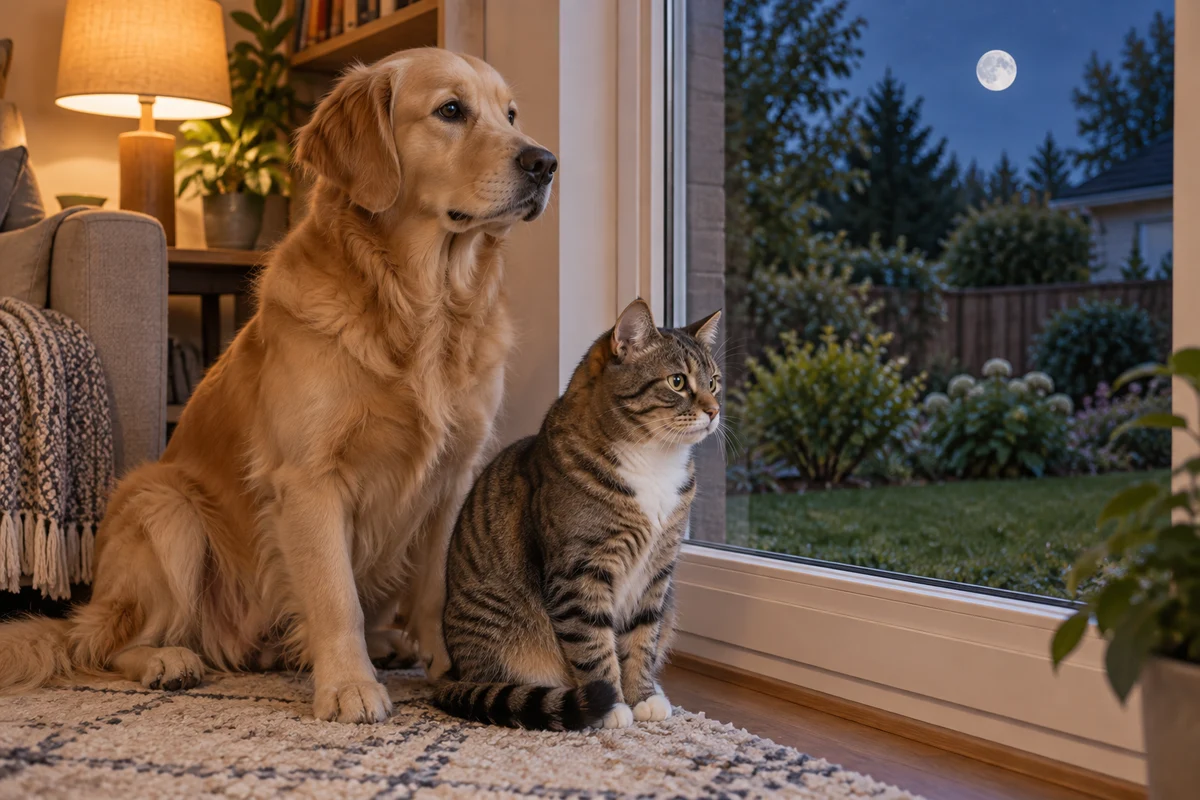
Your dog races down the hallway. Your cat won't leave the window. Someone checks the sky and says, "Of course. Full moon."
It's a neat explanation. It just isn't one you can confidently use to explain your pet's behavior. Veterinary studies have found mixed results, and emergency-room counts aren't the same thing as proof that moonlight makes pets act strangely. Notice what's happening to your pet before giving the moon the credit.
The moon is a talking point, not a diagnosis
A busy evening and a bright moon can happen together. That doesn't tell you whether one caused the other. Maybe the household routine changed. Maybe your puppy has an evening burst of energy. Maybe something outside caught your cat's attention. Those are possibilities to investigate, not an alternative diagnosis from this article.

Start with plain observations: running, pacing, vocalizing, staring, or repeatedly changing position. "Acting weird" is understandable in a group chat, but those specific details are more useful when you speak to your veterinarian.

This isn't a claim that lunar effects are impossible. It's a narrower answer: the studies below do not establish a reliable explanation for your individual dog or cat having an unusual night.
The studies don't tell one simple story
A 2007 Colorado State study reviewed 11,940 dog and cat emergency visits from 1992 through 2002. It found more emergencies during fuller-moon phases. Importantly, that category stretched from waxing gibbous through waning gibbous; it wasn't just the night of the full moon. The authors called for prospective research to assess clinical relevance.
Those records counted veterinary emergencies. They didn't show that a moon caused a pet to howl, get zoomies, or stare out a window. Association in hospital records is not a home-behavior experiment.

Another 2007 study at the University of Melbourne examined 12,102 animal emergency presentations. After adjusting for day of the week and public holidays, it found no statistically significant association between its full-moon period and daily presentations. Its definition was a three-day window centered on the full moon, unlike the broader phase grouping above.
Different hospitals, time periods, and definitions make these imperfect comparisons. Still, reporting only the positive study would leave out an important part of the evidence. Both are older retrospective studies, not fresh research establishing a 2026 pet-behavior trend. We reviewed their public abstracts, not the complete underlying patient records.
An ordinary evening can look dramatic
The AKC's guide to puppies going wild at night describes evening zoomies and discusses activity and rest. A puppy's playful sprint can look spectacular without being evidence of a lunar effect. That doesn't mean every episode of running or restlessness is harmless.

Make the room safe and keep the evening predictable. If you think a window is involved, note whether your pet is watching an animal, responding to a sound, or simply looking outside. You can try closing the curtain while keeping the rest of the routine similar. If the behavior changes, that still doesn't isolate moonlight from the whole window scene.

Avoid turning a small observation into a grand explanation. "The cat settled after I closed the curtain" is a useful note. "The moon was controlling the cat" goes much further than that note supports.

Don't let a moon theory delay care
If your pet is struggling to breathe, collapses, has a seizure, or may have swallowed something harmful, contact your veterinarian or an emergency veterinary hospital immediately. Don't wait to see whether the behavior stops when the moon changes. AAHA's emergency guidance explains why these signs need veterinary attention.
For a less urgent but new or persistent change, share what you observed: when it started, how long it lasted, and any changes in eating, movement, or routine. A short video can help describe an episode if it is safe to record; getting help takes priority over filming.

A 2011 seizure study examined 2,507 seizures in 211 dogs and cats diagnosed with idiopathic epilepsy. It found no significant relationship with lunar phase or illumination and did not support changing anticonvulsant treatment or monitoring based on the lunar cycle. Don't change prescribed medication because of a full-moon post. Discuss treatment questions with your veterinarian.

If you suspect a pattern, record ordinary nights too
Write down the behavior before checking the moon phase. Include uneventful nights, not just the one that becomes a story. Note practical details such as a late walk, guests, a changed bedtime, or activity outside the window.
This is a household observation log, not a scientific trial. It won't prove causation. Its value is helping you explain what changed and decide what to investigate next without relying on a few memorable nights.

The shareable answer is simple: a full moon may explain why everyone is talking about the night. It doesn't automatically explain your pet. Keep the curiosity, but look at the behavior and the evidence separately.
General information, not an individual diagnosis. Research checked September 27, 2026. Images are AI-generated editorial illustrations, not documented research cases.
Leave a Reply