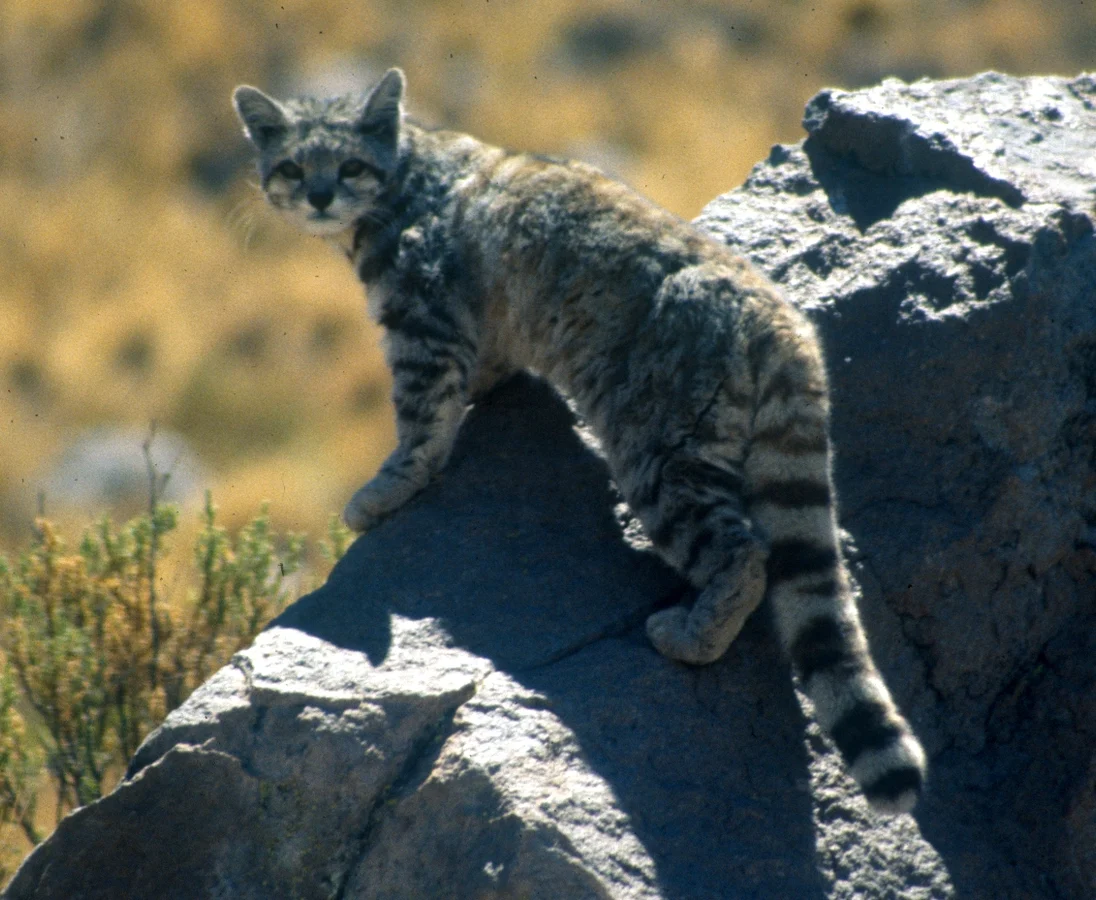
A cat walks past a camera. Nothing explodes, nobody chases it, and the clip is over almost before you have taken in that enormous striped tail. So why are conservation groups excited?
Because finding this particular cat is difficult. But there is a catch in the story circulating online: the date on a headline is not necessarily the date on the recording. The footage discussed here was captured on January 30, 2026, not this week.


First, separate the recording from the announcement
Greater Good Charities announced the footage with WCS Argentina on September 15, 2026. Their release places the recording a few kilometres east of La Payunia Reserve and gives January 30 as the filming date. That distinction matters if a later post describes the animal as being spotted ‘today’.
You can see the original recording through the conservation announcement linked below. The separately credited reference photographs and AI-generated illustrations in this article are not stills from that January camera.
Source: Greater Good Charities: original announcement and footage link.

What makes the cat worth a second look?
The Andean cat, Leopardus jacobita, is a wild South American cat associated with rocky Andean landscapes. Its thick, ringed tail is especially noticeable. ISEC describes a specialist whose ecology is closely tied to mountain habitat and prey such as mountain viscachas.
That is a more interesting explanation than ‘a fluffy stray’. The familiar cat-shaped face makes the animal easy to recognize as a feline, but does not tell us which species it is or how it lives.
Source: ISEC: Andean cat species account.

What one camera record actually tells us
A verified image answers a narrow question: was this species here at this time? It can help researchers decide where to keep looking. It does not automatically tell them how many cats live nearby, whether the animal stays there, or whether kittens are being raised there.

Think of it as a piece of a larger puzzle, not the finished picture. Even several clips may show the same individual. A population claim needs methods that account for detection and repeated records, rather than simply counting exciting videos.

Why camera traps change the story
The attraction of a remote camera is straightforward: it can record an animal without a person standing beside it. For readers, the resulting clip feels like a small window into a place they would probably never visit.
The conservation partners connect this record with habitat-restoration work. We should distinguish that encouraging interpretation from a demonstrated cause. A sighting near restored land is not, by itself, an experiment proving what caused the cat to be there.
Source: Greater Good Charities: original announcement and footage link.

How to share the clip without changing its meaning
A useful caption would say that an Andean cat was filmed near La Payunia in January and that the footage was announced in September. It would link the conservation team, rather than attach an unrelated cat photograph and imply it is the new record.


Skip ‘back from extinction’, ‘new species’, and ‘population saved’. Those phrases add information the recording does not contain. The honest version is already compelling: a rarely seen wild cat, recorded in a landscape people are working to protect.

Where this fits alongside the Tilcayo story
If the Tilcayo tiger cat caught your attention, the Andean cat offers a different reason to keep exploring. One story invites a question about species identity; this one invites a question about what a wildlife record can prove.
Both reward looking past the cute photograph. Keep the species name, recording context, and source together. That is how a short animal clip becomes something worth remembering, rather than another impressive picture with a misleading caption.

Questions readers ask
Was the Andean cat just discovered?
No. This is a record of an already known species, not a new species description.
Does one sighting mean the cats are recovering?
No. It confirms presence; recovery requires broader evidence.
Are these photographs the January recording?
No. They are separately credited reference photographs. The original footage is linked from the announcement.
Read the Tilcayo tiger-cat guide
Sources reviewed
Research note: We reviewed the linked sources, not animals in the field. AI-generated illustrations are explanatory, not wildlife records. Separately credited reference photographs retain their original context. This article contains no affiliate links.
Featured photograph: Jim Sanderson, CC BY-SA 3.0. Resized and converted to WebP. Reference photograph, not the January 2026 camera-trap record.

Leave a Reply