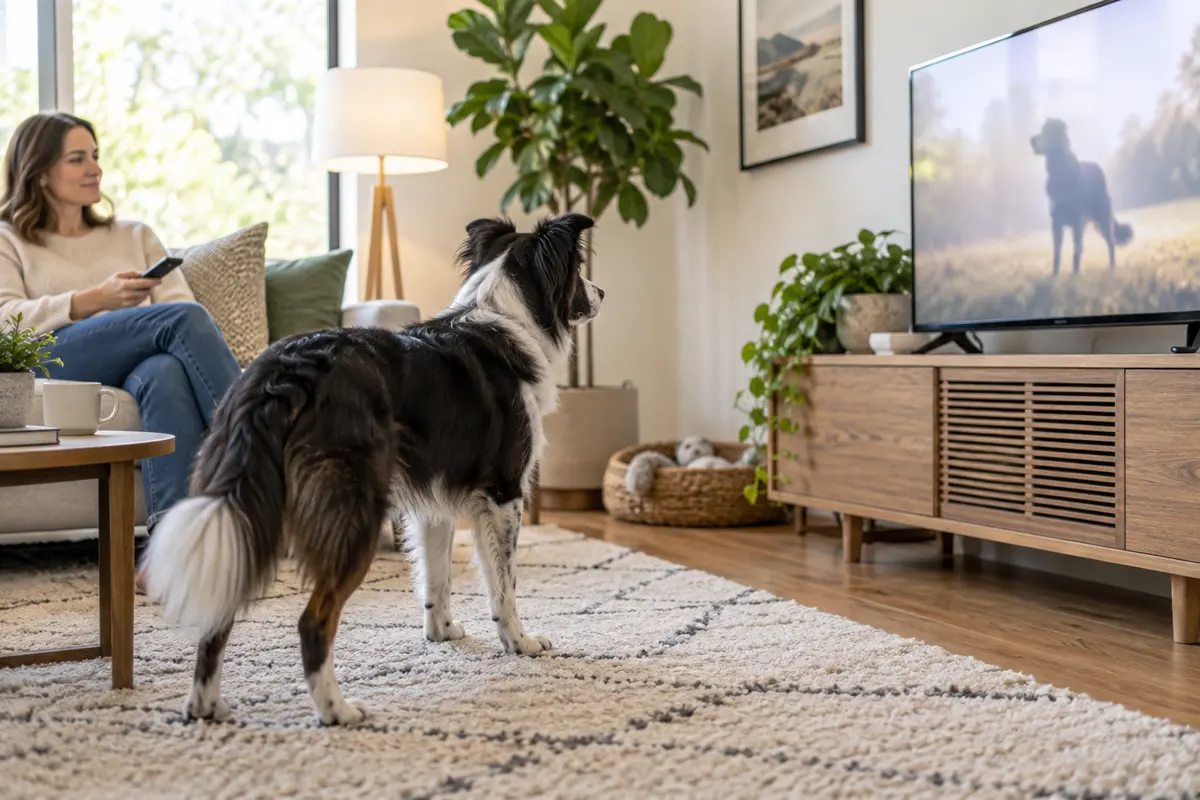
The dog appears on screen for half a second. Your dog launches off the couch, barks at the television, and checks behind it. It looks ridiculous until it happens through an entire movie.
Some dogs ignore screens. Others notice every horse, cartoon animal, whistle, squeak, or background bark. That difference does not mean one dog is smarter. Screen interest varies with vision, hearing, previous learning, temperament, age, and the content itself.

The 30-second trigger check
Replay is useful only if your dog is still comfortable. Use the remote to separate the picture from the sound. Stop immediately if your dog rushes the screen, cannot take food, trembles, hides, or stays agitated after the clip ends.
| Quick test | What happens | Likely clue | First adjustment |
|---|---|---|---|
| Mute the same scene | The reaction mostly stops | Sound may be the stronger trigger | Begin with very low volume |
| Use sound with the screen out of view | Barking starts at a bark, knock, or bell | Audio cue | Practice the sound quietly |
| Show calm movement with no animal sound | Your dog tracks or rushes the screen | Motion or animal shape | Increase distance; shorten the clip |
| Pause the picture | Your dog relaxes when movement stops | Motion intensity | Start with still or slow scenes |
| Call once from a safe distance | Your dog can turn back to you | Still under a workable threshold | Reward the turn and move away |
This is a practical observation tool, not a diagnosis. A dog can respond to several parts of the same scene. A galloping animal may combine rapid motion, hoof sounds, music, and a sudden camera cut.

Six reasons your dog barks at the TV
1. The movement is worth tracking
Dogs can detect movement on a screen, although they do not necessarily interpret the scene as a human does. Fast animals, balls, wheels, and sudden camera cuts can capture attention. Some dogs simply watch. Others move closer, vocalize, or try to follow the action.
2. The sound feels real enough to answer
A bark, whine, doorbell, knock, or squeaky-toy sound may matter more than the picture. Your dog does not need to understand the plot for a familiar noise to trigger an established response. If muting the scene changes everything, train the audio component first.

3. The screen creates an unsolved puzzle
The animal is visible and audible, but there is no matching scent and no normal social response. A dog may approach, circle the set, or look behind it. That investigation is not proof that the dog believes an animal lives inside the television. It only shows that the combination is interesting or confusing.
4. Excitement turns into frustration
A dog that wants to chase, greet, or inspect the on-screen subject cannot reach it. Repeated movement without resolution can increase arousal. Barking may then continue after the triggering image disappears. More exposure is not automatically better when every repetition ends in a full reaction.
5. Barking has become part of the routine
If barking makes people speak, laugh, reach for the dog, throw food, or change the channel, the response may gain a reliable consequence. That does not mean the dog is manipulating you. It means the sequence has been practiced: screen trigger, bark, human response.
6. Your dog is already close to the edge
A dog who has not slept well, has just reacted at the window, or is full of unused energy may respond more strongly than usual. Context matters. The same clip can produce a glance on one evening and a barking burst on another.

A five-step plan for calmer TV time
- Prevent the full rehearsal. For now, mute surprise commercials, use captions, choose calmer programs, or move your dog farther from the screen. Management is not failure. It stops another intense repetition while you teach a different response.
- Teach a resting place with the TV off. Reward your dog for stepping onto a mat, lying down, and staying there briefly. The mat should already predict rest before it is used around a trigger.
- Start with one weak version of the trigger. Use a still image, a distant screen, a very low volume, or a one-second clip. VCA behavior guidance recommends breaking a trigger into components and increasing intensity only while the pet remains relaxed.
- Reward the first good decision. The useful moment may be a glance back at you, four paws staying on the floor, or a quiet return to the mat. Reward that moment before barking begins. Waiting for a meltdown makes the lesson much harder.
- End while your dog is succeeding. Several brief sessions are more useful than a long test. Increase only one variable at a time: volume, movement, duration, or distance. If your dog cannot disengage, the session was too difficult.

What to do during a real show
Training and movie night do not have to be the same event. If you want to watch without coaching every scene, give your dog a safe food puzzle or chew in another part of the room, choose a visual barrier, or let the dog settle in a quieter space. Supervise items that can be chewed or swallowed, and use only foods appropriate for your dog.

Protect the dog and the television
Charging a screen is more than a noise problem. Stabilize or anchor the television according to its manufacturer instructions, keep the console clear, cover or route cables safely, and prevent access to the narrow space behind the set. Do not attach a leash to furniture and leave the dog unsupervised. If the dog repeatedly jumps at the screen, use distance or a physical room barrier while you work on the behavior.

When barking needs more than a home experiment
Ask a qualified reward-based trainer or veterinary behavior professional for help if the reaction is intense, getting worse, difficult to interrupt, or creates a risk of injury or damaged equipment. Speak with your veterinarian when the behavior appears suddenly alongside confusion, altered sleep, pain signs, hearing or vision changes, or other new behavior.
Keep a short record for a week: program, visual trigger, sound trigger, distance, body language, recovery time, and whether your dog could eat or respond to a familiar cue. A specific record is more useful than “barks at everything.”


Frequently asked questions
Does my dog think the animal on TV is real?
You cannot confirm that from barking alone. Dogs can respond to recognizable images and sounds, but investigating the screen does not prove they understand it as a real animal in the room.
Why does my dog react to some animals but not others?
Movement, size, contrast, sound, past experience, and the dog’s state at that moment can all change the response. Test picture and sound separately.
Should I let my dog watch dog videos for enrichment?
Only if your dog remains relaxed and can disengage. Screen content is not a substitute for walks, sniffing, play, rest, training, and social contact suited to that dog.
Can I train with YouTube clips?
Yes, if you control volume, duration, and distance and avoid clips that cause a full reaction. Start easier than you think and stop while your dog is calm.
Will my dog grow out of barking at the TV?
Possibly, but repeated barking can also become well practiced. Management and short reward-based sessions are more reliable than waiting for it to disappear.
Bottom line
Your dog is not barking at “television” as one single thing. The real trigger may be motion, sound, surprise, frustration, or a learned routine. Separate those pieces, work below the reaction threshold, and reward the earliest quiet choice. The goal is not to make the screen meaningless overnight. It is to make looking away and settling easier than charging forward.
Sources: VCA: Can dogs see movement on TV?; VCA: Desensitization and counterconditioning; VCA: Barking in dogs; AKC: Why does my dog watch TV?; Applied Animal Behaviour Science: dog television viewing survey.
Leave a Reply