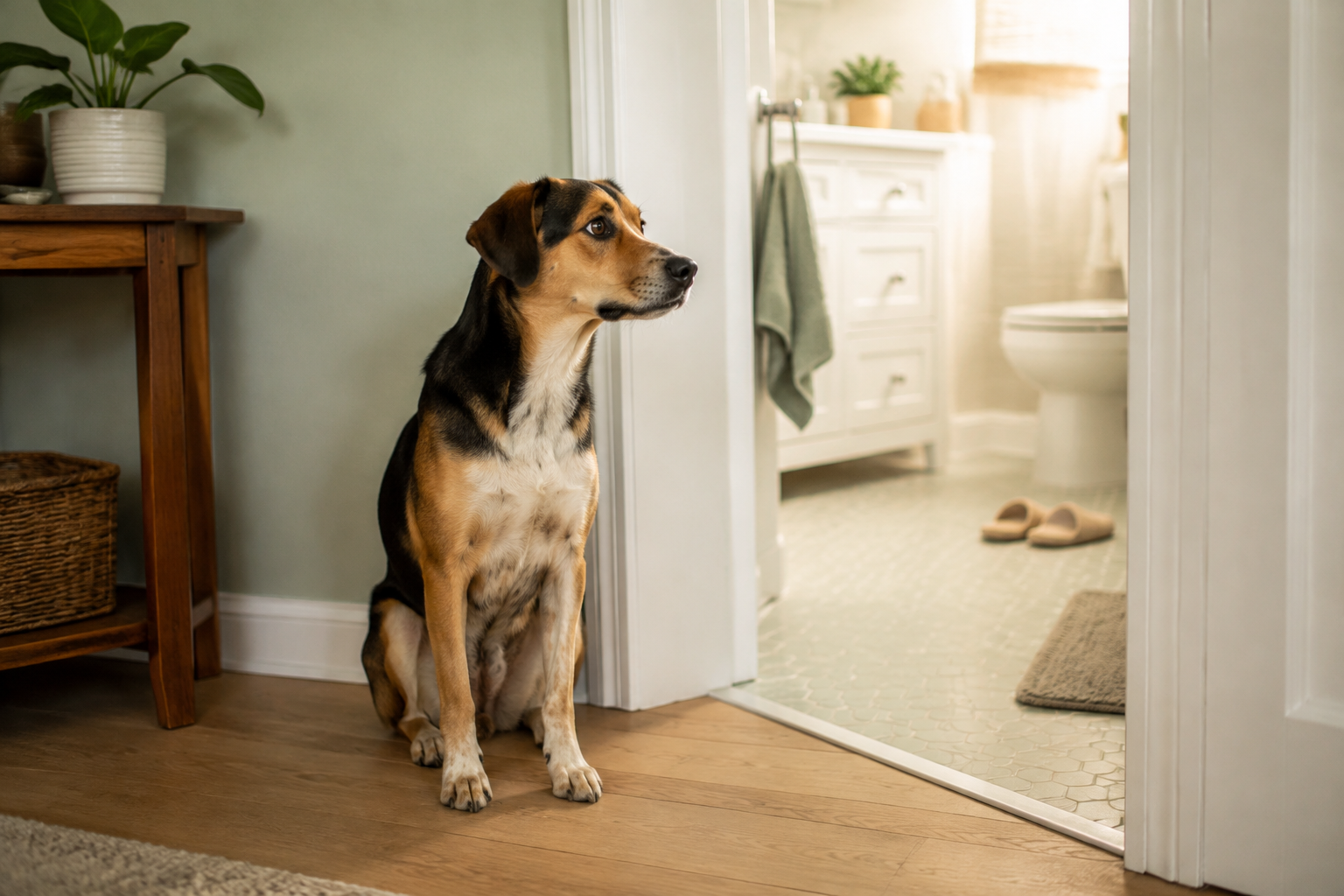

Your dog may have no interest in the bathroom itself. They may simply have noticed that you always disappear behind the same door, at roughly the same times, and that following you is usually more interesting than staying put.
Most of the time, this is ordinary companion-dog behavior. The more useful question is not, “Does my dog follow me?” It is, “What happens if I close the door or leave the room?” A dog that settles nearby is telling a different story from a dog that panics, paces, vocalizes, or tries to get through the door.
The short answer
A 30-second check before you worry
| What you notice | Usually a lower-concern pattern | Worth a closer look |
|---|---|---|
| Door closes | Dog waits, sniffs once, then settles | Dog repeatedly scratches, vocalizes, pants, or cannot settle |
| You leave home | Dog relaxes after a routine departure | Distress begins during departure cues or soon after you leave |
| Change over time | This has always been a quiet habit | The behavior is sudden, escalating, or paired with other changes |
| Your response | Dog can redirect to a bed, toy, or another person | Dog cannot disengage even with ordinary support |

1. You are part of the dog’s normal route
Dogs are excellent at noticing patterns. If you head to the bathroom after waking, before a walk, after dinner, or before bed, the trip can become part of the home’s map. Following you may be no more dramatic than following the person who usually opens the back door or starts breakfast.
This is especially common when one person handles most of the food, walks, play, or training. The dog has learned that your movement predicts something relevant. The American Kennel Club notes that close following can center on a primary caregiver and can be strengthened by the attention and treats that arrive around that person.
What to try: Notice whether your dog follows everyone or mainly the person connected to the most routines. That answer is more informative than the bathroom location.
2. The bathroom is a rare quiet moment with you
To a dog, a seated and stationary person can be easier to approach than a person moving around the kitchen or answering a phone. The room may be small, quiet, and predictable. If you talk to your dog, pet them, or make eye contact there, the pause can become a little pocket of attention.
That is not wrong. It just explains why the behavior repeats. A dog does not need to understand the room’s purpose to learn that standing beside you sometimes produces connection.

3. The behavior has been rewarded without anyone meaning to reward it
Reinforcement can be subtle. You may laugh, say the dog’s name, scratch an ear, open the door quickly, or offer a toy when they appear. From the dog’s perspective, following you reliably creates a response.
This does not mean you caused a problem. It means the pattern has a clear feedback loop. If you would rather have more privacy, change the loop calmly: give the dog a resting place outside the bathroom, reward the choice to settle there, and avoid turning door-following into a game.
4. A closed door is genuinely interesting
Dogs investigate movement, scent, sound, and access. A door that was open a moment ago and is now closed can be a small mystery. Some dogs simply want to check that their person is still nearby. Young dogs and naturally curious dogs may be especially persistent about any room that becomes unavailable.

5. Your dog prefers social proximity
Dogs are social animals, and some individuals choose to keep a closer radius than others. Breed tendencies, early experiences, age, household routines, and personality all affect how much contact a dog seeks. A dog who lies at your feet in every room may be expressing the same preference at the bathroom door.
The key distinction is flexibility. A socially attached dog can usually settle somewhere else when there is nothing happening. A dog in distress often cannot.
6. The follow may be one small part of a bigger change
Bathroom following matters more when it is new or arrives with other changes: reduced appetite, restlessness, altered sleep, house-soiling, fearfulness, pain signs, confusion, or behavior that only appears when a person is absent. The follow is not the diagnosis; it is a clue to bring into the bigger picture.
For a sudden behavior change, start with your veterinarian rather than assuming it is a training issue. For a pattern tied to absence or closed doors, a qualified behavior professional can help you identify the trigger and a humane next step.

When it may mean more than company
The line to watch is distress, not closeness. Behavior sources describe separation-related distress as a pattern that can include persistent barking or howling, pacing, destructive attempts around exits, house-soiling when alone, drooling, or marked anxiety around departure cues. Those signs need context; one bark behind a bathroom door does not establish a diagnosis.
Use a short video or phone recording when it is safe to do so. The ASPCA, VCA, and the American Veterinary Society of Animal Behavior all emphasize observing what happens when the dog is actually separated or alone. A recording can show whether the dog settles after a minute, keeps escalating, or behaves differently when another person remains home.

Contact a veterinarian or qualified behavior professional sooner when:
- the behavior is sudden or much more intense than your dog’s usual behavior;
- your dog repeatedly vocalizes, pants, drools, paces, scratches, or tries to escape when you are out of sight;
- there is destruction focused on a door, window, or exit point;
- house-soiling, appetite, mobility, sleep, or confusion changes appear too; or
- your dog could hurt themselves trying to get to you.
Do not punish a dog for these signs. If distress is part of the picture, punishment can add fear without explaining what you want instead.

A calmer bathroom routine, if you want one
You do not need a dramatic training plan for a dog who quietly sits nearby. Start with a small, repeatable alternative.
- Put a mat or bed just outside the bathroom.
- Invite your dog onto it while the door is open, then reward calm settling.
- Step inside briefly and return before the dog becomes worried.
- Repeat at easy durations; increase only while the dog stays relaxed.
- Keep the routine low-key. The goal is a dog who can choose rest, not a dog who thinks a closed door predicts a major event.

If your dog becomes upset at any stage, make the next repetition easier and consider getting professional guidance instead of pushing through. VCA notes that behavior plans for separation-related distress focus on helping the dog settle while the person is still home and briefly out of sight.
Use a one-week observation instead of guessing
For seven days, make a quick note of four things: the time, what you did before leaving the room, what your dog did once access changed, and how quickly they settled. Add a short video of an ordinary absence if you are concerned. This turns a vague feeling of “clingy lately” into something a veterinarian or behavior professional can actually assess.

Bottom line
Bathroom following is usually a small, ordinary part of sharing a home with a social dog. The useful signal is whether your dog can relax when you are briefly unavailable. A quiet wait is one thing. A new pattern of panic or escalating distress is another, and it deserves a closer look.
