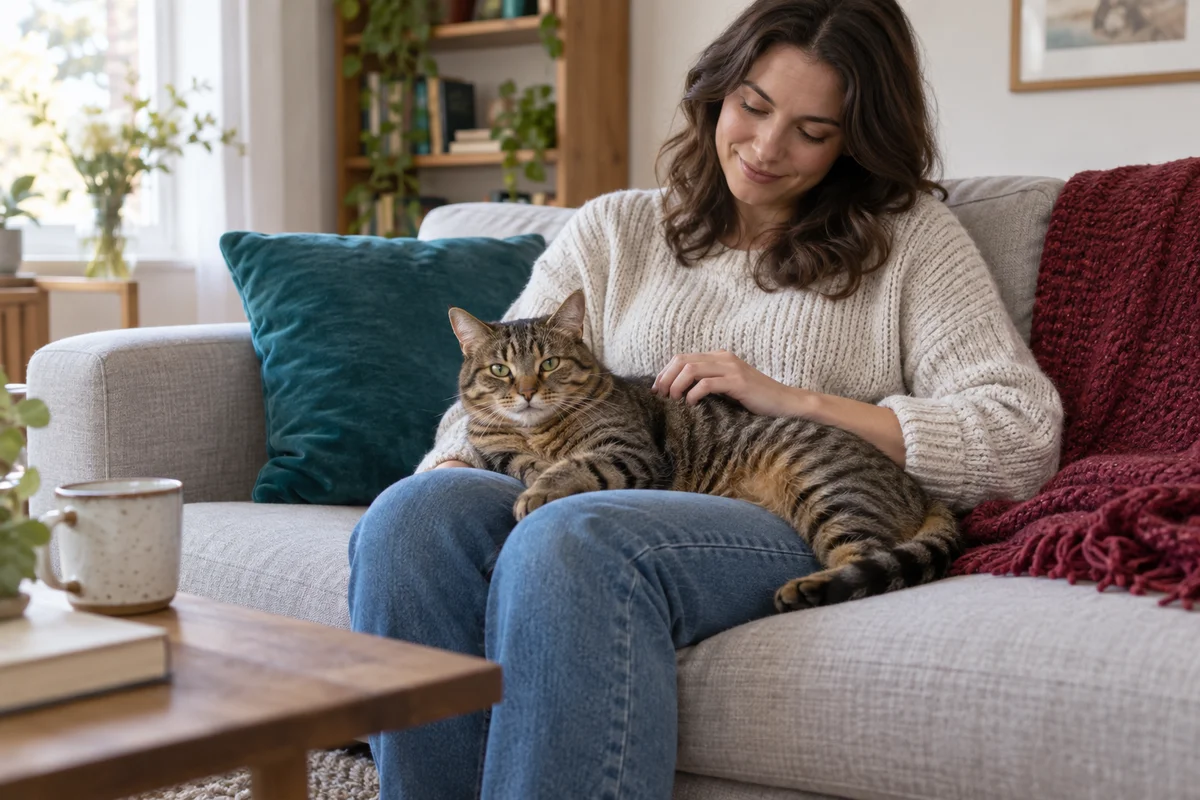
Your cat climbs onto your lap and starts the familiar rumble. Lovely. Then you notice the same sound in the carrier, or while your cat is sitting alone, and suddenly it is harder to read.
A cat that purrs often may be enjoying company or anticipating attention. But purring can also happen during stress or discomfort. The useful question is not just how much your cat purrs; it is whether the setting, behavior and everyday routine have changed.
Before you decide the sound means everything is fine, look at:
- What was happening when it started.
- Whether your cat can move away and settle comfortably.
- Eating, movement and litter-box habits compared with usual.
- Whether this is a new pattern rather than a familiar habit.
A cat having difficulty breathing needs urgent veterinary care, even if you hear a purr. Do not wait for the sound to stop before seeking help.

Start with the moment, not the volume
Think about the last few times you heard it. Was your cat approaching you, settling into a favorite spot, or waiting while you prepared dinner? Or did it begin in an unfamiliar place, during handling, or alongside a change you cannot explain?
Those are different situations. A louder rumble is not automatically a stronger declaration of love, and a quieter one is not automatically a warning.
There is no purring quota in this guide. Counting minutes would make the question look precise without telling you whether your cat is comfortable. Compare the pattern with your own cat's ordinary day instead.
An easy note is enough: "Started when I sat down; stayed loosely curled beside me; ate normally afterward." If something feels different, write that down too. You do not need to keep a minute-by-minute diary of a cat who otherwise seems unchanged.
When the familiar explanation fits
A loose resting posture, ordinary movement and a familiar voluntary interaction can fit a comfortable moment. If your cat chooses your lap, gets up easily when they want to, and carries on with their normal routine, frequent purring by itself is not a reason to interrupt every cuddle.
Cats Protection's body-language guidance recommends reading the situation and the rest of the cat rather than treating purring as a stand-alone happiness signal. No single ear position or expression is a complete answer either.
Give your cat room to choose the interaction. Offer a little attention, pause, and see whether they stay nearby or move on. Following a cat across the room to make the purr continue defeats that choice.

The dinner-time rumble
If it happens as you open the cupboard or set down a bowl, the routine may be part of the story. Cats Protection describes attention-seeking as one context for purring. That does not mean every purr beside a bowl is a demand for another meal.
Keep the usual feeding plan. Check whether food was actually eaten, not just whether your cat came running. A cat approaching dinner and then walking away is a different observation from a cat finishing an ordinary meal.

Some cats are simply more noticeable about it
You may hear one cat across the sofa and barely hear another close beside you. Do not use a neighbor's cat or a short video as the benchmark for yours.
The comparison that matters is familiar versus new. A long-standing rumble during otherwise ordinary company is different from a sudden change in when it happens. If you are unsure whether the sound is actually purring, a short recording can help your veterinarian, provided making it does not delay care or bother your cat.
The same sound in a different setting
At the clinic, a cat can purr without enjoying the visit. In its purring explainer, Cats Protection identifies stress as another possible context, alongside contentment, attention and pain.
This is why "but they're purring" is not a good reason to keep holding a cat who is trying to leave. Allow space when you can do so safely. During a veterinary examination, tell the team what your cat usually does and let them guide the handling.

At home, consider what changed around the interaction: a visitor, unfamiliar handling, another animal nearby, or a place your cat does not usually choose. These are observations, not proof that you have found the cause.
Keep an accessible resting place and avoid forcing contact to test your theory. A calmer environment can make the moment easier, but it does not rule out a health problem if the unusual behavior continues.
Purring is not permission to keep petting
You do not have to wait for a bite to pause. If your cat pulls away, turns toward your hand or tries to end the interaction, stop touching and give them room. Avoid gripping, scolding or chasing them back for one more stroke.
The purr can be part of the moment without overriding what your cat is doing. Reading a familiar sound as a permanent invitation is an easy mistake; a pause is the simpler response.

When a new pattern deserves a call
Purring cannot confirm pain, and it cannot clear your cat of pain. Cats Protection's pain guide includes purring among possible signs, alongside changes such as hiding, reduced eating and hesitation with movement.
Look for a change in the rest of the day. Has your cat stopped coming to a usual resting spot? Are they hesitating at a jump they normally make? Has their appetite changed? Are they spending time alone when that is unusual for them?
None of those observations supplies a diagnosis. They do give your veterinarian something more useful than "the purr sounds different." Contact the clinic if the pattern is new, persistent, or accompanied by other changes. You do not need to identify the problem before asking for advice.
Do not press sore-looking areas or repeatedly pick your cat up to see whether the sound changes. Describe what you have noticed without creating another uncomfortable situation.

Eating less matters even if the purr sounds normal
A reassuring sound should not outweigh an untouched meal. Cornell's guidance on loss of appetite explains that not eating can have serious consequences for cats and needs veterinary assessment.
Call your veterinarian promptly about a cat who is not eating; seek advice sooner when they also seem unwell. Do not treat a purr as a reason to postpone the call or improvise force-feeding.
Breathing difficulty changes the priority
Open-mouth breathing, obvious effort to breathe, or an unusual posture while struggling for air warrants urgent veterinary help. Cornell's respiratory-distress guidance emphasizes prompt treatment.
Do not keep handling the cat to decide whether the noise is a purr. Contact an emergency veterinary service and follow its instructions. A recording is optional; getting help is not.
This does not mean ordinary purring is an emergency. It means an accompanying breathing problem takes priority over an otherwise familiar sound.

What to tell the veterinarian
Start with what changed and when. A brief description of the setting is more useful than trying to interpret your cat's feelings.
You could say: "They usually purr on my lap. Since yesterday, I've noticed it while they sit alone, and they have eaten less." That is an example of how to describe a change, not a sign combination that diagnoses a particular condition.

Have a few details ready:
- When you first noticed the new pattern.
- Whether it happens during touch, rest, meals or handling.
- Any difference in eating, movement or litter-box use.
- Recent changes at home or known health issues.
- A short video, if you already have one and recorded it without disturbing your cat.
Let the clinic decide how soon your cat should be seen. Do not give human pain medicine or another pet's prescription because you suspect discomfort.

Can a cat purr while asleep?
Judge a sleepy moment by the same context rule. Do not wake or repeatedly prod your cat to obtain a reaction. If you have concerns about a new sound, unusual breathing or changes when awake, ask your veterinarian rather than assigning meaning from a clip alone.
Does a cat purring beside me prove they trust me?
It can fit a comfortable interaction, especially when your cat chooses to stay. It is not a complete relationship test. Let them leave, keep interactions predictable, and pay attention to what they do as well as what you hear.
Should I worry if my cat has always purred a lot?
An established pattern in an otherwise unchanged cat is different from a sudden increase or a new setting. Enjoy ordinary company without treating every rumble as a symptom. Bring unexplained changes to your veterinarian, and keep up with regular health care.
The next time the little motor starts, notice the whole moment. A familiar purr can stay a pleasure. It just should not be the only thing you listen to.
Related questions
For a different interaction, see why cats headbutt their people or why cats make biscuits. Those behaviors have their own context; they are not extra proof that a purring cat is well.
Sources and research note
Reviewed September 27, 2026: Cats Protection's purring explainer, body-language guidance, and pain signs; Cornell Feline Health Center's anorexia guidance and breathing-difficulty guidance.
General information, not an individual veterinary assessment. Photos and infographics are AI-generated editorial illustrations, not diagnostic examples or documented patient cases. This article makes no claim that purring heals disease. No products were tested and there are no affiliate links.
Leave a Reply