By KIM | Reviewed October 6, 2026
The face made you stop scrolling. The place deserves a look, too. Behind the Tilcayo headline is a mountain forest, not a newly discovered breed waiting in somebody’s living room.
So where does this little wild cat actually live? The useful answer is more specific than "South America" and more careful than a shaded map of an entire country. Here is what the sources establish, what the landscape looks like in context, and where the evidence stops.
Start with a place, not a whole continent
The formal description places the type locality near Arapata, in Nor Yungas, La Paz, Bolivia. Think of a type locality as the geographic reference attached to the name. It tells you where the name-bearing animal came from; it does not mark every forest where the species lives.

That distinction is easy to lose when a story travels. "Described from Bolivia" becomes "lives throughout Bolivia," and a precise reference turns into a much larger claim. If you are sharing the discovery, the smaller wording is the better wording.
The forest matters as much as the cat
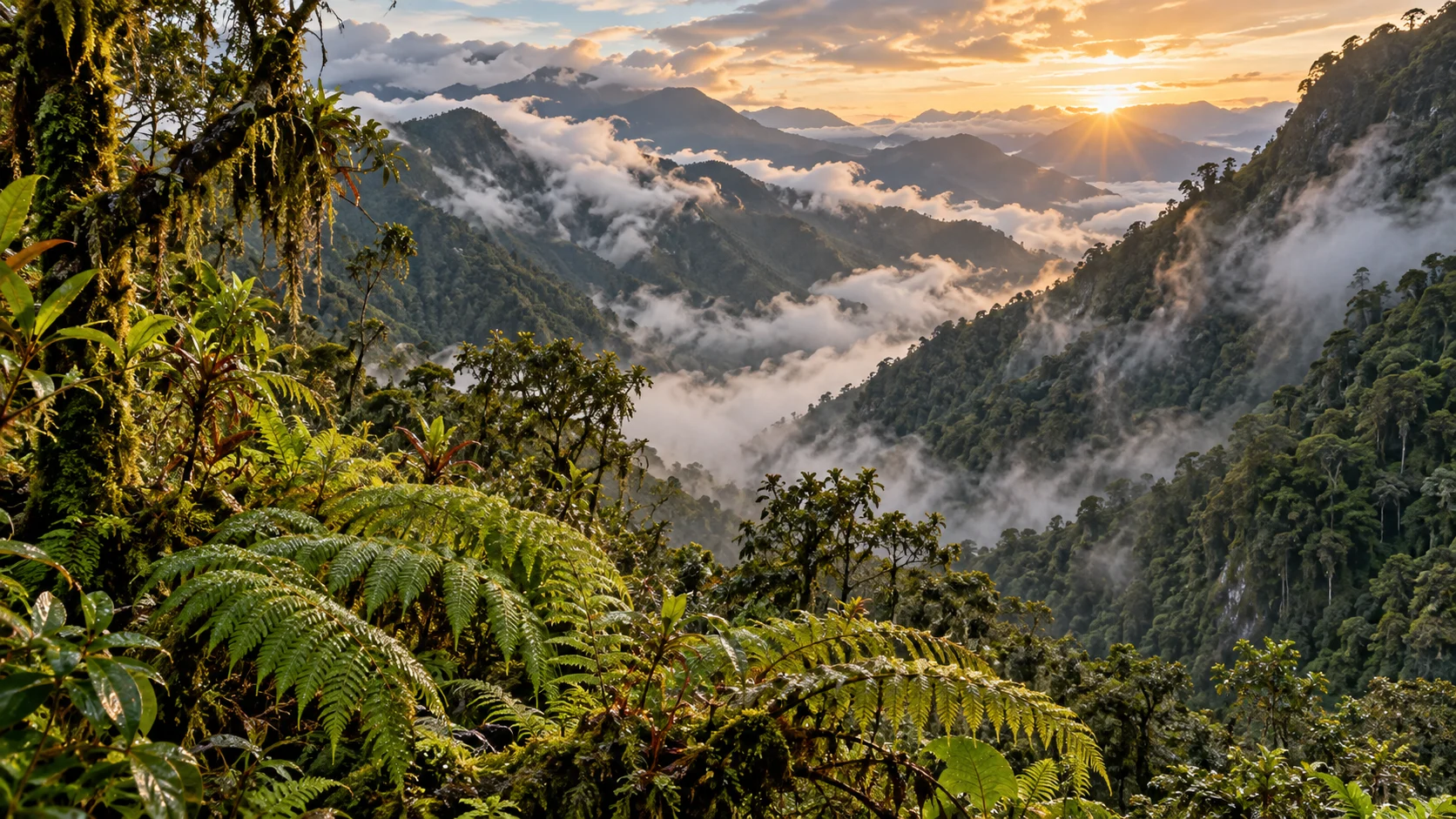
In their interview, the researchers describe the Yungas setting in terms of cloud, steep slopes, and high humidity. It is a mountain-forest context, not a reason to picture the animal in every tropical lowland forest.

The photographs and illustrations you choose change the story you tell. A generic savanna backdrop may make a striking picture, but it would point readers toward the wrong setting here. Our forest scenes are generated explanations of this context, not photographs of the type locality.

Could it live beyond the places already checked?
Possibly, but possibility is not a confirmed record. Researcher Paola Nogales explains that populations elsewhere in the Yungas would need genetic testing before that broader distribution could be asserted.

Imagine finding an unfamiliar bird in one valley. You would have a record for that valley. You would not automatically have a map for the next five valleys. The same reading rule helps here: keep a documented locality, a plausible habitat, and a proposed wider range in three separate boxes.

What would make the next sighting useful?
A good record starts with information that can be checked: who documented it, when, where at an appropriate regional level, and how the identification was made. A repost with no source is an invitation to look further, not a distribution record by itself.

A camera-trap image and a genetic identification also answer different questions. The first may document an animal passing a camera. The second can help investigate which lineage the animal belongs to. Neither becomes a population count simply because a caption calls the animal rare.
A discovery headline does not protect a forest
The participating university points to habitat loss and fragmentation among the threats faced by this group of cats. It also argues that conservation should account for the newly recognized species separately. Those are group-level concerns; they are not a measured Tilcayo population trend.

For readers, the practical change is in what to amplify. A source-backed explanation of the habitat is more useful than a precise-looking map that nobody has verified. Support the people documenting the species and the landscape rather than turning uncertainty into a dramatic number.

Source: Participating university PUCRS explains the research.
Enjoy the story without turning it into a chase
This is not a guide to finding, approaching, feeding, or collecting a Tilcayo. We are deliberately not publishing coordinates or a spotting itinerary. Curiosity does not require giving an elusive animal a crowd.

If you encounter a small unfamiliar wild cat, do not assume that a domestic-cat appearance means domestic-cat handling is appropriate. Keep your distance and seek guidance from the relevant local wildlife authority if help is needed. A viral clip is not a reason to improvise a rescue.
The most interesting answer to "where does it live?" is still being refined. For now, keep Bolivia’s Yungas in the picture, keep the confirmed locality separate from the full range, and leave room for the next verified piece of evidence.
Questions readers ask
Is the Tilcayo confirmed across all of Bolivia?
No. The description establishes a reference locality in the Bolivian Yungas, not a countrywide distribution.
Is a suitable-looking forest proof it lives there?
No. Habitat resemblance is not a species record. Identification and location evidence still matter.
Are these pictures actual Tilcayo locations?
No. They are AI-generated forest and fieldwork concepts. They are not location evidence.
Read the original Tilcayo guide
Sources and image note
- Published taxonomic description, archived by Plazi
- Interview with the describing researchers
- Participating university PUCRS explains the research
- Indexed research abstract
Research-based explanation, not field reporting. We checked the archived taxonomic treatment, indexed abstract, university account, and researchers’ interview. The complete publisher article and supplemental Data S1 were not accessible for this review. All images are generated explanatory assets, not authenticated species photographs or scientific evidence. No affiliate links.
Leave a Reply