By KIM | Reviewed October 6, 2026
Put two spotted cats on your screen and the first question is obvious: what am I supposed to be noticing? With the Tilcayo, the answer is not one magic spot or an unusually cute face.
The published description does identify physical differences. But those clues belong to a research comparison, not a social-media guessing game. Here is a readable way to compare the cats without pretending a photograph can do the whole job.
First, check which name the comparison means
The research team describes the tiger-cat complex as five species, not one uniform animal spread across a continent. It also identifies a newly named Peruvian subspecies, Leopardus tigrinus antisuyo. That subspecies is not another name for the Bolivian Tilcayo.

This is where many comparisons go wrong before the pictures appear. "Tiger cat," "oncilla," a regional common name, and a current scientific name are not automatically interchangeable. On an older page, look for the publication date and the scientific name the author actually used.
Source: Participating university PUCRS explains the research.
Against L. pardinoides: look beyond the spots
The formal diagnosis reports shorter fur, a less bushy tail, lower pattern contrast, and larger irregular open rosettes in the Tilcayo compared with L. pardinoides. It also distinguishes the tail markings from broad, complete bands.

Those are comparative features, not a guarantee that any short-haired spotted cat you find online is a Tilcayo. Lighting can flatten contrast. A tail can be hidden. A crop can remove the very feature a caption asks you to judge. Read the description as a set of clues with context, not a one-image quiz.

Against L. tigrinus and L. guttulus: the reference changes
Compared with L. tigrinus, the diagnosis describes larger, more irregular flank markings and a longer, fuller tail in the Tilcayo. Compared with L. guttulus, it emphasizes larger, more varied markings, lower dorsal contrast, and a relatively longer tail.

Notice the word "compared." A characteristic is informative in relation to the animal being compared, not just because it sounds distinctive in isolation. "Long tail" without a reference, measurement, or source is a weak identification claim.

The difference is also in evidence you cannot see
The indexed study abstract reports genomic comparisons across the tiger-cat complex and concludes that it contains five distinct species. That is why the story cannot be reduced to a coat-pattern collage.

A useful analogy is a book cover and the text inside. Covers can help you notice that two books differ; they cannot tell you everything about their contents. Here, physical descriptions and genetic comparisons contribute different information. Neither should be replaced by a convincing-looking generated picture.

Source: Indexed research abstract.
Nearby does not automatically mean closest relative
The participating university explicitly says the Bolivian species and the newly described Peruvian subspecies are not one another’s closest relatives. Their geographic proximity does not settle the evolutionary relationship.

Do not turn a country comparison into a family tree. A map shows where records belong. A phylogenetic analysis investigates relationships. We are not drawing an invented branching diagram to fill the space between those two questions.
Source: Participating university PUCRS explains the research.
Before sharing a “Tilcayo or not?” picture
Start with the original source rather than the repost. Does the source identify the animal, name the photographer or institution, and explain where the identification came from? If those details are missing, mark the identification as unverified.

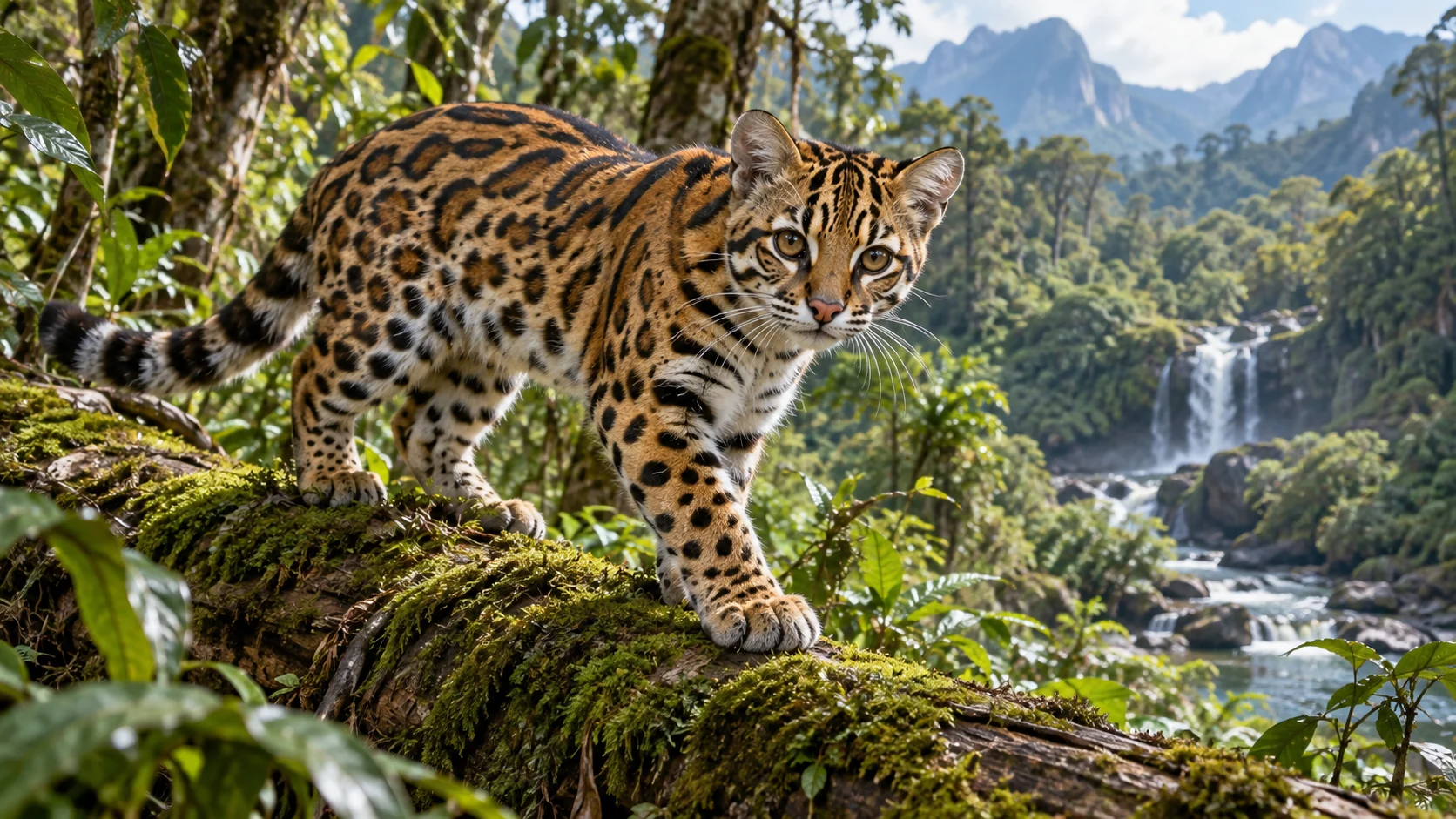
Then separate an illustrative image from an animal record. Our visuals are generated concepts; they do not show authenticated examples of each species. The infographic summarizes written differences, but it does not train a field-identification system.
Finally, resist filling in the gaps. You do not need to decide an animal’s identity to enjoy the discovery. Sharing the research link is a stronger next step than supplying a confident name to a picture with no provenance.
The interesting difference is bigger than a tail
The Tilcayo comparison is not a competition over which cat is smallest, rarest, or most desirable. It is a way to understand why researchers stopped treating similar-looking animals as a single answer.
Keep the physical clues, the molecular evidence, and the uncertainty together. That gives you a much more interesting story than "looks like a house cat" – and a much harder story for a misleading caption to distort.
Questions readers ask
Is the Tilcayo the same as L. tigrinus antisuyo?
No. The study describes a Bolivian species and a Peruvian subspecies as different taxa.
Can I identify a Tilcayo just by tail shape?
No. A published comparative feature is not a standalone identification test for an unsourced photograph.
Do the generated cats show the exact species differences?
No. They are conceptual visuals, not authenticated specimens or diagnostic references.
Read the original Tilcayo guide
Sources and image note
- Published taxonomic description, archived by Plazi
- Interview with the describing researchers
- Participating university PUCRS explains the research
- Indexed research abstract
Research-based explanation, not field reporting. We checked the archived taxonomic treatment, indexed abstract, university account, and researchers’ interview. The complete publisher article and supplemental Data S1 were not accessible for this review. All images are generated explanatory assets, not authenticated species photographs or scientific evidence. No affiliate links.
Leave a Reply