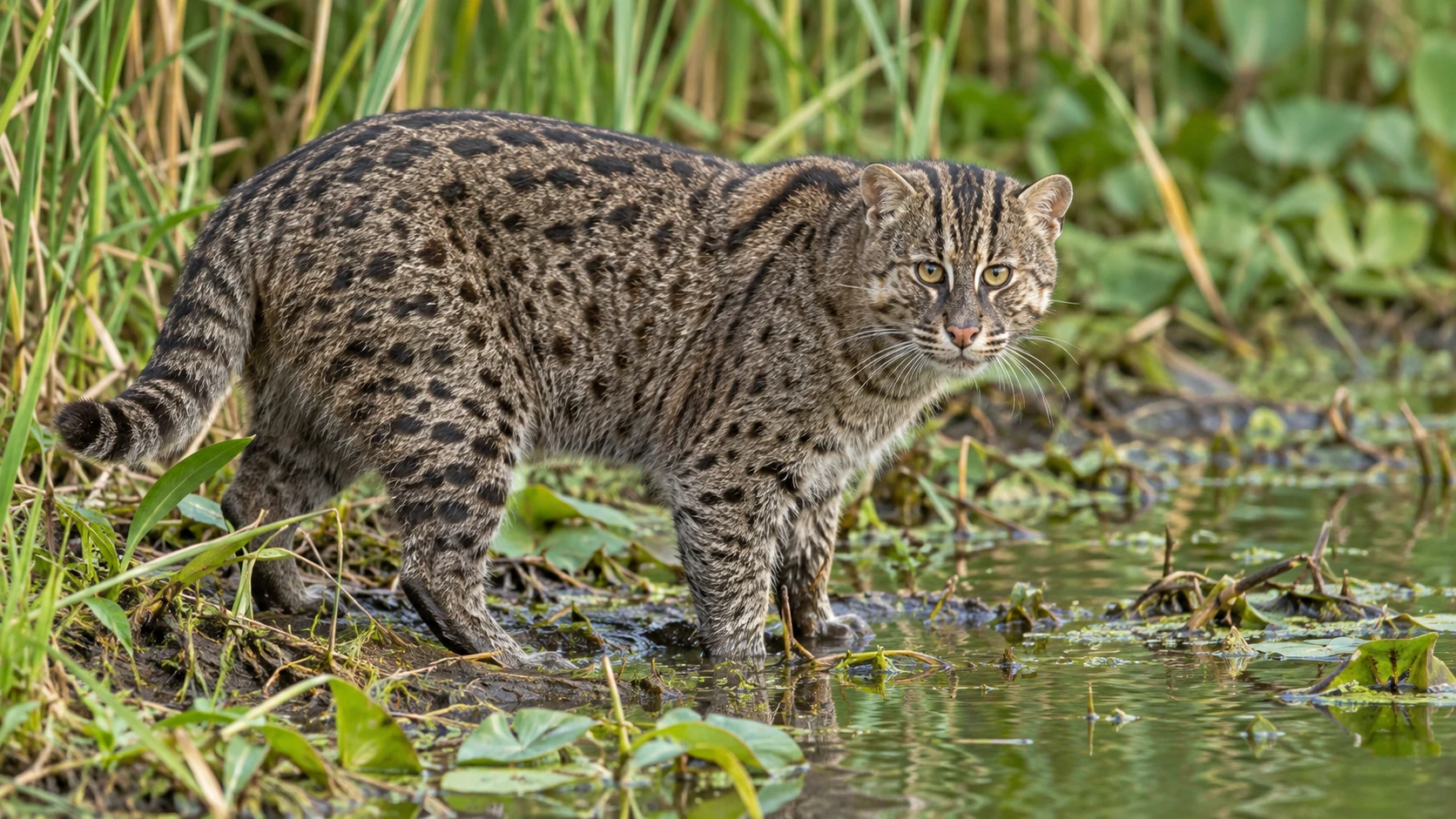
A spotted cat waits at the water’s edge. If your first thought is that somebody’s unusually adventurous pet has gone fishing, the name of the animal is going to make a lot more sense.
A fishing cat is a wild species. Its relationship with water is not a party trick someone taught a house cat for a video.

The name is quite literal
Smithsonian’s National Zoo describes fishing cats hunting at the water’s edge and catching fish and crustaceans. Water is part of their feeding environment, not merely something they occasionally tolerate.
That still does not mean every photograph beside a pond captures an actual hunt. A labelled zoo photograph shows the species; a video may show a particular behaviour. Keep those two kinds of evidence separate.
Source: Smithsonian National Zoo: fishing cat adaptations and hunting.

What helps a cat work around water?
The Smithsonian account describes insulated fur, partial webbing on the feet, and other features suited to a wetland lifestyle. The word ‘partial’ matters: this is not a cat with duck feet.
No single feature explains the whole behaviour. A useful description connects body, habitat, and observed feeding rather than claiming that a paw photograph proves an animal can catch a fish. The evidence works together.
Source: Smithsonian National Zoo: fishing cat adaptations and hunting.

Not every ‘cat fishing’ search means this animal
The phrase can refer to the wild species, a pet interacting with fish, recreational fishing, or an entirely different online expression. If you are trying to identify an animal, start with the scientific name instead of a broad caption.

For the same reason, a large search-interest number for the words alone does not tell us how many people wanted to learn about this species. The animal question should stand on its own, without borrowing popularity from a different subject.

The wetland is part of the story
The Urban Fishing Cat Conservation Project studies and protects fishing cats in Sri Lanka’s urban wetlands. That work is a useful counterpoint to the idea that every wild-cat story takes place far from people.
An urban record is not permission to approach the animal. It is a reason to take the habitat seriously. Ask where the water, cover, and movement routes remain, rather than just where you might get a closer photograph.
Source: Urban Fishing Cat Conservation Project.

A video should show what the caption claims
If a caption says the cat caught a fish, look for the catch rather than assuming it happened after the clip ends. If the caption says this is a new sighting, look for a date, a place, and a named project or observer.

The common photograph of a cat beside water may be perfectly genuine and still unrelated to the claim above it. Species photographs in this article are credited references, not evidence of a specific recent fishing event.

Why this is a different small-cat story
The interest sparked by Tilcayo does not have to lead to six versions of ‘can it be a pet?’ A fishing cat gives us another route: what happens when a feline makes wetlands central to its life?
That question makes the species memorable while keeping the wild-versus-domestic distinction clear. Enjoy the swimming footage, follow the conservation source, and leave ownership fantasies out of the explanation.

Questions readers ask
Can fishing cats swim?
Yes. Swimming and aquatic feeding are described in the species accounts.
Is a domestic cat that likes water a fishing cat?
No. Behaviour does not change its species.
Do the photographs prove a recent sighting?
No. They are credited reference images unless specifically identified otherwise.
Read the Tilcayo tiger-cat guide
Sources reviewed
- Smithsonian National Zoo: fishing cat adaptations and hunting
- Urban Fishing Cat Conservation Project
Research note: We reviewed the linked sources, not animals in the field. AI-generated illustrations are explanatory, not wildlife records. Separately credited reference photographs retain their original context. This article contains no affiliate links.
Leave a Reply