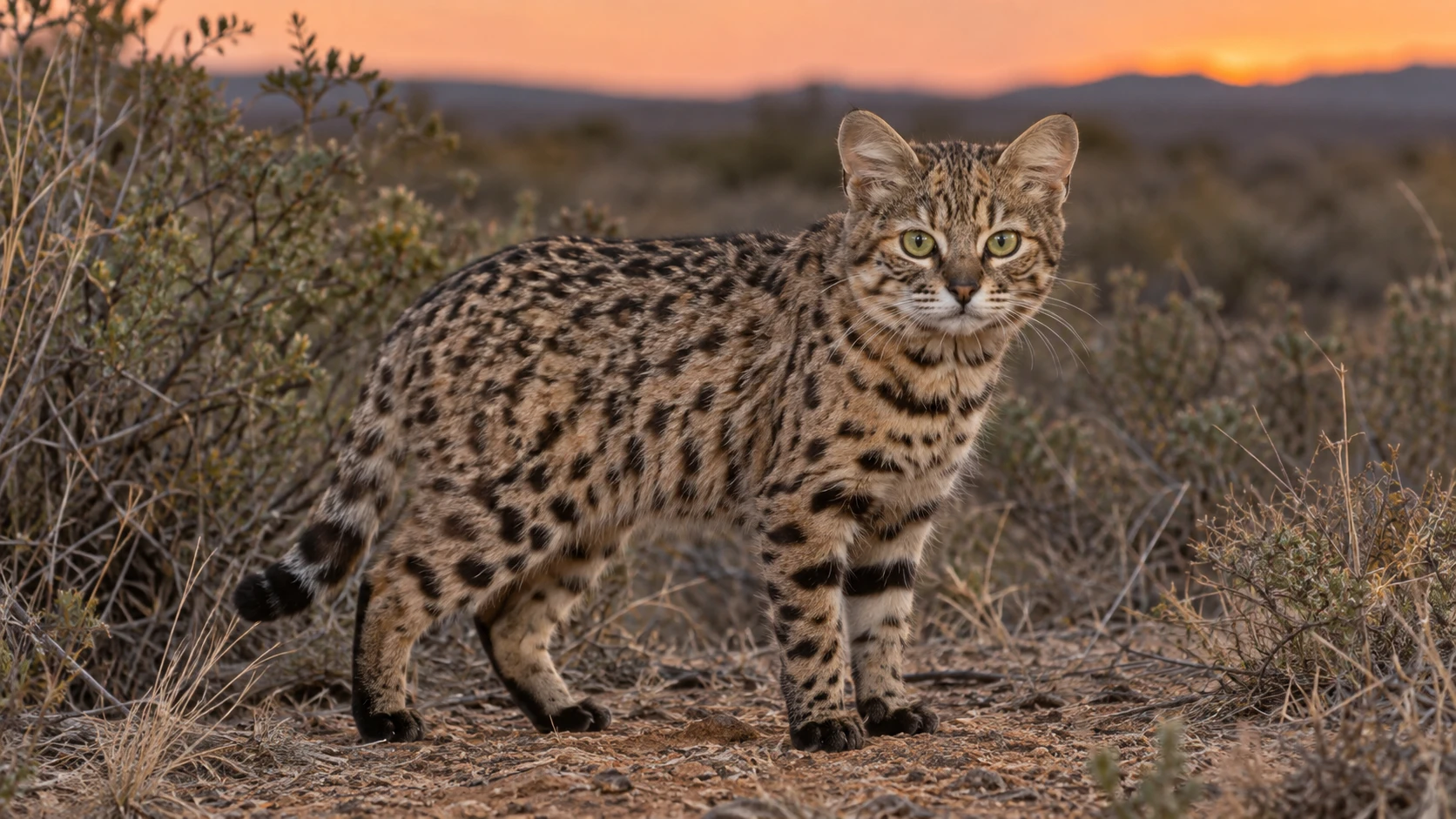
The photograph says ‘tiny spotted cat’. The caption says ‘deadliest cat on Earth’. Those two things seem to disagree until you ask what the caption is measuring.
This is not a story about an animal more dangerous to people than a lion. It is about a small hunter whose reputation rests on how often it catches its prey.

What ‘deadliest’ is trying to say
Panthera’s species spotlight describes the black-footed cat as an exceptionally successful hunter and gives roughly 60% as its hunting success rate. In that context, ‘deadliest’ is shorthand for catching prey efficiently.
A percentage needs a denominator. Successful attempts divided by hunting attempts is a different measure from prey killed in a night, the size of the prey, or risk to a human observer. Mixing those measures makes the catchy comparison meaningless.
Source: Panthera: black-footed cat hunting-success account.

Do not turn the figure into a universal scoreboard
A round number in a species summary is not a live counter attached to every animal. Weather, prey availability, the individual, and the definition of an attempt all matter to an observation. Comparisons are only useful when their methods are comparable.
That is why this article does not set the figure beside unrelated lion or tiger percentages and announce an exact ranking. The small cat’s hunting performance is remarkable enough without a chart assembled from incompatible studies.

The animal behind the caption
ISEC’s field project describes Felis nigripes as a small wild cat of southern Africa and reports a body mass around 1-2.5 kg. The name refers to the dark undersides of the feet, not an entirely black coat.

In photographs, notice the compact body and patterned coat rather than assuming it is an unusual domestic kitten. A species label is especially important when a tightly cropped image leaves out any sense of scale.
Source: ISEC: Black-footed Cat Project.

Why following a small hunter takes work
The Black-footed Cat Working Group uses field research to learn about animals that are difficult to observe. ISEC describes long-running work involving tracking and monitoring. The exciting headline depends on the less glamorous work of finding, following, and recording actual cats.
For a reader, that is a good reason to follow the project as well as the video. A conservation account can tell you what was observed; a repost may only repeat the most dramatic sentence.
Source: ISEC: Black-footed Cat Project.

What a cute photograph does not show
A still image cannot tell you whether the animal is relaxed, tolerant of people, or suitable for a home. ‘Looks like my cat’ is a visual reaction, not a domestication test. A small wild predator is still a wild predator.

Avoid the opposite mistake too: the hunting headline is not a reason to portray this animal as a tiny monster. Let the prey-capture story remain a prey-capture story, and leave imaginary attacks out of it.

A stronger caption than ‘tiny killing machine’
Try: ‘This small southern African wild cat is an unusually successful hunter. The famous figure refers to catching prey, not attacking people.’ Add the original conservation source and the photograph’s credit.
If Tilcayo introduced you to unfamiliar small cats, this is a useful next stop. It asks a new question about an attention-grabbing claim instead of repeating another yes-or-no pet article. The surprising part is real; the scary interpretation is optional and misleading.

Questions readers ask
Is it more dangerous to humans than a lion?
The cited hunting statistic does not answer that question.
Does 60% mean every cat succeeds exactly six times in ten?
No. It is an approximate reported figure, not a rule for each individual or sequence.
Is a black-footed cat a black house cat?
No. Felis nigripes is a separate wild species.
Read the Tilcayo tiger-cat guide
Sources reviewed
Research note: We reviewed the linked sources, not animals in the field. AI-generated illustrations are explanatory, not wildlife records. Separately credited reference photographs retain their original context. This article contains no affiliate links.
Leave a Reply