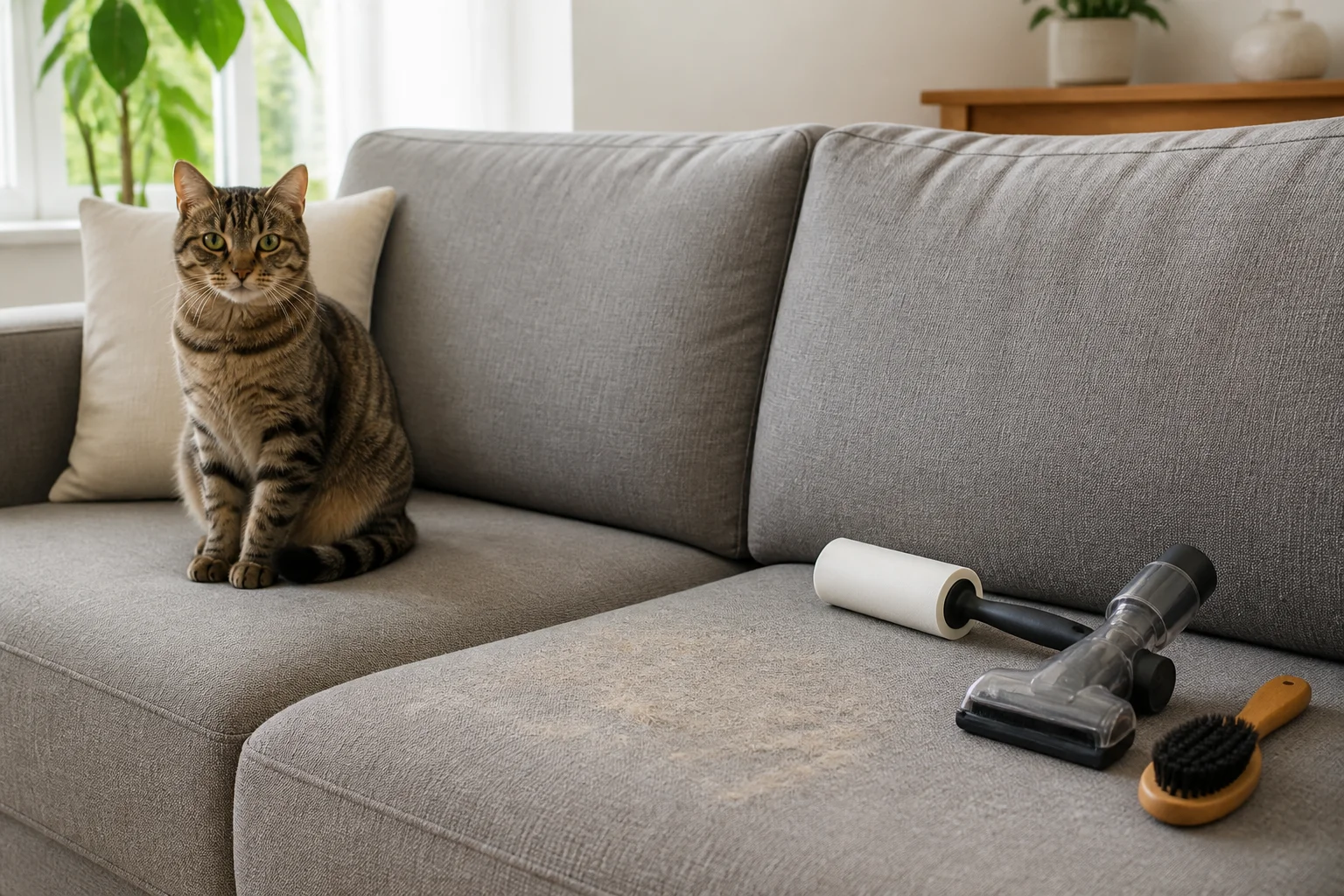
Pet hair is easiest to remove before you add water, spray cleaner, or start rubbing the fabric. Start by working out where the hair is sitting: loose on the surface, packed into a seam, or clinging to the upholstery through static.
The fastest approach is usually a sequence, not one miracle tool. Lift the loose hair first. Vacuum the remaining hair from seams and texture. Only then decide whether the fabric needs a deeper clean. Check the couch care tag before anything damp touches it.

Pick the method by where the hair is stuck
| What you see | Start here | Skip for now |
|---|---|---|
| Hair lying on top of the cushion | Lint roller or a dry rubber glove | Upholstery spray |
| Hair pressed into seams or woven texture | Vacuum crevice tool, then a soft upholstery brush | Hard scraping tools |
| Hair clinging after the obvious pieces are gone | Lint roller or a dry, clean rubber glove | Wet cleaning until you read the tag |
You cannot find a care tag, or it says X |
Vacuum gently or use a light brush only | Water, solvent, foam, steam |

Check the care tag before using moisture
The tag is not a formality. It tells you what the fabric can tolerate. West Elm, Ashley, and La-Z-Boy all use the same basic system: W for water-based cleaning, S for solvent-based cleaning, WS or SW for either, and X for vacuuming or light brushing only. When in doubt, do less. Saturating upholstery can leave water marks, push soil deeper, or affect the backing beneath the fabric.
| Care code | What it means for pet hair cleanup |
|---|---|
W |
Begin dry. If you later need cleaning, use only a water-based method approved for that fabric and test a hidden spot first. |
S |
Keep water-based DIY methods away. Follow the manufacturer direction or use a professional upholstery cleaner. |
WS / SW |
Dry pickup still comes first. You have more options only after a hidden-spot test. |
X |
Stop at vacuuming or very light brushing. Do not add water, foam, solvent, or steam. |

1. Vacuum first, using the small upholstery attachment
Vacuuming is the useful first pass when hair is caught between threads or gathered along the back cushion. Use a clean upholstery tool or crevice attachment, make short passes in both directions, and slow down at piping and seams. A full-size floor head can be awkward here and may just push hair into the fabric.
This is also the safest stopping point for a couch marked X. Do not turn a vacuum pass into a wet-cleaning project just because a few hairs remain.

2. Use a lint roller for the hair sitting on top
A lint roller is boring, which is exactly why it works. It is best for the visible layer of hair on smooth cushions, armrests, and throw pillows. Roll in one direction until the sheet fills, peel it, and keep going. Pressing down hard is unnecessary; it can make the roller less efficient and drag loose fibers.
For a large sectional, use the roller after vacuuming the seams rather than trying to cover every square inch first.

3. Gather static-cling hair with a dry rubber glove
For hair that will not lift with a roller, a clean, dry rubber glove can gather it into small clumps. Put the glove on and use a light, single-direction pass. The point is to collect hair at the end of the stroke, not to scrub the upholstery.
Test this on a hidden spot first, especially on loosely woven fabric, velvet, or fabrics with a raised pile. Stop if the surface catches, pills, or changes direction.

4. Work the seams with a soft upholstery brush
Seams, button tufts, and the narrow space between cushions are where hair keeps reappearing. Use a soft, non-metal upholstery brush to lift it toward the vacuum nozzle. A few gentle strokes are enough. The goal is to loosen trapped hair, not comb the couch aggressively.
Skip stiff brushes, wire brushes, and any tool that has sharp edges. Those can snag threads or roughen a delicate surface.

5. Use a rubber squeegee only on durable, flat upholstery
A small rubber squeegee can gather stubborn hair quickly from tightly woven, flat cushions. Pull it with very light pressure and collect the hair after each pass. This method is not for every couch: raised pile, loose weaves, velvet, boucle, and delicate fabrics can be damaged or left looking brushed in one direction.
Try one hidden corner first. If the fabric catches or the texture changes, stop and return to the vacuum-and-roller route.

6. Treat removable covers as fabric, not as part of the couch
If your cushions have removable covers, check the cover label separately. A removable zip cover is not automatically machine washable. Some can be washed only cold, some need air drying, and some should stay on the cushion for cleaning.
Remove the dry hair first with a roller or vacuum. Then follow the cover label exactly. Washing before removing hair can leave it stuck to the cover, the washer gasket, and whatever goes in next.

7. Keep leather and textured fabrics on a different path
Leather, velvet, boucle, chenille, and heavy texture all need a slower hand. On leather, a soft vacuum brush or dry microfiber cloth is usually the first move; avoid rubber tools that can drag across the finish. On velvet or pile fabrics, brush lightly in the fabric’s natural direction. On boucle or loose weave, use a vacuum attachment and avoid pulling loops with a glove or squeegee.
There is no universal “microfiber method,” either. Check the care tag and the maker’s instructions for your specific sofa before introducing water or cleaner.

The order that usually saves the most time
- Read the care tag.
- Vacuum seams, edges, and texture with the small attachment.
- Pick up the loose layer with a lint roller.
- Use a dry rubber glove or squeegee only if the fabric passes a hidden-spot test.
- Deal with stains or odors separately, using the fabric code rather than the pet-hair method.
That last step matters. Pet hair removal is dry work. A couch can look hairy and also need a stain treatment, but those are two different jobs. Finish the dry pickup before you decide whether the upholstery needs moisture.

When to stop and get help
Stop DIY cleaning if the couch has no readable care tag, the fabric is marked S or X, the texture starts to pill, or you have already introduced moisture and a ring is appearing. The cost of an upholstery cleaner is usually lower than replacing a damaged cushion cover or trying to correct a water mark.
For ordinary pet hair, though, most couches need less chemistry and more order: vacuum first, lift what is loose, then work only the trouble spots.
Sources
- West Elm: How to Clean a Couch – upholstery cleaning-code definitions and the warning against oversaturating fabric.
- Ashley: Care and Cleaning – W, S, WS, and X care-code guidance.
- La-Z-Boy: Fabric and Leather Care – routine vacuuming/light brushing, care-tag checks, hidden-spot testing, and avoiding saturation.
If the sofa problem is repeated licking rather than loose fur, start with the behavior guide instead of another cleaning tool. Why Does My Dog Lick the Couch? 5 Clues to Check
A robot vacuum spreading a toileting accident is a different cleanup problem from fur on upholstery. Use the vacuum-specific guide for that situation. Robot Vacuum Ran Over Dog Poop? Clean It Safely
Scratches are a different sofa problem from loose hair. The scratching guide covers the behavior rather than upholstery cleaning. Why Does My Cat Scratch the Couch? 6 Reasons and What to Do