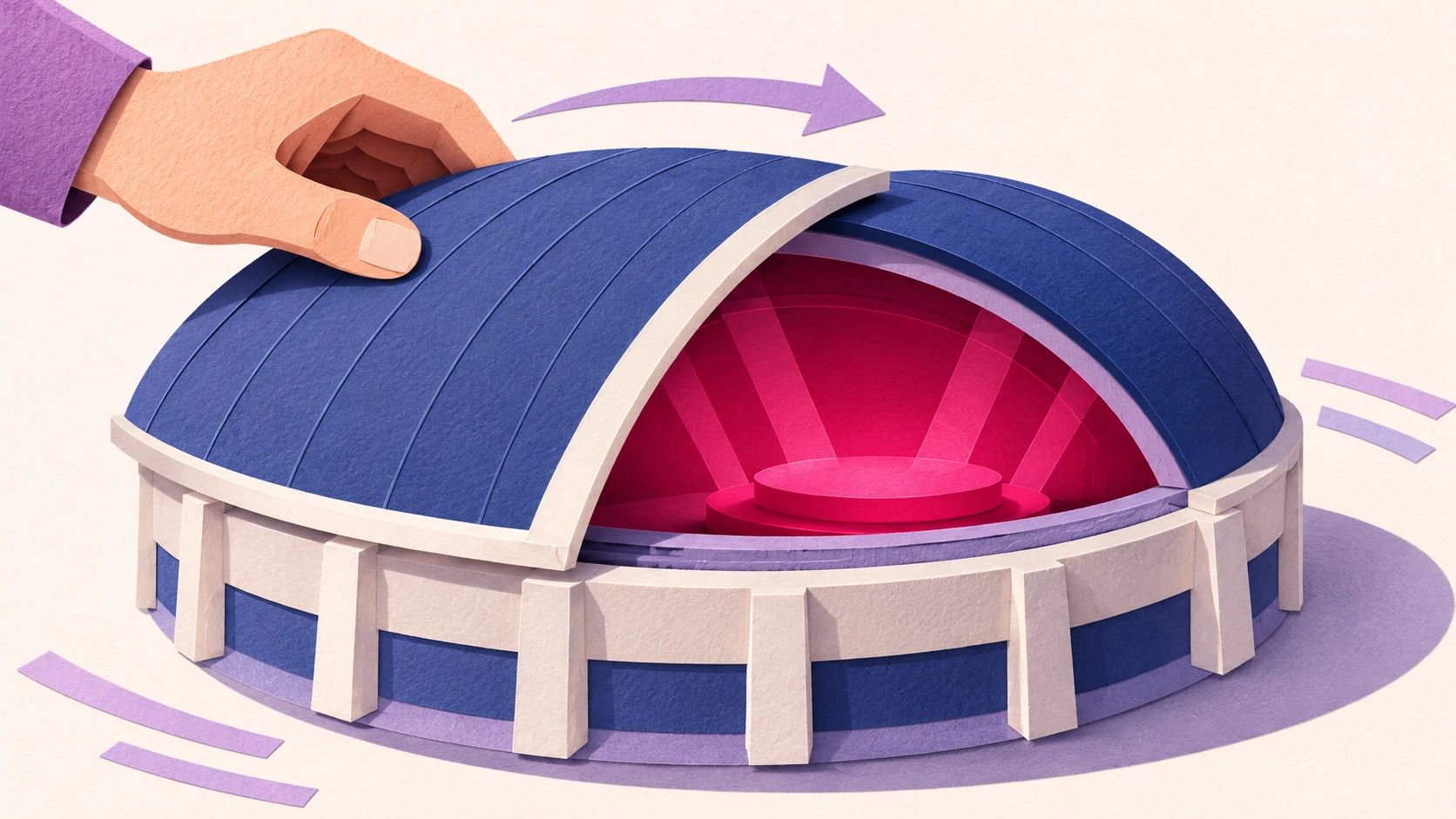
Yes. Pixar’s Turning Red takes place in Toronto in the early 2000s. The low white SkyDome near the CN Tower is the real building behind the film’s 4*Town concert venue. Pixar also studied Toronto’s Chinatown, and the Lee family temple belongs to the film’s fictional story. (Pixar, Toronto Blue Jays)
An imagined paper stadium with its roof sliding open, like the concert venue in the film. AI-generated editorial illustration.
| In Turning Red | Where the idea came from | Real-world connection |
|---|---|---|
| Toronto in the early 2000s | Director Domee Shi’s hometown, drawn in a “chunky cute” style | Toronto, a real city |
| Chinatown | Two specific streets in Toronto’s real Chinatown, which Pixar does not name | Today’s Chinatown around Spadina Avenue and Dundas Street West, as a place to visit |
| The Lee Family Temple | The same Chinatown research, plus trips to historic temples in California built by early Chinese settlers | Fictional, with no real address |
| The 4*Town concert stadium | The SkyDome’s actual dimensions, with the scale adjusted | Rogers Centre, the former SkyDome |
How real is the Toronto in Turning Red?
The city is real, and Pixar gave it a softer, rounder look. Director Domee Shi grew up in Toronto. The film’s artists used familiar details from her hometown to ground their stylized version of the city (Pixar).


Production designer Rona Liu says the team approached the city from a 13-year-old’s point of view. They used Toronto’s skyline, buildings and street signs as references, then rounded corners and avoided sharply tapering shapes (Pixar).

Even Mei’s school has a real starting point. Pixar says Shi pointed artists to the school she attended, and sets supervisor Steve Karski found its blueprints and used them as inspiration for how an urban Toronto school might be laid out. Pixar does not name the school, and neither do we.

What inspired Chinatown and the Lee Family Temple?
Pixar says artists studied two streets in Toronto’s Chinatown, visited a museum in San Francisco and worked with cultural consultants. Domee Shi says the team also visited historic temples built by early Chinese settlers in California to understand how those community spaces felt (Pixar).
So the film’s Chinatown and temple draw on both Toronto streets and temples in California. Pixar does not name the two streets or give the temple a real location, and you will not find the Lee Family Temple in Toronto.
Is the 4*Town concert stadium real?
The building is. Pixar started from the SkyDome’s real dimensions and adjusted the scale for the climax (Pixar). The venue opened in 1989 as SkyDome and became Rogers Centre in 2005. The Blue Jays have since renovated it as a ballpark (Toronto Blue Jays).


4*Town is a fictional band, and the concert in the film is fictional too.

Where can you go in Toronto?
Chinatown: Start near Spadina Avenue and Dundas Street West. These streets are a practical starting point today. Pixar’s account leaves the two streets the artists studied unnamed (Destination Toronto, TTC schedules). Rogers Centre: The Blue Jays offer guided tours that cover the team and stadium’s history. Check the Rogers Centre tours page for availability.


Toronto City Hall: Its curved towers are another detail to look for in the city today. The photograph below shows the building in 2023.


Leave a Reply