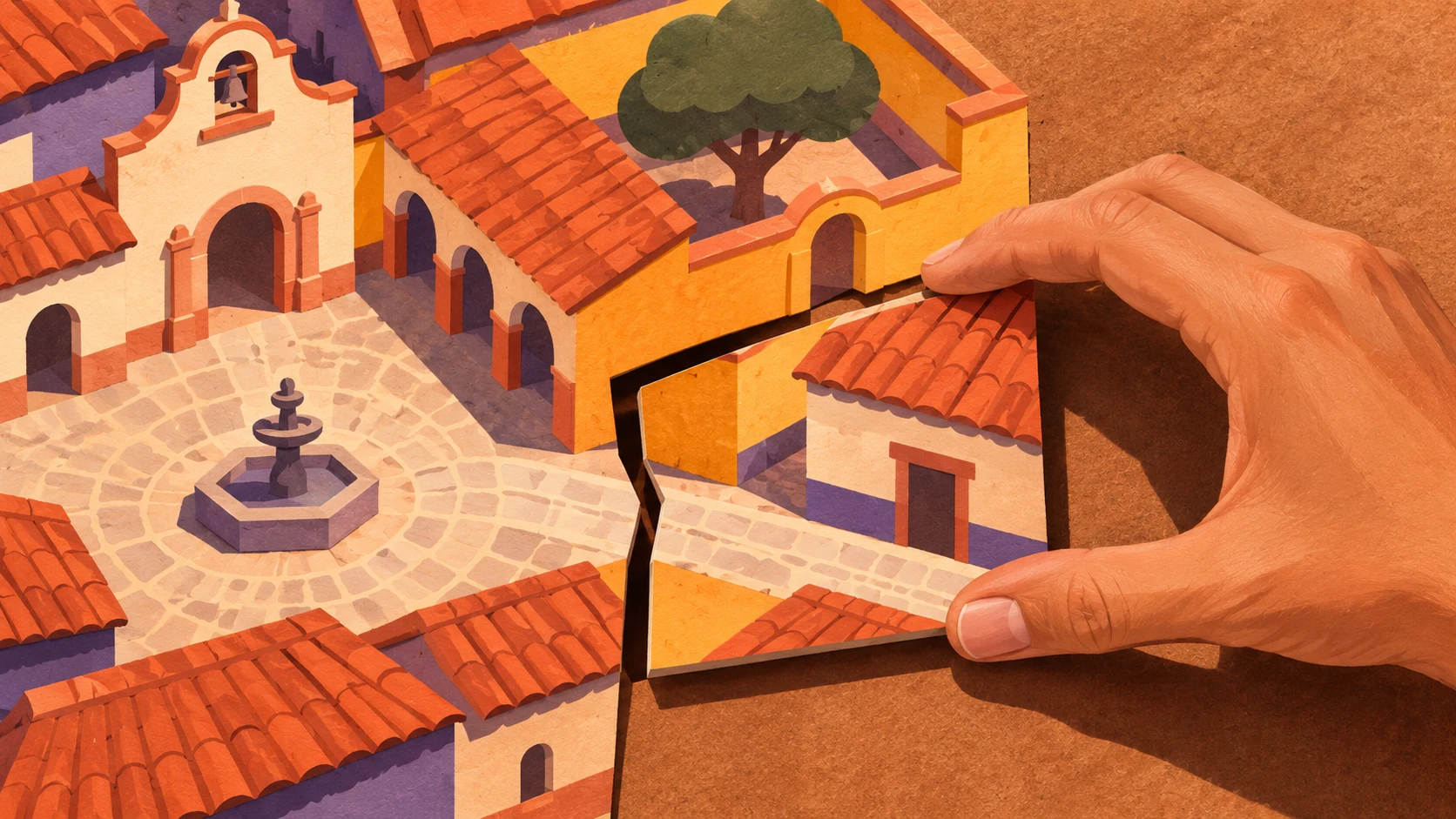
No. Santa Cecilia, the town at the heart of Pixar’s Coco, is fictional. The filmmakers drew on several Mexican villages, and director Lee Unkrich singled out Santa Fe de la Laguna in Michoacán as one of their visual references. Guanajuato’s hillsides helped shape the look of the Land of the Dead. In Oaxaca, you can visit the woodcarving workshop that helped inspire the film’s spirit guides. (Pixar, Unkrich interview, RenderMan, Disney News, workshop visitor guide)
An imagined village, pieced together from many places, much as Coco's filmmakers built Santa Cecilia. AI-generated editorial illustration.
| In Coco | Where the idea came from | Real-world connection |
|---|---|---|
| Santa Cecilia | Several Mexican villages, including Santa Fe de la Laguna as a visual reference | Santa Fe de la Laguna, a visual reference in Michoacán |
| The Land of the Dead | Guanajuato’s hillsides, Tenochtitlán’s setting on water, and sites such as Monte Albán | Guanajuato, a real city |
| The alebrije spirit guides | Mexican folk art, and a development visit to an Oaxaca workshop | Taller Jacobo y María Ángeles, San Martín Tilcajete |
What real places inspired Santa Cecilia?
Pixar describes the town through three places: a town square where people gather, the Rivera compound where Miguel’s great-great-grandmother started the family shoe business, and the local cemetery. Jessup says the team “stayed grounded in reality” in the Land of the Living, with a sun-bleached, dusty town lit up by bright Día de Muertos decorations (Pixar).

Those details came from years of travel. Director Lee Unkrich says that over three years the team visited markets, plazas, workshops, churches, haciendas and cemeteries throughout Mexico, and were welcomed into family homes, where people shared their food, music and traditions (Pixar). Co-director Adrian Molina credits families met in places like Oaxaca, Michoacán and Mexico City with shaping the Riveras (Disney News).
One craft shows up from the very first scene. The film opens with Miguel telling his family’s history through papel picado, the cut-paper banners hung for celebrations. Molina told Disney the team chose papel picado as a way to tell the story of people Miguel had only heard about, while keeping them a little mysterious (Disney News).

One of those visual references was Santa Fe de la Laguna, a village in Michoacán that Unkrich singled out in an interview. The film’s town brings together details from several places the filmmakers visited (Screen Daily).
Which city inspired the Land of the Dead?
Guanajuato: the hillside
Pixar’s RenderMan feature, republished from FXGuide, says the main city of the Land of the Dead is based on Guanajuato. The city’s terraced buildings on steep hillsides were the dominant reference, both for the colourful houses and for the view at night, when the hillside lights up (RenderMan). Pixar then turned that hillside into a vertical city.
In Guanajuato you can see the stacked, painted houses on steep slopes that the film draws on.
Tenochtitlán and Monte Albán: the city’s vertical design
Unkrich wanted the Land of the Dead to keep growing as new residents arrived. Tenochtitlán, the Aztec city once surrounded by water, gave the filmmakers the idea of a city rising from water. That idea led to towers that grow like coral, with each layer representing part of the city’s history (Pixar).
Monte Albán was one of several Mesoamerican sites that inspired the city’s vertical structure. Molina describes building the city up from the roots of ancient Mesoamerican civilization (Disney News).
The film’s marigold bridge grew out of a different observation. During Día de Muertos, the filmmakers saw paths of marigold petals leading from the streets to family altars (Pixar).

Where can you visit a place connected to Coco?
Taller Jacobo y María Ángeles, San Martín Tilcajete
One place you can visit is the workshop of artists Jacobo and María Ángeles in San Martín Tilcajete, Oaxaca (workshop). Disney News reports that Coco‘s filmmakers visited the workshop as early as 2011 and that what they learned there inspired their decision to give alebrijes the role of spirit guides in the Land of the Dead (Disney News). Molina put it more generally: a trip to an alebrije workshop “can inspire you to create an entire class of being”.
One of those characters is Pepita, Mamá Imelda’s spirit guide. Pixar describes her as a winged wildcat with eagle talons (Pixar).
What the workshop calls its work
The workshop primarily describes its copal wood carvings as tonas and nahuales (workshop). Its guided visit walks through how a piece is made, from carving to decorating, and introduces each visitor’s protective animal in the Zapotec calendar (guided visit). It is a working studio, not a film set.

The workshop gives its address as Libres 5, San Martín Tilcajete, Oaxaca. Check its visitor page for current visit arrangements before you go.