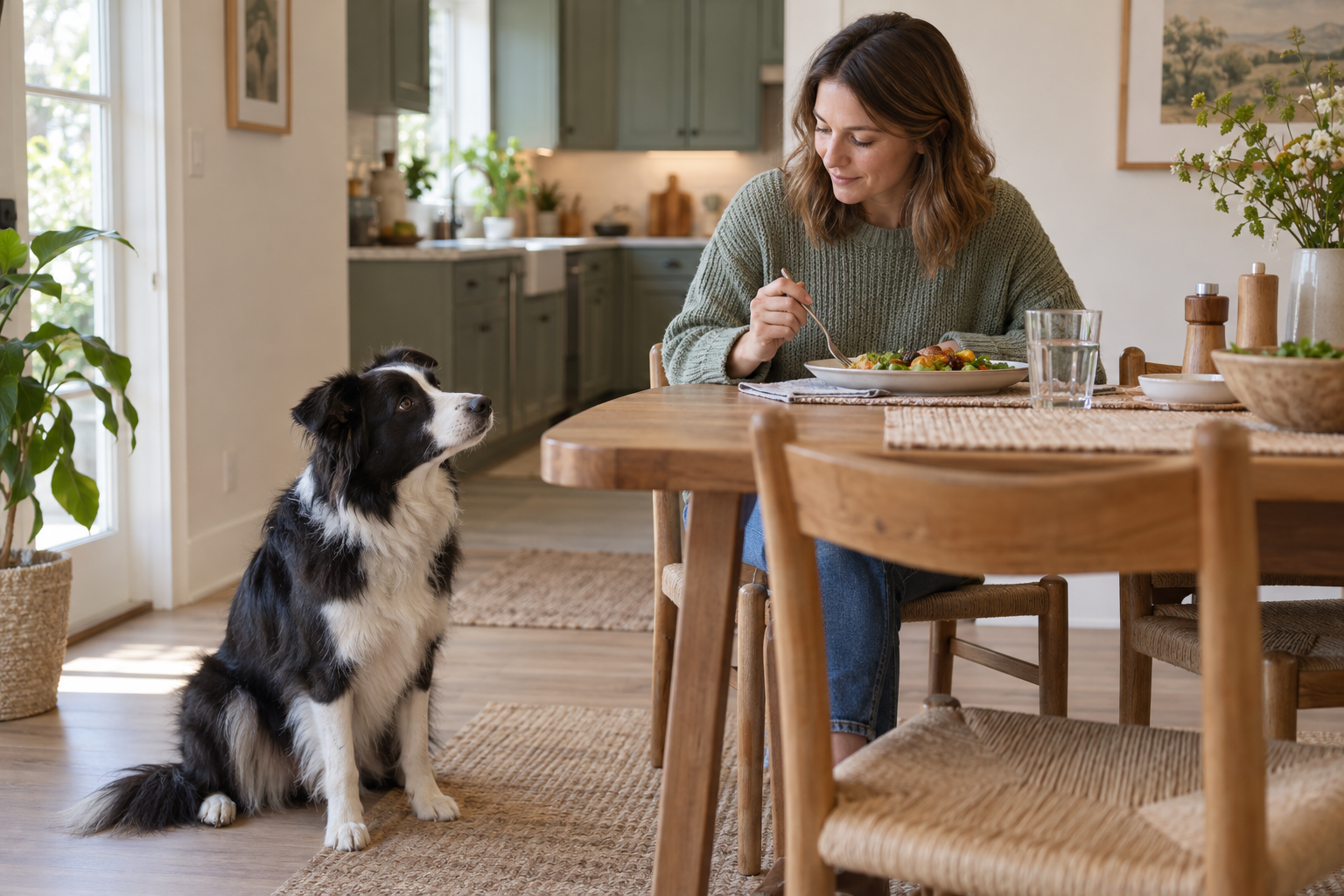
You set down your plate. Before you take the first bite, your dog is already watching.
Not glancing. Watching.
The expression can look so serious that it is easy to invent a story: They must be starving. They feel left out. They have not eaten in hours. Sometimes the simpler explanation is that staring has paid off before.
A 30-second mealtime check
Before deciding what the stare means, look beyond the eyes.
| What you see | What it may mean | What to do |
|---|---|---|
| Soft eyes, loose body, quiet watching | Interest, anticipation, or a learned request | Teach a place to settle and stop feeding from the table |
| Moving closer, whining, pawing, barking | Begging has been reinforced or is escalating | Prevent access, reward a replacement behavior, stay consistent |
| Frozen body, hard stare, lip lift, growl near food | Tension or possible guarding | Create distance; do not confront or grab; seek qualified help |
| New ravenous appetite plus weight, thirst, urine, or digestive changes | Possible feeding, medication, stress, or medical issue | Contact your veterinarian |
One dinner does not diagnose anything. The useful clues are posture, context, how easily the dog disengages, and whether the behavior is new.

1. Your meal smells worth investigating
Dogs do not need to know what roasted chicken or buttered toast is called to notice it. The smell alone can pull their attention toward the table.
That interest is not proof that the dog needs more food. It means a high-value smell is present. If your dog watches quietly, then returns to resting when nothing happens, this may be the entire explanation.

2. The stare has worked before
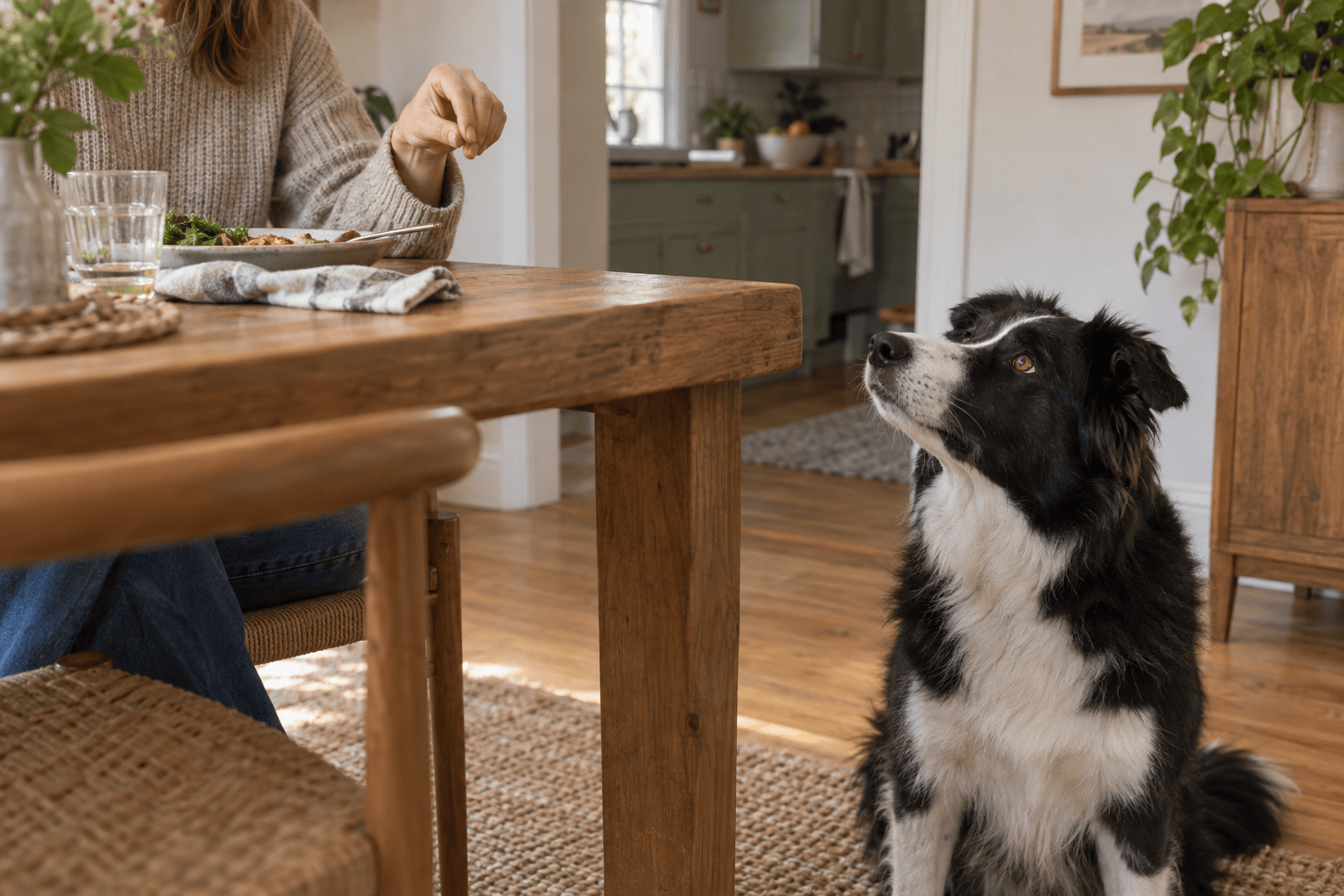
The strongest reason may be history. A tiny piece dropped from a fork, a bite offered “just this once,” or a child slipping food under the table can turn eye contact into a strategy.
From the dog’s perspective, occasional rewards make persistence sensible. A stare that works one time out of ten is still a stare worth trying.
3. Dinner predicts a familiar routine
Dogs notice sequences: plates come out, chairs move, people sit down, and food appears. Your dog may begin watching before the meal because the setup itself predicts what comes next.
Anticipation often looks intense without being distress. If the body remains loose and the dog can respond to a familiar cue, you are probably seeing routine rather than an emergency.

4. Looking at you also gets attention
Food is not the only possible reward. Eye contact, laughter, conversation, touching, or repeatedly saying “no” can all make the interaction more interesting.
This is why arguing with a begging dog often fails. The dog asked for engagement and received it. A clear alternative gives you something useful to reward instead.
5. Your dog does not know where else to be
“Do not stare at my plate” is not a behavior a dog can perform. “Lie on this mat” is.
Without a taught alternative, hovering near the table may be the easiest available choice. A bed or mat a few feet away gives the dog a predictable place, a clear job, and a better chance of succeeding.
6. Your dog may genuinely feel hungrier than usual
Some dogs beg because the behavior was learned. Others may be receiving an inappropriate amount for their size, activity, life stage, or current diet. Stress, age, medication, and medical conditions can also change appetite.
Do not solve a sudden appetite change by quietly adding table scraps. Record what changed and contact your veterinarian, especially when increased hunger appears with weight change, increased thirst or urination, vomiting, or diarrhea. Veterinarian-reviewed PetMD guidance describes these accompanying changes as reasons to seek veterinary assessment.
Is it staring, begging, or a warning?
Calm watching
The dog’s face and body look soft. They may follow the fork with their eyes, but they can look away, lie down, or respond to a cue. This is usually ordinary interest or a low-level learned request.
Active begging
The dog closes the distance, rests a chin on your leg, whines, paws, nudges, barks, or moves from person to person. The behavior is inconvenient, but it is still a training and management problem when the dog remains loose and social.
Tense food-related behavior
A frozen body, closed mouth, hard unblinking eyes, growling, lip lifting, snapping, or blocking access is not a cute version of begging. AKC guidance distinguishes this hard stare and stiff posture from ordinary social looking. Do not stare the dog down, reach for food, or punish the warning. Increase distance and contact a qualified positive-reinforcement trainer, veterinary behaviorist, or veterinarian.

How to stop begging without punishment
1. Stop paying from the table
Everyone in the household needs the same rule. No scraps from plates, laps, counters, or the eating area. If you want to share a dog-safe food, place an appropriate portion in the dog’s bowl later, away from your meal.
2. Teach the mat before dinner
Practice when no one is eating. Place a mat several feet from the table. Reward the dog for stepping onto it, then for sitting or lying down. Keep early sessions short enough that the dog can win. VCA’s place-training guidance uses this same clear alternative.

3. Build duration gradually
Reward after one calm second, then two, then several. Vary the interval rather than making every wait longer. Release the dog before they fail, reset, and repeat.
4. Use part of the daily ration
Training food still counts as food. Reserve some measured kibble or veterinary-approved treats for mat practice instead of adding an untracked stream of calories. General veterinary guidance commonly limits treats and extras to about 10% of daily calories, but your veterinarian should guide an individual diet.

5. Start the routine before your plate arrives
Send the dog to the mat while the meal is being prepared, not after their nose is already beside the plate. A chew, food toy, or part of the dog’s meal can help, provided it is safe for that dog and included in the daily food plan.
6. Expect a brief protest
When a behavior that used to work stops paying, some dogs try harder for a short period. The stare may become a whine; the whine may become a paw. PetMD calls this an extinction burst. Giving food at the loudest moment teaches the dog that escalation works.
Do not rely on ignoring if the dog is frightened, guarding, or likely to become unsafe. Use distance and professional guidance instead.

A simple seven-dinner reset
- Measure the dog’s full daily food allowance.
- Reserve a small portion for mat rewards.
- Cue the mat before human food reaches the table.
- Reward calm behavior at intervals the dog can manage.
- Do not feed from the table, even once.
- End the meal and release the dog calmly.
- Write down what improved and where the routine broke.
Progress may be the dog staying four feet away instead of one foot away. It may be ten quiet seconds instead of immediate whining. Build from the behavior you actually have.
Table scraps are not all equal
Stopping begging is partly about training and partly about safety. Some human foods are toxic to dogs, and rich or fatty leftovers can cause gastrointestinal problems. Bones, skewers, wrappers, and hot food add other hazards.
You do not need to memorize every dangerous ingredient while eating. Use a simpler household rule: the table never pays. Check a veterinary source before intentionally sharing any human food.
When increased hunger needs a veterinarian
Call your veterinarian when the staring or food-seeking is a clear change from your dog’s normal pattern, especially with:
- weight loss or unexpected weight gain;
- increased thirst or urination;
- vomiting, diarrhea, or stool changes;
- a swollen abdomen, weakness, or restlessness;
- a new medication or dose change;
- stealing or eating non-food objects;
- a senior dog showing other behavior or sleep changes.
Bring a short log of meals, treats, medications, water intake, body weight if available, and when the behavior occurs. That is more useful than simply saying, “My dog seems hungry all the time.”

The practical answer
Your dog probably stares while you eat because your meal is interesting and watching you has produced food or attention before. The answer is not to prove that the dog is manipulative or starving. It is to make the rules predictable.
Stop feeding from the table, teach a mat behavior away from the meal, reward calmness with measured food, and keep every household member consistent. Treat a hard stare with a stiff body as a safety issue, and treat a sudden appetite change as a reason to call your veterinarian.
FAQs
Is my dog staring because they are starving?
Not necessarily. Smell, routine, attention, and previous rewards commonly explain the behavior. Confirm that the dog’s diet and portions are appropriate with your veterinarian, especially if hunger has suddenly increased.
Should I ignore my dog while I eat?
Removing attention and food rewards can help, but teaching a mat or bed behavior is clearer. Do not simply ignore behavior that includes guarding, fear, or unsafe escalation.
Can I give my dog one bite after I finish?
You can avoid strengthening table begging by offering only dog-safe food later and away from the eating area. Count it within the dog’s daily nutrition plan.
Why did the begging get worse when I stopped feeding?
A previously rewarded behavior can briefly intensify when the reward disappears. Stay consistent and make the replacement behavior easy enough to succeed.
Why does my dog stare but never whine or paw?
Quiet staring may simply be interest or anticipation. If the dog is relaxed and can disengage, you do not need to treat the gaze itself as a problem.
Sources reviewed
- AKC: Why Does My Dog Stare At Me?
- PetMD: Why Dog Begging Happens and How To Stop It
- PetMD: Why Is My Dog Always Hungry?
- VCA: Train Your Pet to Stop Begging With Go to Your Place
- VCA: Feeding a Canine Glutton
Research note: Pet Tech Compass did not test a product for this article. The guidance was synthesized from the sources above and does not diagnose an individual dog.
Affiliate disclosure: This article does not currently contain affiliate product links. If links are added later, suitability and safety should still be evaluated for the individual dog.
Medical note: This article provides general education. Contact your veterinarian about a sudden or persistent appetite or behavior change.
Leave a Reply