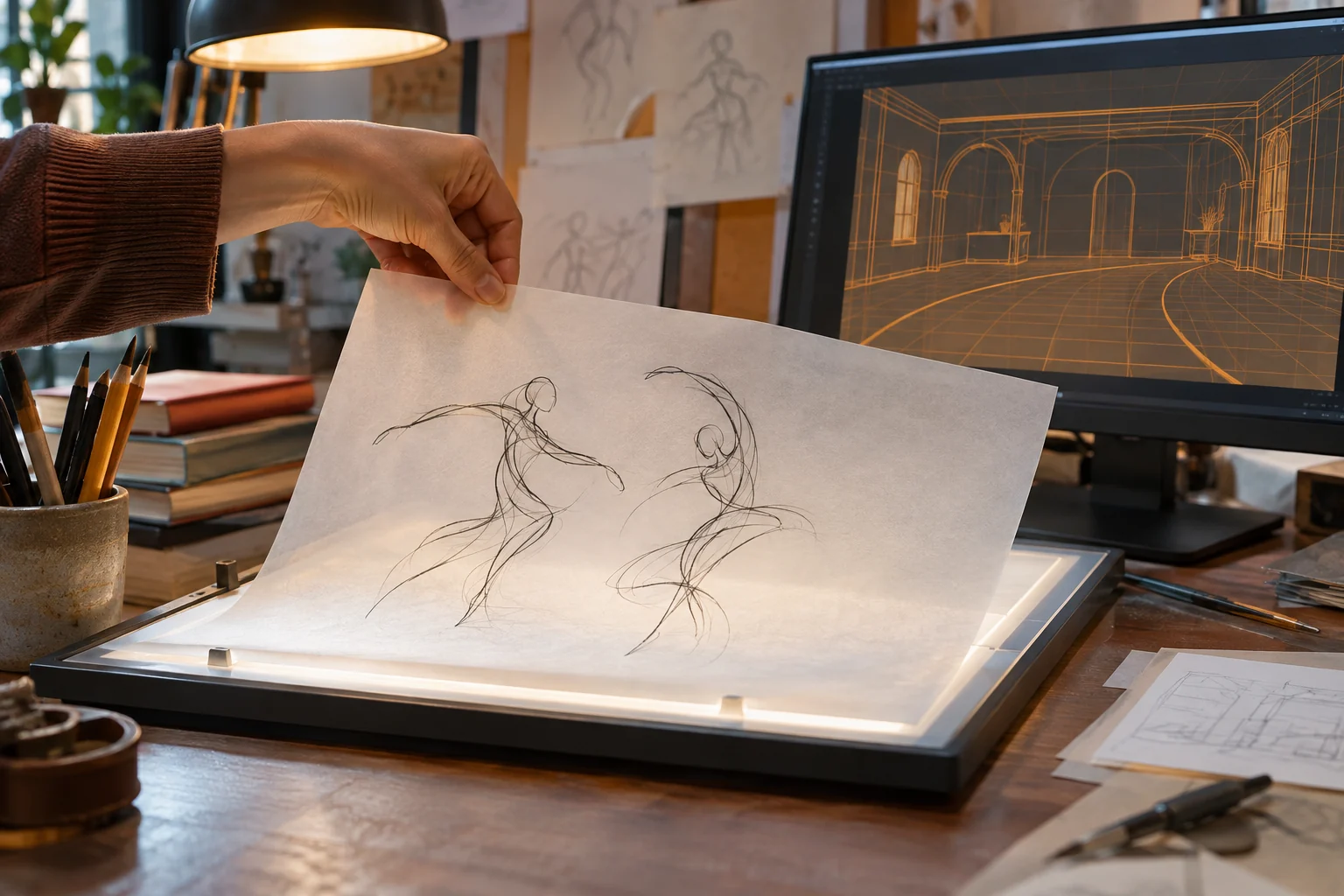
Yes. Disney built the ballroom in the 1991 animated Beauty and the Beast as a 3D computer environment. For this sequence, animator James Baxter drew Belle and the Beast by hand, using a printout of the room’s planned camera moves as a guide. Even the ceiling combines techniques. Its painted fresco was scanned and mapped onto a digital dome. Disney D23’s ballroom production history
| What you see | How Disney made it | What to watch for |
|---|---|---|
| Columns, chandelier and dance floor | The CGI team modeled and rendered the room in three dimensions. | The columns shift against one another as the camera glides through the room. |
| Belle and the Beast | Baxter drew the dancers using the approved wireframe camera move as a guide. | The dancers turn and change perspective while staying grounded on the floor. |
| Painted figures on the ceiling | The team scanned a hand-painted image and mapped it onto the CGI dome. | The painting curves with the ceiling as the view shifts. |

Why build the ballroom in a computer?
Story supervisor Roger Allers and story artist Brenda Chapman proposed giving the title song a computer-generated ballroom. Placing the experiment inside a single sequence let the filmmakers take Belle and the Beast into a space with its own look, then bring them back into the rest of the film. A modeled room also let the artists plan a camera move through the architecture. On a rewatch, follow the columns in the foreground and the room beyond. The way they move across the frame helps explain how the shot creates a sense of depth around the couple. Disney D23’s ballroom production history


How did the hand-drawn dancers fit the moving room?
The artists planned the shot in wireframe, a bare-outline version of the room. They put two simple placeholder figures in it to establish where the couple would be as the view changed. Once the camera move was approved, the team printed the test onto animation paper. Baxter could use those guides to draw the characters at the right scale and angle. Disney’s Computer Animation Production System, or CAPS, let the team scan and color the drawings digitally and combine them with the computer-rendered setting. Watch the couple’s feet against the floor as the perspective turns. The dancers and the room have to agree about where the weight lands. Disney D23’s ballroom production history


What did the artists paint by hand?
The ceiling’s cherubs began as a hand-painted background. The team scanned that artwork and applied it as a texture to the digital dome. That gave the room a painted surface that could move in perspective with its geometry. The polished floor brought several elements together as well. Disney’s production account lists the room, floor, character artwork, shadows and reflections among the elements in each frame. Watch the ceiling for the marriage of painting and geometry, then look down to see how shadows and reflections make the dancers feel present in the space. Disney D23’s ballroom production history


Related guides
Sources by claim
- Disney D23’s ballroom production history — The ballroom decision, Baxter’s wireframe guides, CAPS, the painted fresco and the rendered layers.
- Disney A to Z film entry — The 1991 animated release and use of computer imagery in the ballroom and elsewhere in the film.
Leave a Reply