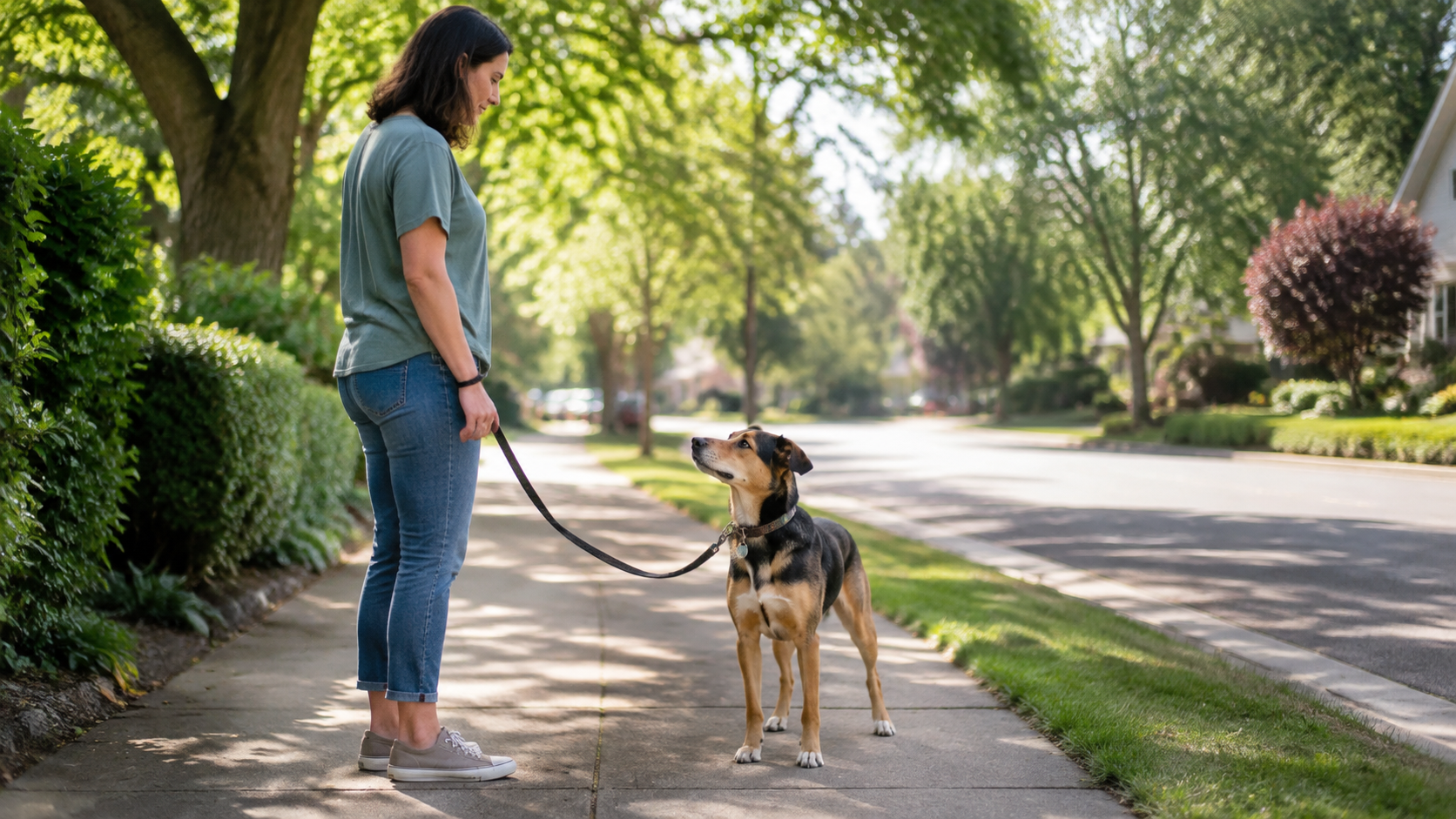
You are not the only person who has had to turn a dog around mid-walk after it went for something you would rather not think about. The behavior has a name, coprophagia, but one episode cannot tell you why it happened.
The first job is not guessing the cause. It is preventing another bite safely, cleaning up the target, and noticing whether this is puppy exploration, an easy-access habit, or a new pattern with other health changes.

Quick answer: what to do the next time it happens
Calmly move your dog away with a familiar leash cue or practiced turn. Pick up the stool or block access as soon as it is safe. Avoid yelling, chasing, or forcing the dog’s mouth open. Make a note of where it happened, whose stool it was if known, whether it is new, and whether anything else has changed.
If your dog may have eaten a toxin, human medication, a foreign object, or unknown animal waste, get guidance from a veterinarian or poison-control professional for that specific exposure. Not every incident is an emergency, but it is not a behavior to leave available.
Use this 30-second check before you buy anything
| What you see | Start here | Why it changes the plan |
|---|---|---|
| A puppy investigates or eats stool occasionally, otherwise feels well and has a normal diet and routine | Tighten supervision, immediate pickup, and reward a turn-away cue | Exploration and easy access are practical starting points |
| A dog repeatedly seeks stool on walks, in the yard, or from a cat litter box | Prevent access consistently and identify the exact setting | The environment may be maintaining a repeatable habit |
| A new adult behavior with weight change, increased appetite, poor stool quality, vomiting, diarrhea, medication change, or other illness signs | Contact a veterinarian | The behavior is part of a wider health picture |
Cat-litter access is a home-setup problem, not an obedience test. Make the litter area unavailable to the dog while keeping it easy and safe for the cat to use.

1. Puppies investigate with their mouths
Puppies explore with their noses and mouths. Some investigate stool and some may eat it. That does not mean every puppy will keep doing it, and it does not mean stool from another animal is harmless.
Treat it like any other unsafe outdoor item: supervise, pick up promptly, interrupt calmly, and reward the puppy for turning toward you or moving to an allowed activity. Practice the cue away from real stool first.

2. The stool itself may be an easy scavenging target
Dogs do not judge stool the way people do. Fresh dog stool, cat litter, horse manure, wildlife droppings, unsecured trash, and a poorly cleaned yard can all become easy scavenging targets. The first solution is access management rather than trying to make every target taste bad.
On walks, keep the dog close enough to see what it is investigating. In the yard, pick up routinely. In a multi-pet home, keep the dog physically out of the cat’s litter area.

3. The routine may be accidentally rewarding the behavior
For some dogs, a shout, chase, or frantic grab can turn the moment into attention or a game. That is not always the reason, but it is a reason to keep your response boring and predictable.
Practice leave it, a U-turn, or a hand target with safe training objects first. Reward the dog for moving away and reconnecting with you. On a real walk, use the cue before the dog reaches the target, then remove the target as soon as you can.

4. Another dog in the home may have a stool issue worth noticing
If one dog repeatedly targets one other dog’s stool, the observation can be useful. Notice whether that stool is unusually loose, bulky, poorly formed, or seems poorly digested. Do not conclude that the other dog is ill, but include both facts when you speak with a veterinarian.

5. Stress, boredom, confinement, or reduced enrichment can contribute
This behavior can occur more often when a dog spends long periods in an uncleaned small area, has less routine, or has too much unsupervised opportunity to scavenge. It is not a label for every dog that eats stool.
Ask practical questions: Did outdoor breaks become rushed? Does it happen only when the dog is alone in the yard? Has the walk routine changed? Timely cleanup, supervised breaks, normal play, and safe sniff walks can reduce opportunity while you work on the behavior.

6. A new adult pattern needs a health check, not internet guessing
Medical conditions, medication effects, digestive upset, reduced nutrient absorption, and increased appetite can contribute to stool eating. None can be diagnosed from this behavior alone. A new adult habit is a reason to look at the entire picture with a veterinarian.
Bring a simple timeline: when you first saw it, what type of stool the dog seeks, diet and medication changes, and shifts in appetite, weight, drinking, stool quality, vomiting, diarrhea, energy, or other behavior.

The first 5 things to change at home
- Pick up dog stool promptly in the yard and on walks.
- Prevent access to cat litter with a physical setup that remains safe for the cat.
- Use a leash or long line during retraining where that is safe and permitted.
- Practice leave it and a turn-away-and-reward routine away from stool.
- Track location, stool source, timing, and companion signs for one to two weeks or until your veterinary conversation.

When to call the vet about stool eating
Book a veterinary visit or call promptly for new adult onset, frequent or repetitive behavior, new appetite, weight, drinking, stool, or energy changes, vomiting or diarrhea, or a possible medication connection.
Seek urgent professional advice for suspected toxin or medication ingestion, foreign material, collapse, severe weakness, repeated vomiting, severe diarrhea, or another acute illness sign. The right response depends on the exact exposure and your dog’s full condition.
Questions owners ask
Can my dog get sick from eating poop?
Feces can expose a dog to parasites, pathogens, or substances from another animal’s diet or treatment. Risk depends on the source and amount. Prompt cleanup and preventing access are practical first steps. If the source is unknown or the dog develops illness signs, contact a veterinarian for situation-specific advice.
Why does my dog only eat cat poop?
Cat litter boxes are easy-access scavenging spots for some dogs. The useful response is a physical household barrier that still lets the cat use the box safely, plus prompt litter maintenance. It is not a sign that your dog is trying to upset you or that you need to punish it.
Should I make my dog vomit after it eats poop?
Do not induce vomiting unless a veterinarian or poison-control professional tells you to do so for that exact exposure. Different sources and materials create different risks, and home vomiting attempts can add harm.
Will my dog stop eating poop if I change its food?
Do not treat a food change as an automatic solution. Some dogs have an access or routine problem, while a new adult pattern may need a health assessment. Start by preventing access and noting the full pattern.
Bottom line
Make stool hard to access, practice a calm alternative response, and avoid punishment. A puppy’s one-time investigation and a new, frequent adult pattern do not mean the same thing. When the behavior is new, persistent, or paired with health changes, involve a veterinarian instead of guessing.
